


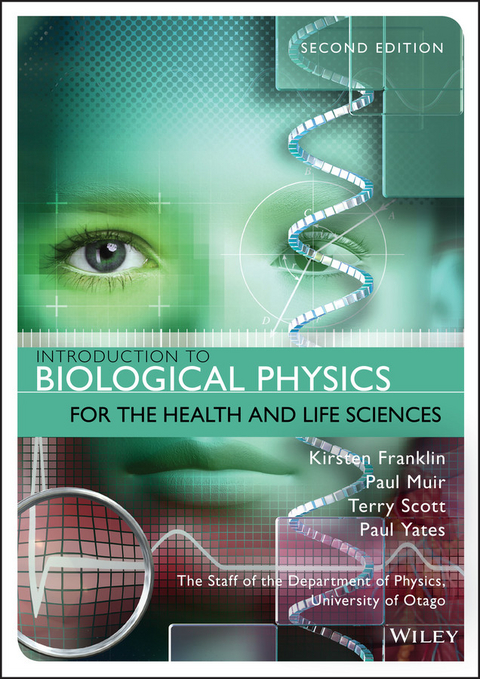
Introduction to Biological Physics for the Health and Life Sciences (eBook)
600 Seiten
Wiley (Verlag)
9781118934487 (ISBN)

A thoroughly updated and extended new edition of this well-regarded introduction to the basic concepts of biological physics for students in the health and life sciences.
Designed to provide a solid foundation in physics for students following health science courses, the text is divided into six sections: Mechanics, Solids and Fluids, Thermodynamics, Electricity and DC Circuits, Optics, and Radiation and Health. Filled with illustrative examples, Introduction to Biological Physics for the Health and Life Sciences, Second Edition features a wealth of concepts, diagrams, ideas and challenges, carefully selected to reference the biomedical sciences. Resources within the text include interspersed problems, objectives to guide learning, and descriptions of key concepts and equations, as well as further practice problems.
NEW CHAPTERS INCLUDE:
- Optical Instruments
- Advanced Geometric Optics
- Thermodynamic Processes
- Heat Engines and Entropy
- Thermodynamic Potentials
This comprehensive text offers an important resource for health and life science majors with little background in mathematics or physics. It is also an excellent reference for anyone wishing to gain a broad background in the subject.
Topics covered include:
- Kinematics
- Force and Newton’s Laws of Motion Energy
- Waves Sound and Hearing
- Elasticity
- Fluid Dynamics Temperature and the Zeroth Law
- Ideal Gases Phase and Temperature Change
- Water Vapour
- Thermodynamics and the Body Static Electricity
- Electric Force and Field
- Capacitance
- Direct Currents and DC Circuits
- The Eye and Vision Optical Instruments
- Atoms and Atomic Physics
- The Nucleus and Nuclear Physics
- Ionising Radiation
- Medical imaging
- Magnetism and MRI
Instructor’s support material available through companion website, www.wiley.com/go/biological_physics
Dr Terry F. Scott, Department of Physics, University of Otago, New Zealand
Research interests include many body theory, Bose Einstein condensation and Physics Education.
Assisted by: Kirsten Franklin, Paul Muir, Lara Wilcocks, Paul Yates and The Staff of the Department of Physics, University of Otago, New Zealand.
Dr Terry F. Scott, Department of Physics, University of Otago, New Zealand Research interests include many body theory, Bose Einstein condensation and Physics Education. Assisted by: Kirsten Franklin, Paul Muir, Lara Wilcocks, Paul Yates and The Staff of the Department of Physics, University of Otago, New Zealand.
I Mechanics 1
Chapter 1 Kinematics 3
Chapter 2 Force and Newton's Laws of Motion 17
Chapter 3 Motion in a Circle 31
Chapter 4 Statics 37
Chapter 5 Energy 47
Chapter 6 Momentum 61
Chapter 7 Simple Harmonic Motion 69
Chapter 8 Waves 79
Chapter 9 Sound and Hearing 91
II Solids and Fluids 107
Chapter 10 Elasticity: Stress and Strain 109
Chapter 11 Pressure 119
Chapter 12 Buoyancy 133
Chapter 13 Surface Tension and Capillarity 141
Chapter 14 Fluid Dynamics of Non-viscous Fluids 149
Chapter 15 Fluid Dynamics of Viscous Fluids 159
Chapter 16 Molecular Transport Phenomena 165
III Thermodynamics 171
Chapter 17 Temperature and the Zeroth Law 173
Chapter 18 Ideal Gases 185
Chapter 19 Phase and Temperature Change 199
Chapter 20 Water Vapour and the Atmosphere 213
Chapter 21 Heat Transfer 227
Chapter 22 Thermodynamics and the Body 239
Chapter 23 Thermodynamic Processes in Ideal Gases 249
Chapter 24 Heat Engines and Entropy 263
Chapter 25 Energy Availability and Thermodynamic Potentials 279
IV Electricity and DC Circuits 293
Chapter 26 Static Electricity 295
Chapter 27 Electric Force and Electric Field 301
Chapter 28 Electrical Potential and Energy 311
Chapter 29 Capacitance 323
Chapter 30 Direct Currents and DC Circuits 333
Chapter 31 Time Behaviour of RC Circuits 351
V Optics 359
Chapter 32 The Nature of Light 361
Chapter 33 Geometric Optics 375
Chapter 34 The Eye and Vision 393
Chapter 35 Wave Optics 411
Chapter 36 Advanced Geometric Optics 429
Chapter 37 Optical Instruments 449
Chapter 38 Atoms and Atomic Physics 463
Chapter 39 The Nucleus and Nuclear Physics 475
Chapter 40 Production of Ionising Radiation 485
Chapter 41 Interactions of Ionising Radiation 499
Chapter 42 Biological Effects of Ionising Radiation 509
Chapter 43 Medical Imaging 519
Chapter 44 Magnetism and MRI 525
Appendices 550
Appendix A Physical Constants 551
Appendix B Basic Maths and Science Skills 553
Appendix C Answers to Odd Numbered Problems 565
Selected Further Reading 576
Index 579
1
Kinematics
- 1.1 Introduction
- 1.2 Distance and Displacement
- 1.3 Speed and Velocity
- 1.4 Acceleration
- 1.5 Average Velocity or Speed
- 1.6 Change in Displacement Under Constant Acceleration
- 1.7 The Acceleration Due to Gravity
- 1.8 Independence of Motion in Two Dimensions
- 1.9 Summary
- 1.10 Problems
1.1 Introduction
Kinematics is that part of mechanics which is concerned with the description of motion. This is a vital first step in coming to an understanding of motion, since we will not be able to describe its causes, or how it changes, without a clear understanding of the properties of motion. Kinematics is about the definition and clarification of those concepts necessary for the complete description of motion. Only six concepts are needed: time, distance, displacement, speed, velocity, and acceleration.
We will begin by focussing on linear motion in one dimension. Later we will expand this to include motion in two and three dimensions, and we will then look at three particularly important special cases of motion in one and two dimensions: circular motion, simple harmonic motion, and wave motion.
Key Objectives
- To develop an understanding of the concepts used to describe motion: time, distance, displacement, speed, velocity, and acceleration
- To understand the relationships between time, displacement, velocity, and acceleration
- To understand the distinction between average and instantaneous velocity and acceleration
- To understand that the horizontal and vertical components of vector quantities, such as acceleration and velocity, may be treated independently
1.2 Distance and Displacement
Motion is characterised by the direction of movement, as well as the amount of movement involved. It is not surprising that we must use vector quantities in kinematics. The distance an object travels is defined as the length of the path that the object took in travelling from one place to another. Distance is a scalar quantity. Displacement, on the other hand, is the distance travelled, but with a direction associated. Thus a road trip of 100 km to the north covers the same distance as a road trip of 100 km to the south, but these two trips have quite different displacements. The use of displacement rather than distance to give directions is commonplace.
1.3 Speed and Velocity
We are accustomed to talking about the speed at which an object is moving. We also talk about the velocity with which an object is moving. In normal usage, these two words mean the same thing. We can talk about the speed with which a car is travelling, or we can talk about its velocity. In physics, we redefine these two words, speed and velocity, so that they have similar, but distinct meanings.
Key concept:
The velocity of an object is the change in its position, divided by the time it took for this change to occur. Velocity is a vector and has both a magnitude and a direction.
Mathematically, the velocity of an object is
where ν is the velocity vector, Δx is the displacement vector and Δt is the time interval over which the displacement occurs. Note that we will use bold symbols, such as ν, for vectors and normal-weight symbols, such as ν, for scalar quantities. Note also that the Greek letter Δ (capital delta) represents the change in a quantity. In the above expression, Eq. (1.1), for example, the change in the position of an object is its final position minus its initial position:
Key concept:
Speed is the magnitude of the velocity. Speed is a scalar, and it does not have a direction.
Vectors in Examples
Many of the numerical examples presented will be one-dimensional, so the vector properties of many quantities are reduced to them being simply positive of negative relative to a certain direction, and thus are addressed in the process of constructing the problem.
The speed of an object is the distance travelled, divided by the time it took to travel that distance:
Note the differences between Eqns. (1.1) and (1.3). In Eq. (1.1), we use bold symbols for both the ν and the x, indicating that we are referring to the velocity and the displacement in this equation. In Eq. (1.3), we use normal weight symbols, ν and x, indicating that we are referring to the speed and distance in this equation.
Many textbooks use d to represent distances and d to represent displacements rather than Δx and Δx. We will often follow this practice when specific reference to the initial and final positions is not called for.
Consider Figure 1.1. A toy car is travelling in a circle around a toy race track and we wish to characterise its motion. If we are interested only in how fast the car is going, we could say it is travelling at 5 m s−1 (= 18 km h−1). Two cars travelling on the same circle will be perfectly well distinguished by noting the different lengths of the circle they traverse in the same time.
Figure 1.1 A toy car on a race track. How do we characterise its motion?
Now consider the situation illustrated in Figure 1.2. In this case, two cars approach the same intersection from different directions. In this situation, we might point out that one of the cars is travelling at 18 km h−1, while the other is travelling at 12 km h−1. However, this will not cover all of the differences between the two cars. Another important fact about them is that they are travelling in different directions. If we wanted to predict where these two cars would be in an hour (for example) it would not be enough to just use the magnitude of their velocity; we would also need to take into account their directions.
Figure 1.2 Linear motion in two directions. The cars are travelling at different speeds and in different directions.
1.4 Acceleration
In kinematics, the acceleration, α, is a vector which quantifies changes in velocity. In everyday conversation we use the word acceleration to mean that the speed of an object is increasing. If an object was slowing down we would say that the object was decelerating. The concept of acceleration in physics is more general and applies to a larger set of situations. In physics, acceleration is defined to be the rate of change (in time) of the velocity:
This definition implies several characteristics of the acceleration:
- Acceleration is a vector: it has a direction as well as a magnitude. The acceleration is the rate of change of the velocity, and velocity is a vector, therefore acceleration must also be a vector.
- The acceleration vector of an object may point in the opposite direction to that object's velocity vector. When this happens, the object's velocity will decrease and may even reverse direction. This means that deceleration (slowing down) is just another acceleration, but in a particular direction.
- An object may have an acceleration without its speed changing at all. Should the acceleration vector point in a direction perpendicular to the velocity vector, the direction of the velocity vector will change, but its length will not. A good example of this is when an object moves in a circle. In this case, the acceleration is always perpendicular to the velocity, so the speed of the object is constant, but its velocity is constantly changing.
To illustrate these ideas, consider a car which starts from rest (νi = 0) and accelerates along a straight road so that its velocity increases by 2 m s−1 every second. The velocity of this car is illustrated at a series of later times in Figure 1.3.
Figure 1.3 A car accelerating at 2 m s−2 for 5 s.
Since the velocity changes by the same amount every second (2 m s−1), the acceleration of the car is constant. The velocity is changing at a rate of 2 m s−1 per second, or 2 metres per second per second. This acceleration would normally be written as α = 2 m s−2 (or 2 m/s2) to the right.
We can calculate the velocity at any time. Since we know how much the velocity increases every second and we also know that the car was initially stationary, we just multiply this rate by the time elapsed since the acceleration began, i.e. we use the equation
Note that this is a vector equation, so that the velocity is in the same direction as the acceleration. For the car in this example, which is accelerating in a straight line at a constant rate of 2 m s−2 from rest, after 4 s the speed is v = αt = 2 m s−2 × 4 s = 8 m s−1, and so on.
What if the car had not been at rest initially? Suppose that the car in the previous example had been travelling at a constant velocity of 5 m s−1 for some unspecified length of time, and then began to accelerate at 2 m s−2. Figure 1.4 shows this car at a sequence of later times. Compare this figure with...
| Erscheint lt. Verlag | 18.2.2019 |
|---|---|
| Sprache | englisch |
| Themenwelt | Naturwissenschaften ► Physik / Astronomie ► Angewandte Physik |
| Schlagworte | Basic Medical Sciences • Biological Physics for the Health and Life Sciences • Biophysics • Biophysik • Force and Newtons’ laws and Motion • Kinematics • Mechanics • Medical & Health Physics • Medical Science • Medizin • Medizinische Grundlagenfächer • Physics • Physik • Physik in Medizin u. Gesundheitswesen • sound generation • Speed and Velocity • The Doppler Effect • Waves |
| ISBN-13 | 9781118934487 / 9781118934487 |
| Informationen gemäß Produktsicherheitsverordnung (GPSR) | |
| Haben Sie eine Frage zum Produkt? |
 EPUB (Adobe DRM)
Kopierschutz: Adobe-DRM
Adobe-DRM ist ein Kopierschutz, der das eBook vor Mißbrauch schützen soll. Dabei wird das eBook bereits beim Download auf Ihre persönliche Adobe-ID autorisiert. Lesen können Sie das eBook dann nur auf den Geräten, welche ebenfalls auf Ihre Adobe-ID registriert sind.
Details zum Adobe-DRM
Dateiformat: EPUB (Electronic Publication)
EPUB ist ein offener Standard für eBooks und eignet sich besonders zur Darstellung von Belletristik und Sachbüchern. Der Fließtext wird dynamisch an die Display- und Schriftgröße angepasst. Auch für mobile Lesegeräte ist EPUB daher gut geeignet.
Systemvoraussetzungen:
PC/Mac: Mit einem PC oder Mac können Sie dieses eBook lesen. Sie benötigen eine
eReader: Dieses eBook kann mit (fast) allen eBook-Readern gelesen werden. Mit dem amazon-Kindle ist es aber nicht kompatibel.
Smartphone/Tablet: Egal ob Apple oder Android, dieses eBook können Sie lesen. Sie benötigen eine
Geräteliste und zusätzliche Hinweise
Buying eBooks from abroad
For tax law reasons we can sell eBooks just within Germany and Switzerland. Regrettably we cannot fulfill eBook-orders from other countries.


