Warlow's Stroke (eBook)
John Wiley & Sons (Verlag)
978-1-118-49241-3 (ISBN)
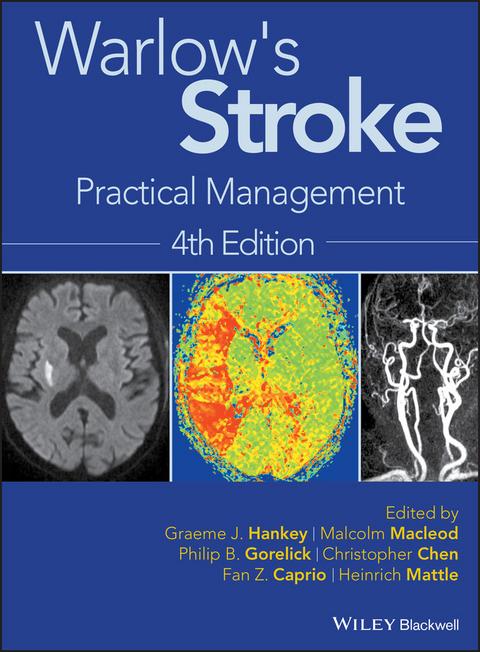
A practical textbook, based on a problem-oriented workflow, that will improve patients' likelihood of full recovery from stroke and prevent future strokes from occurring
Stroke is the leading cause of adult disability and is in the top five causes of death globally. Warlow's Stroke: Practical Management, 4th Edition takes a problem-oriented approach and addresses the questions posed by a stroke patient in the order they are likely to present in clinical practice, for instance, 'Is it a stroke?', 'What sort of stroke?', 'What caused it?', and 'What can be done about it?'.
Beginning with chapters phrased as questions, the book walks the reader through a standard clinical workflow, exploring the practical skills and assessment required at each stage of patient management. Early chapters cover: locating the vascular lesion, identifying the involved arterial territory, the role imaging should play, and the application thereof.
Subsequent chapters look at what causes a transient or persistent ischemic event, an intracerebral hemorrhage and a subarachnoid hemorrhage. Unusual causes of ischemic stroke and transient ischemic attack are also covered. The book then presents a practical approach to the management of stroke and transient ischemic attack; offers specific treatments for acute ischemic stroke and aneurysmal subarachnoid hemorrhage; provides ways for professionals to prevent first or recurrent stroke; and more.
Final chapters of the book discuss rehabilitation after stroke, how patients and carers can be supported in the short term and long term, prevention of recurrent stroke, and the organization of stroke services.
Warlow's Stroke: Practical Management, 4th Edition
- Follows clinical workflow for stroke analysis
- Features evidence-based approach throughout
- Offers practical application aimed at improving patient outcomes
- Written and edited by internationally renowned experts in the field
An essential resource for all practitioners involved in the care of patients who suffer from cerebrovascular disease, but particularly suitable for neurologists, residents, geriatricians, stroke physicians, radiologists and primary care physicians.
The Editors
Graeme J. Hankey MBBS, MD, FRACP, FRCPE, FAHA, FESO, FAAHMS, Professor of Neurology, Medical School, The University of Western Australia, Perth, Australia; and Consultant Neurologist, Sir Charles Gairdner Hospital, Perth, Western Australia
Malcolm Macleod BSc(Hons), MBChB, PhD, FRCP, Professor of Neurology and Translational Neurosciences at the University of Edinburgh, and Honorary Consultant Neurologist and Head of Neurology, NHS Forth Valley, UK
Philip B. Gorelick MD, MPH, FACP, FAHA, FAAN, FANA, Professor Translational Science and Molecular Medicine at Michigan State University, Grand Rapids, MI, USA; and Adjunct Professor, Davee Department of Neurology, Northwestern Feinberg School of Medicine, Chicago, IL, USA; and International Fellow, Population Health Research Institute affiliated with McMaster University Faculty of Health Sciences and Hamilton Health Sciences, Hamilton, ON, Canada; and Professor Emeritus, Department of Neurology and Rehabilitation, University of Illinois College of Medicine, Chicago, IL, USA
Christopher Chen BA, BMBCh, FRCP, Director, Memory Aging & Cognition Centre, National University Health System, Singapore; and Associate Professor, Department of Pharmacology, National University of Singapore, Singapore; and Senior Consultant Neurologist, Department of Psychological Medicine, National University Hospital, Singapore
Fan Z. Caprio MD, Department of Neurology, Northwestern University Feinberg School of Medicine, Chicago, IL, USA
Heinrich Mattle MD, FRCPE, FAHA, FESO, Professor, Senior Consultant, Department of Neurology, University of Bern, Bern, Switzerland
A practical textbook, based on a problem-oriented workflow, that will improve patients' likelihood of full recovery from stroke and prevent future strokes from occurring Stroke is the leading cause of adult disability and is in the top five causes of death globally. Warlow's Stroke: Practical Management, 4th Edition takes a problem-oriented approach and addresses the questions posed by a stroke patient in the order they are likely to present in clinical practice, for instance, 'Is it a stroke?', 'What sort of stroke?', 'What caused it?', and 'What can be done about it?'. Beginning with chapters phrased as questions, the book walks the reader through a standard clinical workflow, exploring the practical skills and assessment required at each stage of patient management. Early chapters cover: locating the vascular lesion, identifying the involved arterial territory, the role imaging should play, and the application thereof. Subsequent chapters look at what causes a transient or persistent ischemic event, an intracerebral hemorrhage and a subarachnoid hemorrhage. Unusual causes of ischemic stroke and transient ischemic attack are also covered. The book then presents a practical approach to the management of stroke and transient ischemic attack; offers specific treatments for acute ischemic stroke and aneurysmal subarachnoid hemorrhage; provides ways for professionals to prevent first or recurrent stroke; and more. Final chapters of the book discuss rehabilitation after stroke, how patients and carers can be supported in the short term and long term, prevention of recurrent stroke, and the organization of stroke services. Warlow's Stroke: Practical Management, 4th Edition Follows clinical workflow for stroke analysis Features evidence-based approach throughout Offers practical application aimed at improving patient outcomes Written and edited by internationally renowned experts in the field An essential resource for all practitioners involved in the care of patients who suffer from cerebrovascular disease, but particularly suitable for neurologists, residents, geriatricians, stroke physicians, radiologists and primary care physicians.
The Editors Graeme J. Hankey MBBS, MD, FRACP, FRCPE, FAHA, FESO, FAAHMS, Professor of Neurology, Medical School, The University of Western Australia, Perth, Australia; and Consultant Neurologist, Sir Charles Gairdner Hospital, Perth, Western Australia. Malcolm Macleod BSc(Hons), MBChB, PhD, FRCP, Professor of Neurology and Translational Neurosciences at the University of Edinburgh, and Honorary Consultant Neurologist and Head of Neurology, NHS Forth Valley, UK. Philip B. Gorelick MD, MPH, FACP, FAHA, FAAN, FANA, Professor Translational Science and Molecular Medicine at Michigan State University, Grand Rapids, MI, USA; and Adjunct Professor, Davee Department of Neurology, Northwestern Feinberg School of Medicine, Chicago, IL, USA; and International Fellow, Population Health Research Institute affiliated with McMaster University Faculty of Health Sciences and Hamilton Health Sciences, Hamilton, ON, Canada; and Professor Emeritus, Department of Neurology and Rehabilitation, University of Illinois College of Medicine, Chicago, IL, USA. Christopher Chen BA, BMBCh, FRCP, Director, Memory Aging & Cognition Centre, National University Health System, Singapore; and Associate Professor, Department of Pharmacology, National University of Singapore, Singapore; and Senior Consultant Neurologist, Department of Psychological Medicine, National University Hospital, Singapore. Fan Z. Caprio MD, Department of Neurology, Northwestern University Feinberg School of Medicine, Chicago, IL, USA. Heinrich Mattle MD, FRCPE, FAHA, FESO, Professor, Senior Consultant, Department of Neurology, University of Bern, Bern, Switzerland.
Contributors vii
Acknowledgments xi
Abbreviations xiii
1 Introduction 1
2 Development of knowledge about cerebrovascular disease 7
Jan van Gijn
3 Is it a vascular event and where is the lesion? 37
Simon Jung and Heinrich P. Mattle
4 Which arterial territory is involved? 129
John C.M. Brust
5 What is the role of imaging in acute stroke? 171
5A Neuroimaging 172
Marwan El-Koussy
5B Ultrasound of the extra- and intracranial arteries 224
Georgios Tsivgoulis and Apostolos Safouris
5C Cardioembolic stroke 241
Issam Mikati and Zeina Ibrahim
6 What caused this transient or persisting ischemic event? 267
Fernando D. Testai
7 Unusual causes of ischemic stroke and transient ischemic attack 345
Fan Z. Caprio and Chen Lin
8 What caused this intracerebral hemorrhage? 399
Farid Radmanesh and Jonathan Rosand
9 What caused this subarachnoid hemorrhage? 437
Matthew B. Maas and Andrew M. Naidech
10 A practical approach to the management of stroke and transient ischemic attack 455
H. Bart van der Worp and Martin Dennis
11 What are this patient's problems? A problem-based approach to the general management of stroke 481
Yannie Soo, Howan Leung, and Lawrence Ka Sing Wong
12 Have the patient's cognitive abilities been affected? 579
Leonardo Pantoni
13 Specific treatment of acute ischemic stroke 587
Eivind Berge and Peter Sandercock
14 Specific treatment of intracerebral hemorrhage 657
Shoichiro Sato and Craig S. Anderson
15 Specific treatment of aneurysmal subarachnoid hemorrhage 679
Gregory Arnone and Sepideh Amin-Hanjani
16 Specific interventions to prevent intracranial hemorrhage 723
Preston W. Douglas, Clio A. Rubinos, and Sean Ruland
17 Preventing recurrent stroke and other serious vascular events 745
Cathra Halabi, Rene Colorado, and Karl Meisel
18 Rehabilitation after stroke: evidence, practice, and new directions 867
Coralie English, Audrey Bowen, Debbie Hébert, and Julie Bernhardt
19 The organization of stroke services 879
Peter Langhorne, Jeyaraj Durai Pandian, and Cynthia Felix
20 Reducing the impact of stroke and improving public health 933
Graeme J. Hankey and Philip B. Gorelick
Index 953
Abbreviations
We don’t care much for abbreviations. They are not literate (Oliver Twist was not abbreviated to OT each time Dickens mentioned his name!), they don’t look good on the printed page, and they make things more difficult to read and understand, particularly for non‐experts. But they do save space and so we have to use them a bit. However, we will avoid them as far as we can in tables, figures and the practice points. We will try to define any abbreviations the first time they are used in each chapter, or even in each section if they are not very familiar. But, if we fail to be comprehensible, then here is a rather long list to refer to.
- ACA
- Anterior cerebral artery
- ACE
- Angiotensin‐converting enzyme
- AChA
- Anterior choroidal artery
- ACoA
- Anterior communicating artery
- ACS
- Acute coronary syndrome
- ACST
- Asymptomatic Carotid Surgery Trial
- ADC
- Apparent diffusion coefficient
- ADH
- Antidiuretic hormone
- ADL
- Activities of daily living
- ADP
- Adenosine diphosphate
- ADPKD
- Autosomal dominant polycystic kidney disease
- AF
- Atrial fibrillation
- AFx
- Amaurosis fugax
- AH
- Ataxic hemiparesis
- AICA
- Anterior inferior cerebellar artery
- AIDS
- Acquired immune deficiency syndrome
- AION
- Anterior ischemic optic neuropathy
- AMI
- Acute myocardial infarction
- ANCA
- Antineutrophil cytoplasmic antibody
- ANF
- Antinuclear factor
- APS
- Antiphospholipid syndrome
- APT
- Antiplatelet Trialists’ Collaboration
- APTT
- Activated partial thromboplastin time
- ARAS
- Ascending reticular activating system
- ARB
- Angiotensin II receptor (AT1) blockers
- ARD
- Absolute risk difference
- ASA
- Atrial septal aneurysm
- ASD
- Atrial septal defect
- ATIII
- Antithrombin III
- ATP
- Adenosine triphosphate
- ATT
- Antithrombotic Trialists’ Collaboration
- AVF
- Arteriovenous fistula
- AVM
- Arteriovenous malformation
- BA
- Basilar artery
- BAD
- Branch atheromatous plaque disease
- BIH
- Benign intracranial hypertension
- BMI
- Body mass index
- BOLD
- Blood oxygenation level‐dependent
- BP
- Blood pressure
- C
- Celsius
- CAA
- Cerebral amyloid angiopathy
- CADASIL
- Cerebral autosomal dominant arteriopathy with subcortical infarcts and leukoencephalopathy
- CARASAL
- Cathepsin A related arteriopathy with strokes and leukoencephalopathy
- CARASIL
- Cerebral autosomal recessive arteriopathy with subcortical infarcts and leukoencephalopathy
- CAST
- Chinese Acute Stroke Trial
- CAVATAS
- Carotid and Vertebral Artery Transluminal Angioplasty Study
- CBF
- Cerebral blood flow
- CBFV
- Cerebral blood flow velocity
- CBV
- Cerebral blood volume
- CCA
- Common carotid artery
- CDU
- Carotid duplex
- CEA
- Carotid endarterectomy
- CE‐MRA
- Contrast‐enhanced MR angiography
- CHD
- Coronary heart disease
- CI
- Confidence interval
- CJD
- Creutzfeldt–Jakob disease
- CK
- Creatine kinase
- CMB
- Cerebral microbleed
- CMRO2
- Cerebral metabolic rate of oxygen
- CMRglu
- Cerebral metabolic rate of glucose
- CNS
- Central nervous system
- COX 2
- Cyclo‐oxygenase 2 inhibitors
- CPP
- Cerebral perfusion pressure
- CPSP
- Central post‐stroke pain
- CSF
- Cerebrospinal fluid
- CT
- Computed tomography
- CTA
- Computed tomography angiography
- CTP
- Cerebral perfusion imaging with CT
- CTP
- Computed tomography perfusion
- CVR
- Cerebrovascular resistance
- CVST
- Cerebral venous sinus thrombosis
- DALY
- Disability‐adjusted life year
DAVFDural arteriovenous fistula- DBP
- Diastolic blood pressure
- DCHS
- Dysarthria clumsy‐hand syndrome
- DIC
- Disseminated intravascular coagulation
- DNA
- Deoxyribose nucleic acid
- DOAC
- Direct oral anticoagulants
- DPM
- Diffusion‐perfusion mismatch
- DSA
- Digital subtraction angiography
- DSC
- Dynamic susceptibility contrast
- DSM
- Diagnostic and statistical manual of mental disorders
- DVT
- Deep venous thrombosis (in the legs or pelvis)
- DWI
- Diffusion‐weighted (MR) imaging
- EACA
- Epsilon‐aminocaproic acid
- EADL
- Extended activities of daily living
- EAFT
- European Atrial Fibrillation Trial
- ECA
- External carotid artery
- ECASS
- European Cooperative Acute Stroke Study
- ECG
- Electrocardiogram
- EC‐IC
- Extracranial–intracranial
- ECST
- European Carotid Surgery Trial
- EEG
- Electroencephalogram
- EMG
- Electromyography
- ESR
- Erythrocyte sedimentation rate
- FAST
- Face‐Arm‐Speech Test
- FAT‐SAT
- Fat saturation sequences
- FDA
- Food and Drug Administration
- FIM
- Functional Independence Measure
- FLAIR
- Fluid attenuated inversion recovery
- FMD
- Fibromuscular dysplasia
- fMRI
- Functional magnetic resonance imaging
- FMZ
- Flumazenil
- GCS
- Glasgow Coma Scale
- GEF
- Glucose extraction fraction
- GKI
- Glucose, potassium and insulin
- GRE
- Gradient‐recalled echo
- HACP
- Homolateral ataxia and crural paresis
- Hg
- Mercury
- HI
- Hemorrhagic infarction
- HIT
- Heparin‐induced thrombocytopenia
- HITS
- High intensity transient signals
- HIV
- Human immunodeficiency virus
- HMPAO
- Hexamethylpropyleneamine oxime
- HTI
- Hemorrhagic transformation of an infarct
- HU
- Hounsfield units
- IAA
- Internal auditory artery
- IAA
- Intra‐arterial angiography
- IAT
- Intra‐arterial treatment
- IC
- Infarct core
- ICA
- Internal carotid artery
- ICH
- Intracerebral hemorrhage
- ICIDH
- International Classification of Impairments, Disabilities and Handicaps
- ICP
- Intracranial pressure
- ICVT
- Intracranial venous thrombosis
- IADSA
- Intra‐arterial digital subtraction angiography
- INR
- International normalized ratio
- IST
- International Stroke Trial
- IVDSA
- Intravenous digital subtraction angiography
- IVIG
- Intravenous immunoglobulins
- IVIM
- Intravoxel incoherent motion
- IVM
- Intracranial vascular malformation
- kPa
- Kilopascals
- L
- Litre
- LAA
- Left atrial appendage
- LACI
- Lacunar infarction
- LACS
- Lacunar syndrome
- LGN
- Lateral geniculate nucleus
- LP
- Lumbar puncture
- LSA
- Lenticulostriate artery
- M
- Molar
- MAC
- Mitral annular calcification
- MAOI
- Monoamine oxidase inhibitor
- MAST‐I
- Multicentre Acute Stroke Trial – Italy
- MCA
- Middle cerebral artery
- MCTT
- Mean cerebral transit time
- MELAS
- Mitochondrial encephalopathy, lactic acidosis, and stroke‐like episodes
- MES
- Microembolic signals
- MFV
- Mean flow velocities
- MI
- Myocardial infarction
- MLF
- Medial longitudinal fasciculus
- MLP
- Mitral leaflet prolapse
- MMSE
- Mini mental state examination
- MND
- Motor neuron disease
- MR
- Magnetic resonance
- MRA
- Magnetic resonance angiography
- MRC
- Medical Research Council
- MRI
- Magnetic resonance imaging
- MRS
- Magnetic resonance spectroscopy
- MRV
- Magnetic resonance venogram
- MTT
- Mean transit time
- NAA
- N‐acetyl aspartate
- NASCET
- North American Symptomatic Carotid Endarterectomy Trial
- NCCT
- Noncontrast CT
- NELH
- National Electronic Library for Health
- NG
- Nasogastric
- NIHSS
- National Institutes of Health Stroke Score
- NINDS
- National Institute of Neurological Disorders and Stroke
- NIRS
- Near infrared spectroscopy
- NNT
- Number‐needed‐to‐treat
- NO
- Nitric oxide
- NSAID
- Nonsteroidal anti‐inflammatory drug
- OA
- Ophthalmic artery
- OCSP
- Oxfordshire Community Stroke Project
- OCP
- Oral contraceptive
- OEF
- Oxygen...
| Erscheint lt. Verlag | 28.1.2019 |
|---|---|
| Sprache | englisch |
| Themenwelt | Medizin / Pharmazie ► Medizinische Fachgebiete ► Neurologie |
| Naturwissenschaften ► Biologie | |
| Schlagworte | Biowissenschaften • Brain Haemorrhage • brain hemorrhage • cerebrovascular disease • danger of stroke • diagnosing stroke • diagnosing stroke events • guide to strokes • intercranial hemorrhage • Life Sciences • Medical Science • Medizin • Neurologie • Neurology • Neuroscience • Neurovascular Disease • Neurovaskuläre Krankheiten • Neurowissenschaften • Preventing stroke • preventing stroke events • preventing strokes • prevent intracranial haemorrhage • providing rehabilitation for stroke patients • stroke • stroke and other vascular events • stroke events • Stroke Management • stroke prevention • treating stroke events • treating stroke patients • types of stroke events • types of vascular events |
| ISBN-10 | 1-118-49241-2 / 1118492412 |
| ISBN-13 | 978-1-118-49241-3 / 9781118492413 |
| Informationen gemäß Produktsicherheitsverordnung (GPSR) | |
| Haben Sie eine Frage zum Produkt? |
 EPUB (Adobe DRM)
Kopierschutz: Adobe-DRM
Adobe-DRM ist ein Kopierschutz, der das eBook vor Mißbrauch schützen soll. Dabei wird das eBook bereits beim Download auf Ihre persönliche Adobe-ID autorisiert. Lesen können Sie das eBook dann nur auf den Geräten, welche ebenfalls auf Ihre Adobe-ID registriert sind.
Details zum Adobe-DRM
Dateiformat: EPUB (Electronic Publication)
EPUB ist ein offener Standard für eBooks und eignet sich besonders zur Darstellung von Belletristik und Sachbüchern. Der Fließtext wird dynamisch an die Display- und Schriftgröße angepasst. Auch für mobile Lesegeräte ist EPUB daher gut geeignet.
Systemvoraussetzungen:
PC/Mac: Mit einem PC oder Mac können Sie dieses eBook lesen. Sie benötigen eine
eReader: Dieses eBook kann mit (fast) allen eBook-Readern gelesen werden. Mit dem amazon-Kindle ist es aber nicht kompatibel.
Smartphone/Tablet: Egal ob Apple oder Android, dieses eBook können Sie lesen. Sie benötigen eine
Geräteliste und zusätzliche Hinweise
Buying eBooks from abroad
For tax law reasons we can sell eBooks just within Germany and Switzerland. Regrettably we cannot fulfill eBook-orders from other countries.
aus dem Bereich