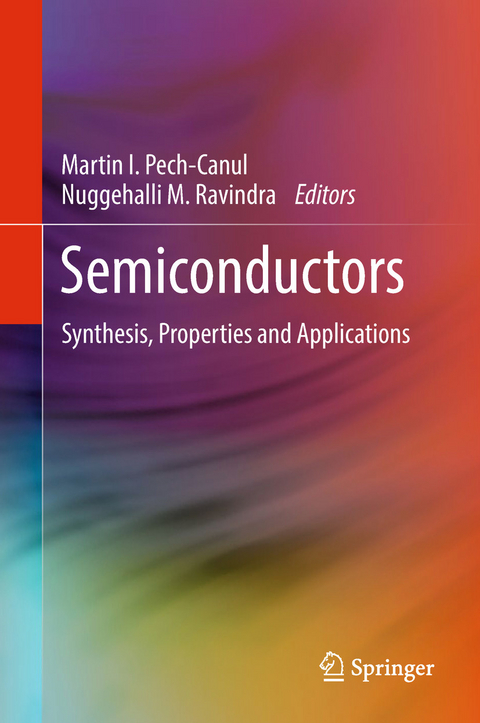
Semiconductors (eBook)
590 Seiten
Springer International Publishing (Verlag)
978-3-030-02171-9 (ISBN)

- Describes new materials and updates to older materials that exhibit optical, optoelectronic and semiconductor behaviors;
- Covers the structural and mechanical aspects of the optical, optoelectronic and semiconductor materials for meeting mechanical property and safety requirements;
- Includes discussion of the environmental and sustainability issues regarding optical, optoelectronic, and semiconductor materials, from processing to recycling.
Dr. Pech-Canul was a Fulbright Scholar and is currently a Researcher and Professor at CINVESTAV, Center for Research and Advanced Studies of The National Polytechnic Institute in Mexico.
Dr. Pech-Canul was a Fulbright Scholar and is currently a Researcher and Professor at CINVESTAV, Center for Research and Advanced Studies of The National Polytechnic Institute in Mexico.Dr. N.M. Ravindra (Ravi) is a Professor of Physics at the New Jersey Institute of Technology.
Preface 5
Contents 7
Introduction 9
1 Semiconductor Fundamentals 12
1.1 Introduction 12
1.2 Principles of Quantum Mechanics 13
1.2.1 Energy Quantization 13
1.2.2 Wave Functions and Quantum Equations in a Nutshell 13
1.2.3 Electronic Wave Functions in Atoms, Molecules, and Bulk Materials 15
1.2.4 Scattering 16
1.3 Fermi–Dirac Statistics 18
1.3.1 Fermions and Bosons 18
1.3.2 The Free Electron Gas 19
1.3.3 Heat Capacity 20
1.4 Concept of Band Structure 21
1.4.1 Solid Matter 21
1.4.2 Direct and Reciprocal Lattices and the Concept of Brillouin Zone 22
1.4.3 Bloch Functions 24
1.4.4 Kronig–Penney Model 24
1.4.5 Metals, Insulators, and Semiconductors 26
1.4.6 Beyond the Band-Structure Paradigm 27
1.5 Intrinsic and Extrinsic Semiconductors 28
1.5.1 Intrinsic Carrier Concentration 29
1.5.2 Donors and Acceptors 30
1.5.3 Recombination Mechanisms 31
1.6 Transport Properties 33
1.6.1 Electrical Conductivity 33
1.6.2 Hall Effect 35
1.6.3 Thermoelectric and Thermomagnetic Effects 36
1.7 Optical Properties 39
1.7.1 Optical Transmission and Absorption 40
1.7.2 Photoconductivity and Photovoltaic Effects 42
1.7.3 Photovoltaic Effect 44
References 46
2 Processing Techniques 47
2.1 Bulk—Crystal Growth 47
2.1.1 Melt Growth 48
2.1.2 Solution Growth 53
2.2 Thin Films—Epitaxial Growth—MBE, ALE, ELO 54
2.2.1 Molecular-Beam Epitaxy (MBE) 55
2.2.2 Atomic Layer Epitaxy (ALE) 58
2.2.3 Epitaxial Lift-off (ELO) 61
2.3 Thin Films—Polycrystalline Films—PECVD, LPCVD, APCVD 62
2.3.1 Plasma-Enhanced Chemical Vapor Deposition (PECVD) 63
2.3.2 Low-Pressure Chemical Vapor Deposition (LPCVD) 65
2.3.3 Atmospheric Pressure CVD (APCVD) 66
2.3.4 Conclusion 67
2.4 Amorphous Films—CVD, Laser Ablation 68
2.4.1 Chemical Vapor Deposition (CVD) 68
2.4.2 Laser Ablation Method 72
2.5 Self-Assembly—Langmuir–Blodgett 74
2.5.1 Self-assembled Monolayers (SAMs) 75
2.5.2 Langmuir–Blodgett (LB) Technique 77
2.5.3 Variants of the Langmuir–Blodgett Technique 80
2.6 Wafer Preparation Methods—RCA, Modified RCA 80
2.6.1 Introduction and Background 80
2.6.2 RCA Cleaning 81
2.6.3 Modified RCA 83
2.6.4 HF Step or Diluted Hydrofluoric Acid (HF or DHF @20–25 °C) 84
2.7 Diffusion 84
2.7.1 Basic Models for Diffusion 85
2.7.2 Diffusion Mechanisms in Semiconductors 86
2.8 Ion Implantation 89
2.8.1 Energy Loss 89
2.8.2 Range of Incident Ions 90
2.8.3 Ion Implantation Damage 91
2.8.4 Conventional Ion Implantation Techniques 91
2.9 Vacuum Deposition Techniques 93
2.9.1 Conventional Evaporation 93
2.9.2 Sputtering 95
References 97
3 Characterization Techniques 104
3.1 Electrical Properties 104
3.1.1 Introduction 104
3.1.2 Hall Effect 105
3.1.3 Electrical Resistivity 107
3.1.4 Capacitance–Voltage Measurements 108
3.1.5 Current–Voltage Measurements 109
3.1.6 Deep Level Transient Spectroscopy 109
3.1.7 AC Impedance Spectroscopy 110
3.2 Optical Properties 111
3.2.1 Ellipsometry 114
3.3 Structural Properties 115
3.3.1 Introduction 115
3.3.2 X-Ray Diffractometry 115
3.3.3 Electron Diffraction and High-Resolution Transmission Electron Microscopy (HRTEM) 119
3.3.4 Atomic Force Microscopy 120
3.3.5 Scanning Electron Microscopy (SEM) 120
3.3.6 Raman Spectroscopy 125
3.4 Compositional Properties 127
3.4.1 X-ray Photoelectron Spectroscopy (XPS) 127
References 134
4 Vanadium Oxides: Synthesis, Properties, and Applications 136
4.1 Introduction 136
4.1.1 General Considerations 136
4.1.2 Insulator–Metal Transitions (IMT): Mott, Hubbard, and Peierls Mechanism 139
4.1.3 Literature Review 142
4.2 First Principles Electronic Structure Methods 144
4.2.1 Modern Density Functional Theory: Kohn–Sham Approach 145
4.2.2 Basis Sets 146
4.2.3 Pseudopotential 148
4.2.4 Integral Over the First Brillouin Zone 149
4.2.5 Metals—Fermi Surface Sampling 150
4.2.6 ABINIT 151
4.2.7 Vanadium Oxides: Symmetries and Structure 152
4.2.8 Optimization of Unit Cell 157
4.2.9 Convergence Studies 157
4.2.10 BoltzTraP: Calculations of Boltzmann Transport Properties 159
4.3 Electronic Properties of Vanadium Oxides 160
4.3.1 General Considerations 160
4.3.2 Electronic Band Structure of Bulk V2O5 162
4.3.3 Electronic Band Structure of Bulk VO2 165
4.3.4 Electronic Band Structure of Bulk V2O3 167
4.3.5 Summary 174
4.4 Transport Properties of Vanadium Oxides 174
4.4.1 General Considerations 174
4.4.2 Transport Properties of Bulk V2O5 177
4.4.3 Transport Properties of Bulk VO2 179
4.4.4 Summary 180
4.5 Optical Properties of Vanadium Oxides 182
4.5.1 General Considerations 182
4.5.2 Review of Optical Spectra 183
4.5.3 Application of Penn Model 188
4.5.4 Sum Rule 191
4.5.5 Summary 194
4.6 Vanadium Oxides: Synthesis/Deposition 195
4.6.1 Sol–Gel Methods 197
4.6.2 Sputtering Methods 198
4.6.3 Reactive Evaporation 200
4.6.4 Pulsed Laser Deposition 200
4.6.5 Chemical Vapor Deposition 201
4.7 Simulation of Spectral Emissivity of Vanadium Oxides (VOx) Based Microbolometer Structures 203
4.7.1 Introduction 203
4.7.2 Results and Discussion 206
4.7.3 Summary 213
4.8 Applications of Vanadium Oxides 214
References 216
5 Graphene: Properties, Synthesis, and Applications 228
5.1 Introduction 228
5.1.1 Objective 228
5.1.2 Background 228
5.2 Literature Review 232
5.2.1 Electronic Properties 233
5.2.2 Optical Properties of Graphene 240
5.2.3 Mechanical Properties 248
5.3 Computational Methods 252
5.3.1 Density Functional Theory (DFT) 253
5.3.2 Emissivity Calculations 258
5.3.3 Theory of Atomistic Simulation 258
5.4 Modeling and Simulation 264
5.4.1 Electronic Properties 264
5.4.2 Optical Properties 269
5.4.3 Mechanical Properties 272
5.4.4 Thermal Conductivity Calculations 274
5.4.5 Transport Parameter Calculations 280
5.4.6 Emissivity Calculations 288
5.5 Results and Discussion 298
5.5.1 Summary of Methods Used for Simulations 298
5.5.2 Electronic Properties 298
5.5.3 Optical Properties 302
5.5.4 Mechanical Properties 311
5.5.5 Thermal Conductivity 318
5.6 Synthesis Techniques 326
5.7 Applications of Graphene 328
5.8 Conclusions 330
References 332
6 Transition Metal Dichalcogenides Properties and Applications 342
6.1 Background 342
6.2 Physical Properties of MoS2 and WS2 343
6.2.1 Monolayer Structure 343
6.2.2 Bulk Structure 344
6.3 Electronic Properties of MoS2 and WS2 345
6.3.1 Band Structure of MoS2 and WS2 346
6.3.2 Temperature Dependence of Bandgap in Monolayer MoS2 and WS2 349
6.4 Optical Properties of MoS2 and WS2 350
6.4.1 Optical Properties of Suspended MoS2 and WS2 351
6.4.2 Optical Properties of MoS2 and WS2 on Selected Substrates 361
6.5 Electrical Properties of MoS2 and WS2 364
6.5.1 Carrier Mobility 364
6.6 Applications of MoS2 and WS2 370
6.6.1 Introduction 371
6.6.2 Digital Electronics 371
6.6.3 Optoelectronics 372
6.7 Physical Properties of MoSe2 and WSe2 375
6.7.1 Introduction 375
6.7.2 Structure 375
6.8 Electronic properties of MoSe2 and WSe2 378
6.8.1 General Considerations 378
6.8.2 Electronic Band Structure of MoSe2 379
6.8.3 Electronic Band Structure of WSe2 381
6.8.4 Temperature Dependence of Energy Gap of Monolayer MoSe2 and WSe2 382
6.9 Optical Properties of MoSe2 and WSe2 384
6.9.1 Introduction 384
6.9.2 Optical Constants of MoSe2 and WSe2 385
6.9.3 Optical Properties of Suspended Monolayer and Bulk MoSe2 and WSe2 386
6.9.4 Optical Properties of Monolayer, Bulk MoSe2, and WSe2 on Various Substrates 390
6.9.5 Optical Bandgap of Monolayer MoSe2 and WSe2 393
6.10 Electrical Properties of MoSe2 and WSe2 395
6.10.1 Electrical Properties of MoSe2 and WSe2 395
6.11 Applications of MoSe2 and WSe2 398
6.11.1 Field-Effect Transistors 399
6.11.2 Optoelectronics 400
6.11.3 Heterostructures 400
References 401
7 Group II–VI Semiconductors 406
7.1 CdS and Related Binary, Ternary, and Quaternary Compounds 407
7.1.1 Processing Techniques 408
7.1.2 Properties 431
7.1.3 Applications 445
7.2 ZnO and Related Binary, Ternary, and Quaternary Compounds 449
7.2.1 Processing Techniques 449
7.2.2 Properties 456
7.2.3 Applications 459
7.3 HgTe and Related Binary, Ternary, and Quaternary Compounds 460
7.3.1 Processing Techniques 461
7.3.2 Properties 462
7.3.3 Applications 465
References 466
8 Other Miscellaneous Semiconductors and Related Binary, Ternary, and Quaternary Compounds 474
8.1 Introduction 474
8.1.1 Semiconductors and Their Alloys 474
8.1.2 Growth Techniques 475
8.1.3 Wide Band Gap Alloys and Their Applications 478
8.1.4 Narrow Band Gap Alloys and Their Applications 479
8.1.5 Solar Cell Materials 480
8.2 Theory of First-Principles Calculations 481
8.2.1 Theoretical Background 481
8.2.2 Density Functional Theory (DFT) 483
8.2.3 Exchange-Correlation Functional 484
8.2.4 Pseudopotentials 485
8.3 Chapter Framework 486
8.4 Elastic Properties of Binary and Ternary Semiconductors 487
8.4.1 Overview 487
8.4.2 Existing Models on Bulk and Shear Modulus 488
8.4.3 Development of New Expressions 489
8.4.4 Comparison with Experimental Data 491
8.4.5 Elastic Constants of Ternary Semiconductors 495
8.4.6 Summary 496
8.5 Properties of III–V Ternary Alloys 496
8.5.1 Overview 496
8.5.2 Theoretical Background 498
8.5.3 Ordered Structures of Ternary Alloys 498
8.5.4 Structural Properties 500
8.5.5 Formation Enthalpies 503
8.5.6 Electronic Properties and Bowing Parameter 504
8.5.7 Comparison with Experiments and Other Calculations 506
8.5.8 Summary 506
8.6 Properties of II–VI Ternary Alloys 507
8.6.1 Overview 507
8.6.2 Theoretical Background 507
8.6.3 Special Quasirandom Structures 508
8.6.4 Ground State Structure 509
8.6.5 Crystal Field Splitting 509
8.6.6 Spin-Orbit Splitting and Band Gap 511
8.6.7 Dependence on Alloy Composition 511
8.6.8 Comparison with Experiments 513
8.6.9 Summary 514
8.7 Fingerprints of Y2 Ordering in III–V Ternary Alloys 514
8.7.1 Overview 514
8.7.2 Spontaneous Y2 Ordering 515
8.7.3 Hopefield Quasicubic Model 516
8.7.4 Fingerprints of Y2 Ordering 517
8.7.5 Comparison with Other Orderings 519
8.7.6 Comparison with Experiments 521
8.7.7 Summary 522
8.8 Pressure Dependence of Energy Gap of III–V and II–VI Ternary Semiconductors 522
8.8.1 Theoretical Background 522
8.8.2 Modeling Pressure Dependent Band Gap of Ternary Alloys 524
8.8.3 Results and Discussion 526
8.8.4 Comparison with Experiments 529
8.8.5 Temperature Coefficients of Ternary Alloys 532
8.8.6 Summary 532
8.9 Electronic and Optical Properties of I2–II–IV–VI4 Quaternary Semiconductors 532
8.9.1 Theoretical Background 532
8.9.2 Crystal Structures 533
8.9.3 Electronic Properties 534
8.9.4 Optical Properties 538
8.9.5 Summary 540
8.10 Electronic and Optical Properties of Wurtzite-Derived Semiconductors—Cu2ZnSiS4 and Cu2ZnSiSe4 541
8.10.1 Abstract 541
8.10.2 Background 542
8.10.3 Crystal Structure 542
8.10.4 Band Structures 543
8.10.5 Optical Properties 545
8.10.6 Summary 546
References 546
9 Organic Semiconductors 555
9.1 Processing Techniques 555
9.1.1 Vacuum Deposition 556
9.1.2 Solution Deposition 559
9.2 Properties 564
9.2.1 Conjugated Polymers 565
9.2.2 Conduction Phenomena 566
9.2.3 Charge Carrier Mobility 569
9.2.4 Optical Properties 570
9.3 Applications 571
9.3.1 Organic Field-Effect Transistors 571
9.3.2 Organic Light-Emitting Diodes 573
9.3.3 Organic Photovoltaic Devices 574
References 576
10 Emerging Opportunities and Future Directions 582
10.1 Introduction 582
10.2 Chemical Bath Deposition 585
10.3 Environmental, Health and Safety-Related Aspects 586
10.4 Summary and Concluding Remarks 587
References 589
Index 591
| Erscheint lt. Verlag | 17.1.2019 |
|---|---|
| Zusatzinfo | XI, 590 p. 368 illus., 276 illus. in color. |
| Verlagsort | Cham |
| Sprache | englisch |
| Themenwelt | Naturwissenschaften ► Chemie |
| Naturwissenschaften ► Physik / Astronomie | |
| Technik ► Elektrotechnik / Energietechnik | |
| Technik ► Maschinenbau | |
| Schlagworte | Ceramic Varistors • Functional Ceramic Materials • Materialographic Preparation • Microstructure Characterization • Nonlinear Optical Semi-organic Crystals • Optical Semiconductor Materials • optoelectronic devices • Optoelectronic materials • semiconductor materials |
| ISBN-10 | 3-030-02171-8 / 3030021718 |
| ISBN-13 | 978-3-030-02171-9 / 9783030021719 |
| Informationen gemäß Produktsicherheitsverordnung (GPSR) | |
| Haben Sie eine Frage zum Produkt? |
 PDF (Wasserzeichen)
DRM: Digitales Wasserzeichen
Dieses eBook enthält ein digitales Wasserzeichen und ist damit für Sie personalisiert. Bei einer missbräuchlichen Weitergabe des eBooks an Dritte ist eine Rückverfolgung an die Quelle möglich.
Dateiformat: PDF (Portable Document Format)
Mit einem festen Seitenlayout eignet sich die PDF besonders für Fachbücher mit Spalten, Tabellen und Abbildungen. Eine PDF kann auf fast allen Geräten angezeigt werden, ist aber für kleine Displays (Smartphone, eReader) nur eingeschränkt geeignet.
Systemvoraussetzungen:
PC/Mac: Mit einem PC oder Mac können Sie dieses eBook lesen. Sie benötigen dafür einen PDF-Viewer - z.B. den Adobe Reader oder Adobe Digital Editions.
eReader: Dieses eBook kann mit (fast) allen eBook-Readern gelesen werden. Mit dem amazon-Kindle ist es aber nicht kompatibel.
Smartphone/Tablet: Egal ob Apple oder Android, dieses eBook können Sie lesen. Sie benötigen dafür einen PDF-Viewer - z.B. die kostenlose Adobe Digital Editions-App.
Buying eBooks from abroad
For tax law reasons we can sell eBooks just within Germany and Switzerland. Regrettably we cannot fulfill eBook-orders from other countries.
aus dem Bereich