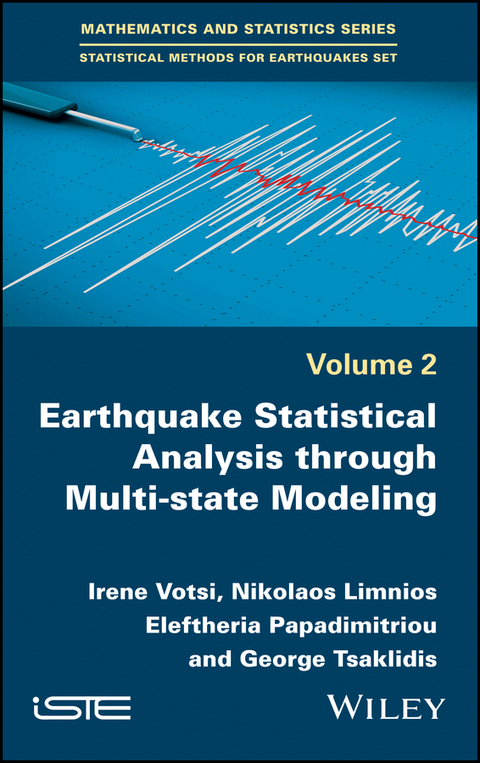
Earthquake Statistical Analysis through Multi-state Modeling (eBook)
192 Seiten
John Wiley & Sons (Verlag)
978-1-119-57906-9 (ISBN)
The introductory chapter outlines state-of-the-art earthquake modeling approaches based on stochastic models. Chapter 2 presents seismogenesis in association with the evolving stress field. Chapters 3 to 5 present earthquake occurrence modeling by means of hidden (semi-)Markov models and discuss associated characteristic measures and relative estimation aspects. Further comparisons, the most important results and our concluding remarks are provided in Chapters 6 and 7.
Irene Votsi is Assistant Professor of Statistics at the Manceau Laboratory of Mathematics, Le Mans University, France. Nikolaos Limnios is Professor of Applied Mathematics at the University of Technology of Compiègne, Sorbonne University, France. Eleftheria Papadimitriou is Professor of Seismology at the Aristotle University of Thessaloniki, Greece. George Tsaklidis is Professor of Probability and Statistics at the Aristotle University of Thessaloniki, Greece.
List of Abbreviations ix
List of Symbols xi
Preface xv
Introduction xix
Chapter 1. Fundamentals on Stress Changes 1
1.1. Introduction 1
1.2. Stress interaction 4
1.3. Stress changes calculation 12
1.4. Modeling of Coulomb stress changes for different faulting types 15
1.4.1.DeltaCS for strike-slip faulting 15
1.4.2.DeltaCS for dip-slip faulting 16
1.5. Seismicity triggered by stress transfer 21
1.5.1. Triggering of strong earthquakes 21
1.5.2. Aftershock triggering 23
1.5.3. Triggering of mining seismicity 28
1.6. Discussion on stress interaction 31
Chapter 2. Hidden Markov Models 35
2.1. Introduction 35
2.2. Hidden Markov framework 37
2.3. Seismotectonic regime and seismicity data 42
2.4. Application to earthquake occurrences 44
2.4.1. Two hidden states and three observation types 45
2.4.2. Three hidden states and three observation types 48
2.4.3. Model selection and simulation 50
2.4.4. Steps number for the first earthquake occurrence 53
2.5. Conclusion 54
Chapter 3. Hidden Markov Renewal Models 57
3.1. Introduction 57
3.2. Semi-Markov framework 58
3.3. Hidden Markov renewal framework 65
3.4. Modeling earthquakes in Greece 66
3.4.1. Hitting times and earthquake occurrence numbers 69
3.5. Conclusion 73
Chapter 4. Hitting Time Intensity 75
4.1. Introduction 75
4.2. DTIHT for semi-Markov chains 76
4.2.1. Statistical estimation of the DTIHT 78
4.3. DTIHT for hidden Markov renewal chains 83
4.3.1. Statistical estimation of the DTIHT 85
4.4. Conclusion 87
Chapter 5. Models Comparison 89
5.1. Introduction 89
5.2. Markov framework 90
5.2.1. HMM case 92
5.2.2. HMRM case 92
5.3. Markov renewal framework 93
5.3.1. HMM case 95
5.3.2. HMRM case 96
5.4. Conclusion 97
Discussion & Concluding Remarks 99
Appendices 105
Appendix 1 107
Appendix 2 113
Appendix 3 117
References 119
Index 137
| Erscheint lt. Verlag | 3.1.2019 |
|---|---|
| Sprache | englisch |
| Themenwelt | Mathematik / Informatik ► Mathematik ► Angewandte Mathematik |
| Mathematik / Informatik ► Mathematik ► Wahrscheinlichkeit / Kombinatorik | |
| Naturwissenschaften ► Geowissenschaften ► Geologie | |
| Schlagworte | Computational / Numerical Methods • Engineering statistics • Maschinenbau • Mathematical Modeling • Mathematics • Mathematik • Mathematische Modellierung • mechanical engineering • Rechnergestützte / Numerische Verfahren im Maschinenbau • Statistics • Statistik • Statistik in den Ingenieurwissenschaften |
| ISBN-10 | 1-119-57906-6 / 1119579066 |
| ISBN-13 | 978-1-119-57906-9 / 9781119579069 |
| Informationen gemäß Produktsicherheitsverordnung (GPSR) | |
| Haben Sie eine Frage zum Produkt? |
 PDF (Adobe DRM)
Kopierschutz: Adobe-DRM
Adobe-DRM ist ein Kopierschutz, der das eBook vor Mißbrauch schützen soll. Dabei wird das eBook bereits beim Download auf Ihre persönliche Adobe-ID autorisiert. Lesen können Sie das eBook dann nur auf den Geräten, welche ebenfalls auf Ihre Adobe-ID registriert sind.
Details zum Adobe-DRM
Dateiformat: PDF (Portable Document Format)
Mit einem festen Seitenlayout eignet sich die PDF besonders für Fachbücher mit Spalten, Tabellen und Abbildungen. Eine PDF kann auf fast allen Geräten angezeigt werden, ist aber für kleine Displays (Smartphone, eReader) nur eingeschränkt geeignet.
Systemvoraussetzungen:
PC/Mac: Mit einem PC oder Mac können Sie dieses eBook lesen. Sie benötigen eine
eReader: Dieses eBook kann mit (fast) allen eBook-Readern gelesen werden. Mit dem amazon-Kindle ist es aber nicht kompatibel.
Smartphone/Tablet: Egal ob Apple oder Android, dieses eBook können Sie lesen. Sie benötigen eine
Geräteliste und zusätzliche Hinweise
Buying eBooks from abroad
For tax law reasons we can sell eBooks just within Germany and Switzerland. Regrettably we cannot fulfill eBook-orders from other countries.
aus dem Bereich