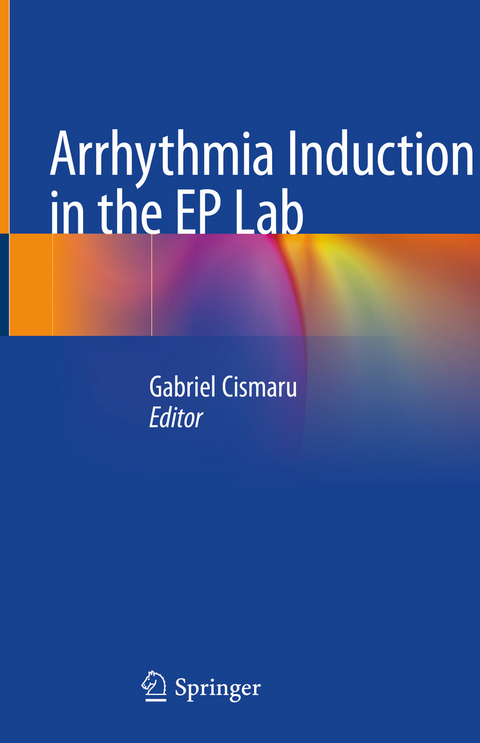
Arrhythmia Induction in the EP Lab (eBook)
IX, 228 Seiten
Springer International Publishing (Verlag)
978-3-319-92729-9 (ISBN)
This book focuses on how to induce clinical arrhythmias in the electrophysiology (EP) laboratory, a procedure that is indispensable for analyzing the underlying mechanisms, and identifying the most effective treatment of the arrhythmia. In the main part of the book, the authors share their own experiences with 13 different medications that can be injected or infused for arrhythmia induction - ranging from isoprenaline and atropine to ephedrine - all of which can be easily found in any cardiology department.
Each chapter begins with a description of the drug's chemical structure and mechanism of actions, then illustrates the infusion preparation, dosage and side effects and lastly analyzes its electrophysiological properties and highlights the most important clinical studies on it. For each drug the authors list - in dedicated tables - administration protocols from their own hospital.This book is of interest to postgraduate students, cardiology residents, cardiologists and pediatric cardiologists with special interest in arrhythmias, as well as to trainees, technicians and nurses involved in the EP lab.
Dr. Cismaru Gabriel earned his MD degree in 2005 from the 'Iuliu Hatieganu' University of Medicine and Pharmacy, Cluj-Napoca (Romania) and received his PhD in medicine in 2016 from the same university. During residency he trained in cardiology and invasive cardiology at CHU Clermont-Ferrand France and CH Dinan (France). After completing his residency in cardiology, Dr. Cismaru began his electrophysiology fellowship at the Insitut Lorrain du Coeur et des Vaisseaux Louis Mathieu, Nancy-France. In 2011 he started working at the Electrophysiology Laboratory of the Rehabilitation Hospital Cluj-Napoca. He currently performs catheter ablation for simple cardiac arrhythmias, like atrial flutter, supraventricular tachycardias and WPW syndrome, but also for complex arrhythmias: atrial fibrillation, ventricular tachycardia and ventricular fibrillation.
His main research interests are: arrhythmias, catheter ablation of atrial fibrillation and ventricular tachycardia, pacemaker and internal defibrillator implantation. He has authored or coauthored peer-reviewed articles on cardiac arrhythmias, electrophysiology and catheter ablation. He is co-author of a number of book chapters and editor of following 2 books in the field of electrophysiology: Bedside Procedures and Brugada Syndrome.Dr. Cismaru Gabriel earned his MD degree in 2005 from the “Iuliu Hatieganu” University of Medicine and Pharmacy, Cluj-Napoca (Romania) and received his PhD in medicine in 2016 from the same university. During residency he trained in cardiology and invasive cardiology at CHU Clermont-Ferrand France and CH Dinan (France). After completing his residency in cardiology, Dr. Cismaru began his electrophysiology fellowship at the Insitut Lorrain du Coeur et des Vaisseaux Louis Mathieu, Nancy-France. In 2011 he started working at the Electrophysiology Laboratory of the Rehabilitation Hospital Cluj-Napoca. He currently performs catheter ablation for simple cardiac arrhythmias, like atrial flutter, supraventricular tachycardias and WPW syndrome, but also for complex arrhythmias: atrial fibrillation, ventricular tachycardia and ventricular fibrillation. His main research interests are: arrhythmias, catheter ablation of atrial fibrillation and ventricular tachycardia, pacemaker and internal defibrillator implantation. He has authored or coauthored peer-reviewed articles on cardiac arrhythmias, electrophysiology and catheter ablation. He is co-author of a number of book chapters and editor of following 2 books in the field of electrophysiology: Bedside Procedures and Brugada Syndrome.
1 Introduction: Why do we need arrhythmia induction.- 2 Isoprenaline.- 3 Adrenaline.- 4 Atropine.- 5 Salbutamol.- 6 Caffeine.- 7 Adenosine.- 8 Dobutamine.- 9 Dopamine.- 10 Noradrenaline.- 11 Aminophylline.- 12 Inducibility of ventricular fibrillation with flecainide and ajmaline during programmed ventricular stimulation in patients with Brugada syndrome.- 13 What to do when clinical arrhythmia is uninducible. Stepwise approach.
| Erscheint lt. Verlag | 4.1.2019 |
|---|---|
| Zusatzinfo | IX, 228 p. 138 illus., 131 illus. in color. |
| Verlagsort | Cham |
| Sprache | englisch |
| Themenwelt | Medizin / Pharmazie ► Medizinische Fachgebiete |
| Naturwissenschaften ► Biologie | |
| Schlagworte | adrenaline • arrhythmia induction • atropine • cardiac arrhythmias • Catheter Ablation • isoprenaline • programmed ventricular stimulation • uninducible arrhythmia |
| ISBN-10 | 3-319-92729-9 / 3319927299 |
| ISBN-13 | 978-3-319-92729-9 / 9783319927299 |
| Informationen gemäß Produktsicherheitsverordnung (GPSR) | |
| Haben Sie eine Frage zum Produkt? |
 PDF (Wasserzeichen)
DRM: Digitales Wasserzeichen
Dieses eBook enthält ein digitales Wasserzeichen und ist damit für Sie personalisiert. Bei einer missbräuchlichen Weitergabe des eBooks an Dritte ist eine Rückverfolgung an die Quelle möglich.
Dateiformat: PDF (Portable Document Format)
Mit einem festen Seitenlayout eignet sich die PDF besonders für Fachbücher mit Spalten, Tabellen und Abbildungen. Eine PDF kann auf fast allen Geräten angezeigt werden, ist aber für kleine Displays (Smartphone, eReader) nur eingeschränkt geeignet.
Systemvoraussetzungen:
PC/Mac: Mit einem PC oder Mac können Sie dieses eBook lesen. Sie benötigen dafür einen PDF-Viewer - z.B. den Adobe Reader oder Adobe Digital Editions.
eReader: Dieses eBook kann mit (fast) allen eBook-Readern gelesen werden. Mit dem amazon-Kindle ist es aber nicht kompatibel.
Smartphone/Tablet: Egal ob Apple oder Android, dieses eBook können Sie lesen. Sie benötigen dafür einen PDF-Viewer - z.B. die kostenlose Adobe Digital Editions-App.
Buying eBooks from abroad
For tax law reasons we can sell eBooks just within Germany and Switzerland. Regrettably we cannot fulfill eBook-orders from other countries.
aus dem Bereich