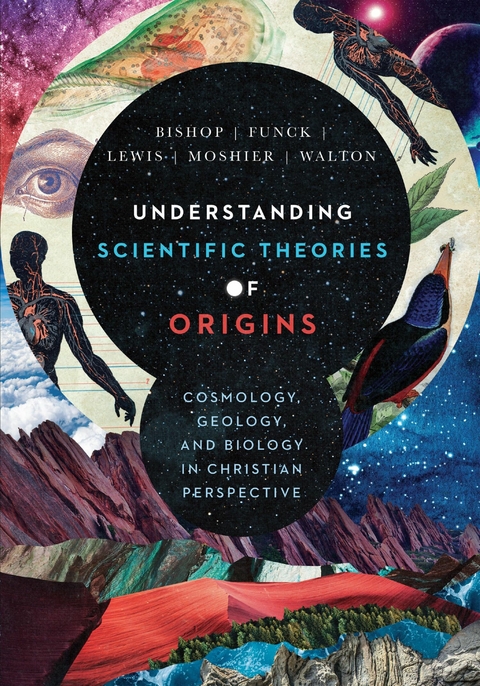
Understanding Scientific Theories of Origins (eBook)
688 Seiten
IVP Academic (Verlag)
978-0-8308-9164-1 (ISBN)
Robert C. Bishop (PhD, University of Texas) is associate professor of physics and philosophy and the John and Madeleine McIntyre Endowed Professor of Philosophy and History of Science at Wheaton College. His research interests include the physical and social sciences, particularly the implications of science and its assumptions for theories of mind, free will and consciousness. Bishop is the author of The Philosophy of the Social Science and co-editor of Between Chance and Choice: Interdisciplinary Perspectives on Determinism.Widely published in scientific and religious journals, Bishop is a member of the American Physical Society, the American Association for the Advancement of Science, the American Scientific Affiliation and the Philosophy of Science Association. He is also the area editor for philosophy of science at the Internet Encyclopedia of Philosophy.
John H. Walton (PhD, Hebrew Union College) is professor of Old Testament at Wheaton College and Graduate School. Previously he was professor of Old Testament at Moody Bible Institute in Chicago for twenty years. Some of Walton's books include The Lost World of Adam and Eve, The Lost World of Scripture, The Lost World of Genesis One, Ancient Near Eastern Thought and the Old Testament, The Essential Bible Companion, The NIV Application Commentary: Genesis, and The IVP Bible Background Commentary: Old Testament (with Victor Matthews and Mark Chavalas). Stephen O. Moshier (PhD, Louisiana State University) is professor of geology and chair of the geology and environmental science department at Wheaton College, where he also serves as the director of the Black Hills Science Station. Besides his work in academia, he has also practiced geology as an oil company explorationist, with much of his early research describing and interpreting oil reservoir rocks. More recently, his research efforts are in the field of geoarchaeology, participating in expeditions to the Sinai coast, Egypt, and Israel. Moshier has served as past president of the Geological Society of Kentucky and the Affiliation of Christian Geologists and currently serves on the Executive Council of the American Scientific Affiliation. Robert C. Bishop (PhD, University of Texas) is associate professor of physics and philosophy and the John and Madeleine McIntyre Endowed Professor of Philosophy and History of Science at Wheaton College. His research interests include the physical and social sciences, particularly the implications of science and its assumptions for theories of mind, free will and consciousness. Bishop is the author of The Philosophy of the Social Science and co-editor of Between Chance and Choice: Interdisciplinary Perspectives on Determinism.Widely published in scientific and religious journals, Bishop is a member of the American Physical Society, the American Association for the Advancement of Science, the American Scientific Affiliation and the Philosophy of Science Association. He is also the area editor for philosophy of science at the Internet Encyclopedia of Philosophy. Larry L. Funck (PhD, Lehigh University) is an emeritus professor at Wheaton College where he taught inorganic chemistry for over forty years. He continues to be engaged in Wheaton's chemistry department teaching the origin of life component in the Theories of Origins course. His reseach interests include transition metals, especially as they relate to bioinorganic model studies.Funck is a member of the American Chemical Society, the American Scientific Affiliation and the Midwest Association of Chemistry Teachers at Liberal Arts Colleges (MACTLAC). He was a Fulbright Fellow at the University of Lesotho and served as the chief reader for College Board's Advanced Placement chemistry program. Raymond J. Lewis (PhD, University of California, Santa Barbara) is associate professor of biology at Wheaton College. His research interests include genetics and physiology of marine algae, environmental ethics and botany. He has published articles in many scientific journals and is a member of the American Scientific Affiliation, the International Phycological Society, and the Botanical Society of America.
| Erscheint lt. Verlag | 4.12.2018 |
|---|---|
| Reihe/Serie | BioLogos Books on Science and Christianity |
| Zusatzinfo | 217 figures, 15 tables, 70 sidebars |
| Verlagsort | Lisle |
| Sprache | englisch |
| Themenwelt | Geisteswissenschaften ► Philosophie ► Erkenntnistheorie / Wissenschaftstheorie |
| Geisteswissenschaften ► Religion / Theologie | |
| Naturwissenschaften ► Biologie ► Evolution | |
| Schlagworte | Astronomy • Biblical • Big Bang • Biologos • Biology • Care • Chemistry • christian evolutio • Christian science textbook • concordism • Cosmology • Creation • creation care • earth • Education • Environment • Evolution • Evolutionary creation • Faith • Genesis • Geology • Human Evolution • human origins • Intelligent Design • Modern • Modern Science • Naturalism • Nature • Origins • origins textbook • physical anthropology • scholar • Science • science and christianity • science and faith • science and faith textbook • science education • Sciences • Science Textbook • scientific study • Solar System • Study • Textbook • theistic • Theistic evolution • Theology • theories of origins • theory of origins |
| ISBN-10 | 0-8308-9164-1 / 0830891641 |
| ISBN-13 | 978-0-8308-9164-1 / 9780830891641 |
| Informationen gemäß Produktsicherheitsverordnung (GPSR) | |
| Haben Sie eine Frage zum Produkt? |
 EPUB (Wasserzeichen)
DRM: Digitales Wasserzeichen
Dieses eBook enthält ein digitales Wasserzeichen und ist damit für Sie personalisiert. Bei einer missbräuchlichen Weitergabe des eBooks an Dritte ist eine Rückverfolgung an die Quelle möglich.
Dateiformat: EPUB (Electronic Publication)
EPUB ist ein offener Standard für eBooks und eignet sich besonders zur Darstellung von Belletristik und Sachbüchern. Der Fließtext wird dynamisch an die Display- und Schriftgröße angepasst. Auch für mobile Lesegeräte ist EPUB daher gut geeignet.
Systemvoraussetzungen:
PC/Mac: Mit einem PC oder Mac können Sie dieses eBook lesen. Sie benötigen dafür die kostenlose Software Adobe Digital Editions.
eReader: Dieses eBook kann mit (fast) allen eBook-Readern gelesen werden. Mit dem amazon-Kindle ist es aber nicht kompatibel.
Smartphone/Tablet: Egal ob Apple oder Android, dieses eBook können Sie lesen. Sie benötigen dafür eine kostenlose App.
Geräteliste und zusätzliche Hinweise
Buying eBooks from abroad
For tax law reasons we can sell eBooks just within Germany and Switzerland. Regrettably we cannot fulfill eBook-orders from other countries.
aus dem Bereich