Electrowetting (eBook)
350 Seiten
Wiley-VCH (Verlag)
978-3-527-41240-2 (ISBN)
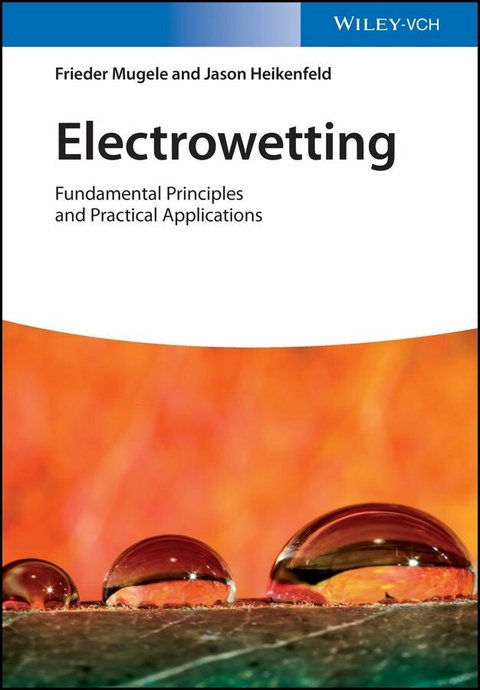
Written by two of the most knowledgeable experts in the field, the text covers both current as well as possible future applications, providing basic working principles of lab-on-a-chip devices and such optofluidic devices as adaptive lenses and optical switches. Furthermore, novel e-paper display technology, energy harvesting and supercapacitors as well as electrowetting in the nano-world are discussed. Finally, the book contains a series of exercises and questions for use in courses on microfluidics or electrowetting.
With its all-encompassing scope, this book will equally serve the growing community of students and academic and industrial researchers as both an introduction and a standard reference.
Frieder Mugele is the head of the Physics of Complex Fluids group at the University of Twente in Enschede, The Netherlands. Having obtained his academic degrees in physics at the University of Konstanz, Germany, he spent several years at the University of California in Berkeley, USA, and the University of Ulm, Germany, before his present appointment in Twente. Professor Mugele's research focuses on various aspects of solid-liquid interfaces and the properties of liquids on the micro- and nanoscale. He has been active in electrowetting since the late 1990s contributing in particular to the theoretical understanding and to fundamental concepts of electrowetting-driven microfluidics.
Jason Heikenfeld is a Professor and Assistant Vice President for Commercialization at the Univ. of Cincinnati. He directs the Novel Devices Laboratory which has established highly-focused international leadership roles in an emergent technological paradigms including electrowetting, electronic paper, and most recently sweat biosensing technology. Prof. Heikenfeld's research approach centers on discovering and addressing the hidden challenges that can hinder the transition of innovative science into commercial application. Professor Heikenfeld is also a prolific inventor and serial entrepreneur, and during his teaching years was the highest-rated STEM educator at the University of Cincinnati.
Frieder Mugele is the head of the Physics of Complex Fluids group at the University of Twente in Enschede, The Netherlands. Having obtained his academic degrees in physics at the University of Konstanz, Germany, he spent several years at the University of California in Berkeley, USA, and the University of Ulm, Germany, before his present appointment in Twente. Professor Mugele's research focuses on various aspects of solid-liquid interfaces and the properties of liquids on the micro- and nanoscale. He has been active in electrowetting since the late 1990s contributing in particular to the theoretical understanding and to fundamental concepts of electrowetting-driven microfluidics. Jason Heikenfeld is a Professor and Assistant Vice President for Commercialization at the Univ. of Cincinnati. He directs the Novel Devices Laboratory which has established highly-focused international leadership roles in an emergent technological paradigms including electrowetting, electronic paper, and most recently sweat biosensing technology. Prof. Heikenfeld's research approach centers on discovering and addressing the hidden challenges that can hinder the transition of innovative science into commercial application. Professor Heikenfeld is also a prolific inventor and serial entrepreneur, and during his teaching years was the highest-rated STEM educator at the University of Cincinnati.
1 A prelude on wetting
1.1 Homogeneous surfaces - Young-Laplace equation & Young-Dupré equation
1.2. Wetting in external fields - gravity & electric fields (leaky dielectric model)
1.3 Nano-scale wetting: effective interface potential
1.4 Wetting of heterogeneous surfaces - c.a. hysteresis & heterogeneity; Gibbs pinning criterion; metastability; Wenzel, Cassie-Baxter eq.,
1.5 Dynamic wetting
2 From electrocapillarity to electrowetting - a historic perspective
2.1 Lippmann's experiments; Lippmann equation in physical chemistry
2.2 Early applications (EC electrometer)
2.3 Early electrowetting (Frumkin)
3 Basic principles of modern electrowetting
3.1 Electrowetting on dielectric:
3.1.1 Derivation of EW equation
3.1.2 Effective surface tension picture
3.1.3 Origin of the minus sign
3.1.4 From Debye layer capacitance to dielectric layer: where is the energy (gain)?
3.1.5 AC vs. DC electrowetting
3.2 Microscopic picture
3.2.1 Local electric field & modified Laplace eq.
3.2.2 Consequences: diverging local fields
3.2.3 Reconciliation micro-macro
3.3 c.a. saturation: the big mystery of EW
4 Classical wetting phenomena controlled by electrowetting
4.1 Morphology transition on structured surfaces (wetting of fibers; EW of superhydrophobic surfaces)
4.2 Drop actuation by wettability gradients
4.3 Drop dynamics (oscillations, relaxation times, damped vs. overdamped)
4.4 Contact line dynamics (in air - in oil)
5 Numerical simulations of electrowetting (?)
6 Electrowetting materials
6.1 Insulators (dielectric breakdown; charge trapping; self-healing)
6.2 Liquids (small ions vs. large ions; colloidal stability; solubility (water in oil); surfactants)
7 Applications of EW
7.1 Lab-on-a-Chip devices
7.1.1 Classical device design & drop manipulation
7.1.2 Systems integration (bus architecture; programming)
7.1.3 Bio-challenges (surfactants; protein adsorption; cells)
7.1.4 Combined EW + detection (SPR, MALDI)
7.1.5 Electrowetting in two-phase flow microfluidics
7.2 Optoelectrowetting
7.2.1 Adaptive lenses
7.2.2 Autofocus systems
7.2.3 Beam stearing
7.2.4 Optical switches
7.2.5 Diffractive elements
7.2.6 Lens arrays
7.3 Electrowetting displays
7.3.1 Basics of display technology
7.3.2 The liquavista design
7.3.3 Cincinatti design
8 The future of EW
8.1 Novel applications
8.1.1 Reverse electrowetting: Energy harvesting systems
8.1.2 Reserve batteries & supercapacitor?
8.1.3 MALDI for EW
8.1.4 Reversible sponge
8.1.5 Mechanical actuators
8.2 Breaking the limits: nano EW; beyond c.a. hysteresis
| Erscheint lt. Verlag | 7.12.2018 |
|---|---|
| Sprache | englisch |
| Themenwelt | Naturwissenschaften ► Chemie |
| Schlagworte | Applications • BASIC • criterion • Dünne Schichten, Oberflächen u. Grenzflächen • dynamic • Electrical & Electronics Engineering • Electrical Engineering - Displays • electrocapillarity • Electrometer • Electrowetting • Elektrobenetzung • Elektronische Displays • Elektrotechnik u. Elektronik • Equation • frumkin • Historic • homogeneous • Lippmann • Materials Science • Materialwissenschaften • Modern • Optics & Photonics • Optik u. Photonik • Perspective • Physical Chemistry • Physics • Physik • prelude • Principles • Surfaces • Thin Films, Surfaces & Interfaces • Wetting • younglaplace |
| ISBN-10 | 3-527-41240-9 / 3527412409 |
| ISBN-13 | 978-3-527-41240-2 / 9783527412402 |
| Informationen gemäß Produktsicherheitsverordnung (GPSR) | |
| Haben Sie eine Frage zum Produkt? |
 PDF (Adobe DRM)
Kopierschutz: Adobe-DRM
Adobe-DRM ist ein Kopierschutz, der das eBook vor Mißbrauch schützen soll. Dabei wird das eBook bereits beim Download auf Ihre persönliche Adobe-ID autorisiert. Lesen können Sie das eBook dann nur auf den Geräten, welche ebenfalls auf Ihre Adobe-ID registriert sind.
Details zum Adobe-DRM
Dateiformat: PDF (Portable Document Format)
Mit einem festen Seitenlayout eignet sich die PDF besonders für Fachbücher mit Spalten, Tabellen und Abbildungen. Eine PDF kann auf fast allen Geräten angezeigt werden, ist aber für kleine Displays (Smartphone, eReader) nur eingeschränkt geeignet.
Systemvoraussetzungen:
PC/Mac: Mit einem PC oder Mac können Sie dieses eBook lesen. Sie benötigen eine
eReader: Dieses eBook kann mit (fast) allen eBook-Readern gelesen werden. Mit dem amazon-Kindle ist es aber nicht kompatibel.
Smartphone/Tablet: Egal ob Apple oder Android, dieses eBook können Sie lesen. Sie benötigen eine
Geräteliste und zusätzliche Hinweise
Buying eBooks from abroad
For tax law reasons we can sell eBooks just within Germany and Switzerland. Regrettably we cannot fulfill eBook-orders from other countries.
aus dem Bereich