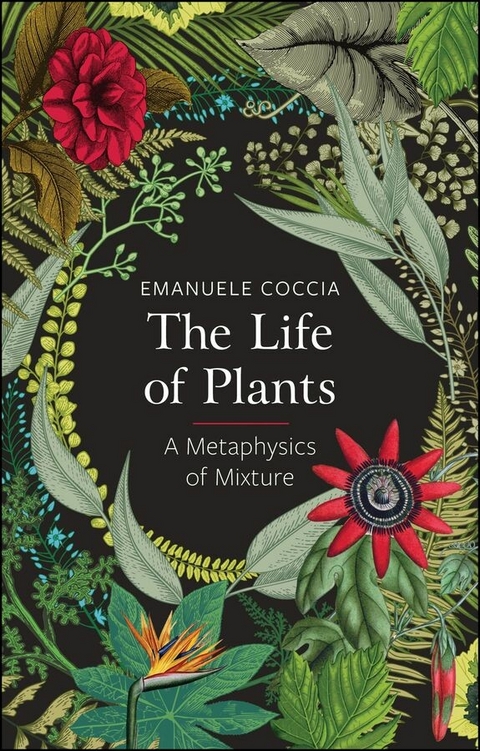
We barely talk about them and seldom know their names. Philosophy has always overlooked them; even biology considers them as mere decoration on the tree of life. And yet plants give life to the Earth: they produce the atmosphere that surrounds us, they are the origin of the oxygen that animates us. Plants embody the most direct, elementary connection that life can establish with the world.
In this highly original book, Emanuele Coccia argues that, as the very creator of atmosphere, plants occupy the fundamental position from which we should analyze all elements of life. From this standpoint, we can no longer perceive the world as a simple collection of objects or as a universal space containing all things, but as the site of a veritable metaphysical mixture. Since our atmosphere is rendered possible through plants alone, life only perpetuates itself through the very circle of consumption undertaken by plants. In other words, life exists only insofar as it consumes other life, removing any moral or ethical considerations from the equation. In contrast to trends of thought that discuss nature and the cosmos in general terms, Coccia's account brings the infinitely small together with the infinitely big, offering a radical redefinition of the place of humanity within the realm of life.
Emanuele Coccia is Associate Professor at the École des Hautes Études en Sciences Sociales (EHESS), Paris.
We barely talk about them and seldom know their names. Philosophy has always overlooked them; even biology considers them as mere decoration on the tree of life. And yet plants give life to the Earth: they produce the atmosphere that surrounds us, they are the origin of the oxygen that animates us. Plants embody the most direct, elementary connection that life can establish with the world. In this highly original book, Emanuele Coccia argues that, as the very creator of atmosphere, plants occupy the fundamental position from which we should analyze all elements of life. From this standpoint, we can no longer perceive the world as a simple collection of objects or as a universal space containing all things, but as the site of a veritable metaphysical mixture. Since our atmosphere is rendered possible through plants alone, life only perpetuates itself through the very circle of consumption undertaken by plants. In other words, life exists only insofar as it consumes other life, removing any moral or ethical considerations from the equation. In contrast to trends of thought that discuss nature and the cosmos in general terms, Coccia s account brings the infinitely small together with the infinitely big, offering a radical redefinition of the place of humanity within the realm of life.
Emanuele Coccia is Associate Professor at the École des Hautes Études en Sciences Sociales (EHESS), Paris.
Acknowledgments ix
Author's Preface xi
I Prologue
1 On Plants, or the Origin of Our World 3
2 The Extension of the Domain of Life 7
3 On Plants, or the Life of the Spirit 12
4 Toward a Philosophy of Nature 17
II Leaf Theory: The Atmosphere of the World
5 Leaves 25
6 Tiktaalik roseae 29
7 In Open Air: Ontology of the Atmosphere 35
8 The Breath of the World 54
9 Everything Is in Everything 66
III Theory of the Root: The Life of the Stars
10 Roots 77
11 The Deepest Are the Stars 86
IV Theory of the Flower: The Reason of Forms
12 Flowers 99
13 Reason Is Sex 105
V Epilogue
14 On Speculative Autotrophy 113
15 Like an Atmosphere 119
Notes 123
"Back to animals! Back to mushrooms! And now back to plants! It is with plants that this marvellous, witty, and immensely literate book wants us, the human readers, to get acquainted again. And, of course, with plants it is actually toward the sun that we are reoriented. Philosophy is on the move again, not exactly forward but downward, giving a completely different meaning to what counts as a foundation to thought."
Bruno Latour
"The view of life as interdependence is a particularly affecting and relevant way to think about living and coping in the Anthropocene, when the ways that humans affect the literal composition of the atmosphere has become the existential question of our time."
The Nation
1
On Plants, or the Origin of Our World
We barely speak of them and their name escapes us. Philosophy has always overlooked them, more out of contempt than out of neglect.1 They are the cosmic ornament, the inessential and multicolored accident that reigns in the margins of the cognitive field. The contemporary metropolis views them as superfluous trinkets of urban decoration. Outside the city walls, they are hosts—weeds—or objects of mass production. Plants are the always open wound of the metaphysical snobbery that defines our culture. The return of the repressed, of which we must rid ourselves in order to consider ourselves as “different”: rational humans, spiritual beings. They are the cosmic tumor of humanism, the waste that the absolute spirit can’t quite manage to eliminate. The life sciences have neglected them, too.* “Current biology, conceived of on the basis of our knowledge of animals, pays no attention to plants”—“the standard evolutionary literature is zoocentric.”2 And biology manuals approach plants “in bad faith,” “as decorations on the tree of life, rather than as the forms that have allowed the tree itself to survive and grow.”3
The problem is not just one of epistemological deficiency: “as animals, we identify much more immediately with other animals than with plants.”4 In this spirit, scientists, radical ecology, and civil society have fought for decades for the liberation of animals;5 and affirming the separation between human and animal (the anthropological machine of which philosophy speaks)6 has become commonplace in the intellectual world. By contrast, it seems that no one ever wanted to question the superiority of animal life over plant life and the rights of life and death of the former over those of the latter. A form of life without personality and without dignity, it does not seem to deserve any spontaneous empathy, or the exercise of a moralism that higher living beings are capable of eliciting.7 Our animal chauvinism8 refuses to go beyond “an animal language that does not lend itself to a relation to plant truth.”9 In a sense, antispecies animalism is just another form of anthropocentrism and a kind of internalized Darwinism: it extends human narcissism to the animal realm.
Plants are untouched by this prolonged negligence: they affect a sovereign indifference toward the human world, the culture of civilizations, the succession of domains and ages. Plants seem absent, as though lost in a long, deaf, chemical dream. They don’t have senses, but they are far from being shut in on themselves: no other being adheres to the world that surrounds it more than plants do. They don’t have the eyes or ears that may have allowed them to distinguish the forms of the world and to multiply its image through the iridescence of colors and sounds that we give it.10 They participate in the world in its totality in everything they meet. Plants do not run, they cannot fly; they are not capable of privileging a specific place in relation to the rest of space, they have to remain where they are. Space, for them, does not crumble into a heterogeneous chessboard of geographical difference; the world is condensed into the portion of ground and sky they occupy. Unlike most higher animals, they have no selective relation to what surrounds them: they are, and cannot be other than, constantly exposed to the world around them. Plant life is life as complete exposure, in absolute continuity and total communion with the environment. It is for the sake of adhering as much as possible to the world that they develop a body that privileges surface over volume: “In plants, the very high proportion of surface to volume is one of the most characteristic traits. It is through this vast surface, literally spread in the environment, that plants absorb from the space the diffuse resources that are necessary to their growth.”11 Their absence of movement is nothing but the reverse of their complete adhesion to what happens to them and their environment. One cannot separate the plant—neither physically nor metaphysically—from the world that accommodates it. It is the most intense, radical, and paradigmatic form of being in the world. To interrogate plants means to understand what it means to be in the world. Plants embody the most direct and elementary connection that life can establish with the world. The opposite is equally true: the plant is the purest observer when it comes to contemplating the world in its totality. Under the sun or under the clouds, mixing with water and wind, their life is an endless cosmic contemplation, one that does not distinguish between objects and substances—or, to put differently, one that accepts all their nuances to the point of melting with the world, to the point of coinciding with its very substance. We will never be able to understand a plant unless we have understood what the world is.
Notes
* Translator’s note: Unless otherwise specified, all the translations of quotations (French or otherwise) have been made by the book’s translator, Dylan J. Montanari, from Coccia’s French original. Material in square brackets has also been added by the translator. 1. The only great exception in modernity is the masterpiece by Gustav Theodor Fechner, Nanna oder über das Seelenleben der Pflanzen (Leipzig: Leopold Voss, 1848). Against this great silence, the voice of a small number of researchers and intellectuals has begun to rise, so much so that one hears talk of a “plant turn.” See Elaine P. Miller, The Vegetative Soul: From Philosophy of Nature to Subjectivity in the Feminine (Albany: SUNY Press, 2002); Matthew Hall, Plants as Persons: A Philosophical Botany (Albany: SUNY Press, 2011); Eduardo Kohn, How Forests Think: Toward an Anthropology of the Human (Berkeley: University of California Press, 2013); Michael Marder, Plant Thinking: A Philosophy of Vegetal Life (New York: Columbia University Press, 2013); Michael Marder, The Philosopher’s Plant: An Intellectual Herbarium (New York: Columbia University Press, 2014); and Jeffrey Nealon, Plant Theory: Biopower and Vegetable Life (New York: Columbia University Press, 2015). With a few exceptions (more or less), this literature insists on finding the truth about plants in purely philosophical or anthropological research, without having any truck with contemporary botanical thought—which, on the contrary, has produced remarkable masterpieces in the philosophy of nature. Here are only those that have influenced me most: Agnes Arber, The Natural Philosophy of Plant Form (Cambridge: Cambridge University Press, 1950); David Beerling, The Emerald Planet: How Plants Changed Earth’s History (Oxford: Oxford University Press, 2007); Daniel Chamovitz, What a Plant Knows: A Field Guide to the Senses (New York: Scientific American / Farrar, Straus & Giroux, 2012); Edred John Henry Corner, The Life of Plants (Cleveland: World, 1964); Karl J. Niklas, Plant Evolution: An Introduction to the History of Life (Chicago: University of Chicago Press, 2016); Sergio Stefano Tonzig, Letture di biologia vegetale (Milan: Mondadori, 1975); François Hallé, Éloge de la plante: Pour la nouvelle biologie (Paris: Seuil, 1999); Stefano Mancuso and Alessandra Viola, Verde brillante: Sensibilità e intelligenza nel mondo vegetale (Florence: Giunti, 2013). Attention to plants is also central in contemporary American anthropology, starting with Anna Lowenhaupt Tsing’s masterpiece The Mushroom at the End of the World: On the Possibility of Life in Capitalist Ruins (Princeton: Princeton University Press, 2015), which is indeed centered around a mushroom, and with the works of Natasha Myers, who is also preparing a book on the subject. See especially Natasha Myers and Carla Hustak, “Involutionary Momentum: Affective Ecologies and the Sciences of Plant/Insect Encounters,” Differences: A Journal of Feminist Cultural Studies, 23.3 (2012): 74–117. 2. François Hallé, Éloge de la plante: Pour une nouvelle biologie (Paris: Seuil, 1999), p. 321. Along with Niklas, Hallé is a botanist who has made the great effort to transform the contemplation of the life of plants into a properly metaphysical object of study. 3. Niklas, Plant Evolution, p. viii. 4. W. Marshall Darley, “The Essence of Plantness,” American Biology Teacher, 52.6 (1990): 354–7, here p. 356. 5. Among the most famous examples, see Peter Singer, Animal Liberation: A New Ethics for Our Treatment of Animals (New York: HarperCollins, 1975) [reissued several times], and Jonathan Safran Foer, Eating Animals (New York: Little, Brown, 2009). But the debate is very old: see the two great works of antiquity, one by Plutarch, On the Intelligence of Animals [De sollertia animalium], the other by Porphyry, On Abstinence from Killing Animals [De abstinentia]. On the history of the debate, see Renan Larue, Le Végétarisme et ses ennemis: Vingtcinq siècles de débates (Paris: PUF, 2015). The debate over animals, which is strongly marked by an extremely superficial moralism, seems to forget that heterotrophy presupposes the killing of other living beings as a natural and necessary dimension of...
| Erscheint lt. Verlag | 5.12.2018 |
|---|---|
| Sprache | englisch |
| Themenwelt | Geisteswissenschaften ► Philosophie ► Allgemeines / Lexika |
| Naturwissenschaften ► Biologie ► Botanik | |
| Naturwissenschaften ► Biologie ► Ökologie / Naturschutz | |
| Schlagworte | Atmosphere • Continental Philosophy • Ecology • Environmental Studies • Environmental Studies Special Topics • Kontinentalphilosophie • Metaphysik • Nature • Philosophie • Philosophy • Philosophy Special Topics • Spezialthemen Philosophie • Spezialthemen Umweltforschung • Umweltforschung |
| ISBN-13 | 9781509531554 / 9781509531554 |
| Informationen gemäß Produktsicherheitsverordnung (GPSR) | |
| Haben Sie eine Frage zum Produkt? |
 EPUB (Adobe DRM)
Kopierschutz: Adobe-DRM
Adobe-DRM ist ein Kopierschutz, der das eBook vor Mißbrauch schützen soll. Dabei wird das eBook bereits beim Download auf Ihre persönliche Adobe-ID autorisiert. Lesen können Sie das eBook dann nur auf den Geräten, welche ebenfalls auf Ihre Adobe-ID registriert sind.
Details zum Adobe-DRM
Dateiformat: EPUB (Electronic Publication)
EPUB ist ein offener Standard für eBooks und eignet sich besonders zur Darstellung von Belletristik und Sachbüchern. Der Fließtext wird dynamisch an die Display- und Schriftgröße angepasst. Auch für mobile Lesegeräte ist EPUB daher gut geeignet.
Systemvoraussetzungen:
PC/Mac: Mit einem PC oder Mac können Sie dieses eBook lesen. Sie benötigen eine
eReader: Dieses eBook kann mit (fast) allen eBook-Readern gelesen werden. Mit dem amazon-Kindle ist es aber nicht kompatibel.
Smartphone/Tablet: Egal ob Apple oder Android, dieses eBook können Sie lesen. Sie benötigen eine
Geräteliste und zusätzliche Hinweise
Buying eBooks from abroad
For tax law reasons we can sell eBooks just within Germany and Switzerland. Regrettably we cannot fulfill eBook-orders from other countries.
aus dem Bereich