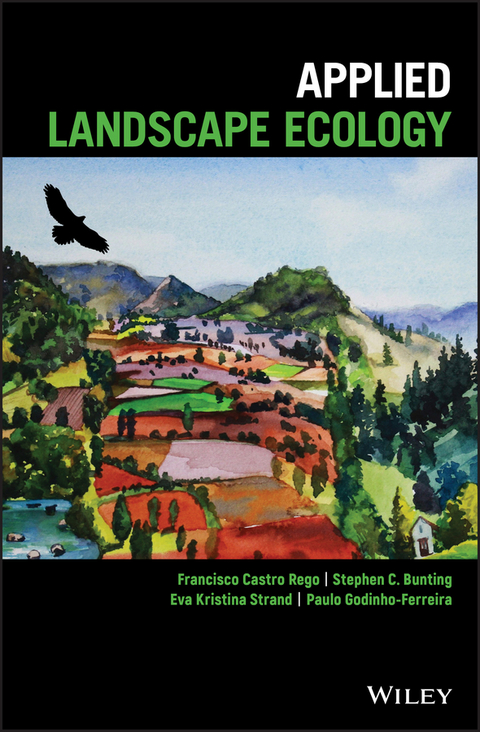
Applied Landscape Ecology (eBook)
John Wiley & Sons (Verlag)
978-1-119-36822-9 (ISBN)
An insightful guide to the concepts and practices of modern landscape ecology
Elements of geography, conservation biology, soil science and other disciplines factor into landscape ecology's rich analyses of the ecological and environmental forces at play across different terrains. With its unique, organism-oriented approach to the subject, Applied Landscape Ecology considers the effects of ecological processes upon particular species and places its findings within the context of larger-scale concerns. Students, researchers, and practitioners alike will find this a rewarding and instructive read that offers practical and detailed information on the latest methods and technologies used in the field today.
This essential resource:
- Takes an interdisciplinary approach to landscape ecology
- Examines the subject within the contexts of specific organisms
- Covers cutting-edge technologies and methods
- Represents a collaboration between an international team of landscape ecology experts
Whether new to the practice or an established ecologist, anyone with an interest in this exciting and developing field should have a copy of Applied Landscape Ecology at their disposal.
Francisco Castro Rego, Professor of Landscape Ecology, Centre for Applied Ecology 'Prof. Baeta Neves', InBio and School of Agriculture, University of Lisbon, Lisbon, Portugal
Stephen C. Bunting, Emeritus Professor of Landscape and Rangeland Ecology, College of Natural Resources, University of Idaho, Moscow, ID, USA
Eva Kristina Strand, Professor of Landscape Ecology, College of Natural Resources, University of Idaho, Moscow, ID, USA
Paulo Godinho-Ferreira, Senior Researcher of Landscape Ecology, Centre for Applied Ecology 'Prof. Baeta Neves', InBio and Institute for Agrarian and Veterinarian Research, Lisbon, Portugal
Francisco Castro Rego, Professor of Landscape Ecology, Centre for Applied Ecology "Prof. Baeta Neves", InBio and School of Agriculture, University of Lisbon, Lisbon, Portugal. Stephen C. Bunting, Emeritus Professor of Landscape and Rangeland Ecology, College of Natural Resources, University of Idaho, Moscow, ID, USA. Eva Kristina Strand, Professor of Landscape Ecology, College of Natural Resources, University of Idaho, Moscow, ID, USA. Paulo Godinho-Ferreira, Senior Researcher of Landscape Ecology, Centre for Applied Ecology "Prof. Baeta Neves", InBio and Institute for Agrarian and Veterinarian Research, Lisbon, Portugal.
1
Concepts and Approaches in Landscape Ecology
1.1 The Historical Development of Landscape Ecology as a Science
Ecology as a written science probably has its known beginnings in ancient Greece with Aristotle and particularly with his successor, Theophrastus, who was one of the first philosophers to study “the relationships between the organisms and their environment”. This definition of the term Ecology that was first used two millennia later by the German zoologist Ernst Haeckel, who, in 1866, associated the Greek words Oikos (house) and Logos (science) (Figure 1.1).
Figure 1.1 The Greek philosopher Theophrastus (371–287 BC) (left) and the German ecologist Ernst Haeckel (1834–1919 AC) (right).
Source: https://upload.wikimedia.org/wikipedia/commons/3/38/Theophrastus._Line_engraving._Wellcome_V0005785.jpg, https://upload.wikimedia.org/wikipedia/commons/2/2f/Ernst _Haeckel_2.jpg (3 December 2017).
Haeckel further expanded the definition of Ecology in his writings in 18691: “By ecology we mean the body of knowledge concerning the economy of nature, the investigation of the total relations of the animal both to its inorganic and to its organic environment; including above all, its friendly and inimical relations with those animals and plants with which it comes directly or indirectly into contact.”
Other subdisciplines of ecology focus on the study of the distribution and abundance of individuals of the same species (population ecology)2, on the interaction between populations (community ecology)3, or, especially after the very influential book published in 1953 by Eugene Odum4, on the study of ecosystems (systems ecology). Ecology has expanded from populations to communities and ecosystems, and more recently to landscape scales.
The English word “landscape” first appeared in the late sixteenth century when the term landschap was introduced by Dutch painters who used it to refer to paintings whose primary subject matter was natural scenery, associating the word “land” (of Germanic origin) and the suffix “schaft” or “scape”, meaning shape5 (Figure 1.2).
Figure 1.2 Landscape painting of Richmond castle (1639) by the Dutch landscape painter Alexander Keirincx (1600–1652).
Source: Yale Center for British Art, Paul Mellon Collection: Netherlandish Painters Active in Britain in the Sixteenth and Seventeenth Centuries, http://ezine.codart.nl/17/issue/46/artikel/netherlandish‐painters‐active‐in‐britain‐in‐the‐16th‐and‐17th‐centuries/?id=191 (17 February 2017).
In the seventeenth and eighteenth centuries, “landscape” continued to be associated with paintings, but a new meaning of the term developed when Alexander von Humboldt (1769–1857) started the new science of plant geography. Humboldt explored the visual qualities of painted landscapes transforming the concept of landscape from its primary visual meaning into an abstract entity by finding its ecological unity6 (Figure 1.3). The concept of landscape was moving from art to ecological science.
Figure 1.3 Painting of the German naturalist Alexander von Humboldt (1769–1859) (left) and photo of the German geographer Carl Troll (1899–1975) (right). https://en.wikipedia.org/wiki/Alexander_von_Humboldt#/media/File:Alexandre_humboldt.jpg, https://de.wikipedia.org/wiki/Carl_Troll (17 February 2017).
Source: Portrait of Alexander von Humboldt by Friedrich Georg Weitsch, 1806,
Following the work of Humboldt, it was another German geographer, Carl Troll, who first coined in 19397 the term “landscape ecology” hoping that a new science could be developed that integrated the spatial approach of geographers and the functional approach of ecologists (Figure 1.3).
However, the science of landscape ecology would be one of the latest forms of ecology to develop. It was not until the 1980s that the concept was more widely developed and works on landscape ecology started to be produced in Europe and in North America with the books by Vink (1983)8, Naveh and Lieberman (1984)9, and Forman and Godron (1986)10. After the publication of this latter book, which is now considered to be a main foundation of this science, references to landscape ecology started to become common in scientific literature and further developed after the beginning of the publication of the scientific journal of Landscape Ecology in 1987.
After that initial period, landscape ecology studies also became common in other basic and applied ecological journals. The development of landscape ecology was rapid and several important books were produced after the 1980s. In 1995 Forman published his comprehensive award‐winning book Land Mosaics: The Ecology of Landscapes and Regions11 (Figure 1.4).
Figure 1.4 The USA scientist Richard Forman (born 1935) with two of his fundamental books in Landscape Ecology.
Source: Harvard University, Graduate School of Design, http://www.gsd.harvard.edu/person/richard‐t‐t‐forman/ (2 May 2017).
Since 1995 several other books have been published by various authors in both Europe and North America, as in the Netherlands by Zonneveld (1995)12, in Italy by Farina (1998)13 and by Ingegnoli (2002)14, in France by Burel and Baudry (1999)15, in the United States by Turner, Gardner, and O´Neill (2001)16, by Coulson and Tchakerian (2010)17, and by Forman, again, with others, on Road Ecology: Science and Solutions (2003)18 and on Urban Ecology: Science of Cities (2014)19.
Also, many edited books with applications of landscape ecology analyses were published since the late 1980s, such as those by Turner (1987)20, Turner and Gardner (1991)21, Bissonette (1997)22, Klopatek and Gardner (1999)23, Sanderson and Harris (2000)24, Wiens, Moss, Turner, and Mladenoff (2006)25, Wu and Hobbs (2007)26, McKenzie, Miller, and Falk (2011)27, and Perera, Drew, and Johnson (2012)28.
Landscape ecology was definitely settled as a new science and several books were published on the corresponding quantitative methods, as that in the Netherlands by Jongman, ter Brak, and van Tongeren (1995)29 on data analysis in community and landscape ecology. A major development of analytical methods used in landscape ecology came in 1995 with the release of the FRAGSTATS software in association with the publication of a very useful USDA Forest Service General Technical Report by McGarigal and Marks30. Due to its popularity the program has been updated and recently upgraded to accommodate ArcGIS10 (version 3.4) and it has been central to other books for quantifying and measuring landscape characteristics, such as that of Leitão, Miller, Ahern, and McGarigal (2006)31. From this perspective, it is also important to recognize the book edited by Gergel and Turner (2002)32 covering many of the quantitative methods in landscape ecology.
During the last decades the science of landscape ecology developed with input from new technologies (Figure 1.5) and contributions from many other disciplines such as geology, soil science, plant ecology, wildlife ecology, conservation biology, genetics, human ecology, urban ecology, and landscape architecture. In addition, landscape ecology was enhanced by the rapid advancement of computer sciences, remote sensing, geographic information system technologies, and landscape modeling. Remote sensing images obtained from satellite platforms displaying features of the Earth’s surface first became available in the latter half of the twentieth century. Finally, landscape ecologists were able to view landscape patterns over large land areas and it became increasingly feasible to quantify change in both spatial and temporal dimensions. Currently the landscape ecology perspective is essential in addressing broad‐scale complex issues such as those associated with global change.
For example, the Landsat satellites have been collecting multispectral images at 15–80 m resolution since the 1970s at a 16‐day interval and the moderate‐resolution imaging spectroradiometers (MODISs) have been collecting 250–1000 m resolution images every 1–2 days since 2002. Technological advancement has also been made in data collection at very fine spatial scales. Light detection and ranging (LiDAR) is a technique with the ability to map objects in three dimensions by measuring the time it takes for a laser signal to travel from the sensor to the object and back to the sensor. Sensors mounted on unmanned aircraft systems (UASs) can provide images with subcentimeter resolutions.
Figure 1.5 The top image is a LiDAR acquisition of hundreds of conifer trees. The lower left image shows the branching structure of a tree and the lower right image is a synoptic view of one complete 360 degree scan of a mixed conifer forest near Moscow, Idaho, USA. The images were taken with a Leica green terrestrial laser scanner. Colors correspond to the relative return intensity of the LiDAR instrument, with greens and yellows showing...
| Erscheint lt. Verlag | 26.11.2018 |
|---|---|
| Sprache | englisch |
| Themenwelt | Naturwissenschaften ► Biologie ► Ökologie / Naturschutz |
| Schlagworte | Angewandte Ökologie • Applied Ecology • Aquatic landscapes • Biowissenschaften • composition of landscapes • Concepts of landscape ecology • Conservation Science • distance methods • diversity of habitats and landscapes</p> • Diversity of species and habitats • Ecological corridors and greenways • fractal dimension • Fragmentation • fundamentals of landscape ecology • habitat selection • Interior and core areas • Island biogeography and metapopulations • Landscape composition and structure • Landscape configuration and complexity • Landscape disturbance and equilibrium • Landscape Dynamics • landscape ecology • Landscape elements • landscape management • landscape metrics • Landscape spatial pattern • Life Sciences • linear features and corridors in the landscape • Linear networks and connectivity • <p>History of landscape ecology • Methods & Statistics in Ecology • movements through landscapes • Movements through landscapes and percolation theory • Naturschutzbiologie • Ökologie / Methoden, Statistik • Patch edge and shape • Quadrat methods • the history of landscape ecology • Transition matrix model and Markov chains • understanding applied landscape ecology • vertical dimensions of landscapes • Vertical structure of vegetation |
| ISBN-10 | 1-119-36822-7 / 1119368227 |
| ISBN-13 | 978-1-119-36822-9 / 9781119368229 |
| Informationen gemäß Produktsicherheitsverordnung (GPSR) | |
| Haben Sie eine Frage zum Produkt? |
 EPUB (Adobe DRM)
Kopierschutz: Adobe-DRM
Adobe-DRM ist ein Kopierschutz, der das eBook vor Mißbrauch schützen soll. Dabei wird das eBook bereits beim Download auf Ihre persönliche Adobe-ID autorisiert. Lesen können Sie das eBook dann nur auf den Geräten, welche ebenfalls auf Ihre Adobe-ID registriert sind.
Details zum Adobe-DRM
Dateiformat: EPUB (Electronic Publication)
EPUB ist ein offener Standard für eBooks und eignet sich besonders zur Darstellung von Belletristik und Sachbüchern. Der Fließtext wird dynamisch an die Display- und Schriftgröße angepasst. Auch für mobile Lesegeräte ist EPUB daher gut geeignet.
Systemvoraussetzungen:
PC/Mac: Mit einem PC oder Mac können Sie dieses eBook lesen. Sie benötigen eine
eReader: Dieses eBook kann mit (fast) allen eBook-Readern gelesen werden. Mit dem amazon-Kindle ist es aber nicht kompatibel.
Smartphone/Tablet: Egal ob Apple oder Android, dieses eBook können Sie lesen. Sie benötigen eine
Geräteliste und zusätzliche Hinweise
Buying eBooks from abroad
For tax law reasons we can sell eBooks just within Germany and Switzerland. Regrettably we cannot fulfill eBook-orders from other countries.
aus dem Bereich