


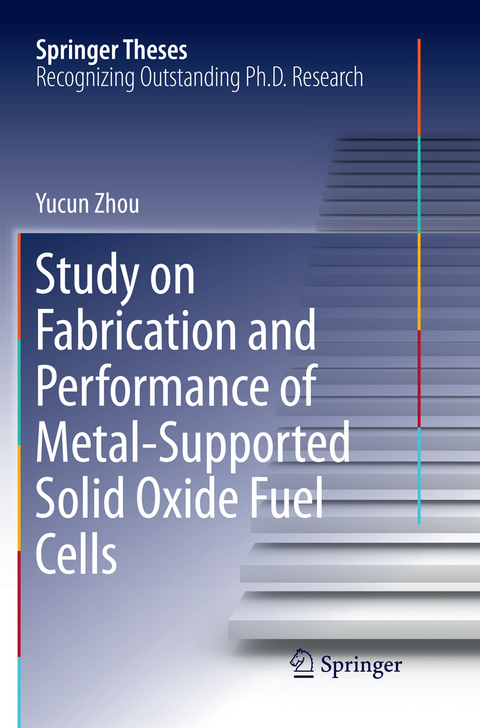
Study on Fabrication and Performance of Metal-Supported Solid Oxide Fuel Cells
Seiten
2018
|
Softcover reprint of the original 1st ed. 2018
Springer Verlag, Singapore
978-981-13-4916-4 (ISBN)
Springer Verlag, Singapore
978-981-13-4916-4 (ISBN)
By optimizing the electrode materials, preparation process for the fuel cells, and nano-micro structure of the electrode, the resulting MS-SOFCs demonstrated (1) great output power densities at low temperatures, e.g., 1.02 W cm-2 at 600°C, when operating in humidified hydrogen fuels and air oxidants;
This book highlights the development of novel metal-supported solid oxide fuel cells (MS-SOFCs). It describes the metal-supported solid oxide fuel cells (MS-SOFCs) that consist of a microporous stainless steel support, nanoporous electrode composites and a thin ceramic electrolyte using the “tape casting-sintering-infiltrating” method. Further, it investigates the reaction kinetics of the fuel cells’ electrodes, structure–performance relationship and degradation mechanism. By optimizing the electrode materials, preparation process for the fuel cells, and nano-micro structure of the electrode, the resulting MS-SOFCs demonstrated (1) great output power densities at low temperatures, e.g., 1.02 W cm-2 at 600°C, when operating in humidified hydrogen fuels and air oxidants; (2) excellent long-term stability, e.g., a degradation rate of 1.3% kh-1 when measured at 650°C and 0.9 A cm-2 for 1500 h. The design presented offers a promising pathway for the development of low-cost, high power-density and long-term-stable SOFCs for energy conversion.
This book highlights the development of novel metal-supported solid oxide fuel cells (MS-SOFCs). It describes the metal-supported solid oxide fuel cells (MS-SOFCs) that consist of a microporous stainless steel support, nanoporous electrode composites and a thin ceramic electrolyte using the “tape casting-sintering-infiltrating” method. Further, it investigates the reaction kinetics of the fuel cells’ electrodes, structure–performance relationship and degradation mechanism. By optimizing the electrode materials, preparation process for the fuel cells, and nano-micro structure of the electrode, the resulting MS-SOFCs demonstrated (1) great output power densities at low temperatures, e.g., 1.02 W cm-2 at 600°C, when operating in humidified hydrogen fuels and air oxidants; (2) excellent long-term stability, e.g., a degradation rate of 1.3% kh-1 when measured at 650°C and 0.9 A cm-2 for 1500 h. The design presented offers a promising pathway for the development of low-cost, high power-density and long-term-stable SOFCs for energy conversion.
Research Background.- Fabrication and investigation of intermediate-temperature MS-SOFCs.- Fabrication and investigation of low-temperature MS-SOFCs.- Fabrication and investigation of MS-SOFCs with a symmetrical configuration.- Summary and Outlook.
| Erscheinungsdatum | 19.12.2018 |
|---|---|
| Reihe/Serie | Springer Theses |
| Zusatzinfo | 90 Illustrations, black and white; XII, 93 p. 90 illus. |
| Verlagsort | Singapore |
| Sprache | englisch |
| Maße | 155 x 235 mm |
| Themenwelt | Naturwissenschaften ► Chemie ► Physikalische Chemie |
| Technik ► Elektrotechnik / Energietechnik | |
| Technik ► Maschinenbau | |
| Schlagworte | Micro-porous stainless steel support • Nano-porous electrode composites • Nanostructured Electrodes • Solid Oxide Fuel Cells • Thin ceramic electrolyte |
| ISBN-10 | 981-13-4916-9 / 9811349169 |
| ISBN-13 | 978-981-13-4916-4 / 9789811349164 |
| Zustand | Neuware |
| Informationen gemäß Produktsicherheitsverordnung (GPSR) | |
| Haben Sie eine Frage zum Produkt? |
Mehr entdecken
aus dem Bereich


aus dem Bereich
Quantenmechanik | Spektroskopie | Statistische Thermodynamik
Buch | Softcover (2024)
De Gruyter (Verlag)
CHF 83,90
200 Aufgaben zum sicheren Umgang mit Quellen ionisierender Strahlung
Buch | Hardcover (2023)
Hanser, Carl (Verlag)
CHF 48,95


