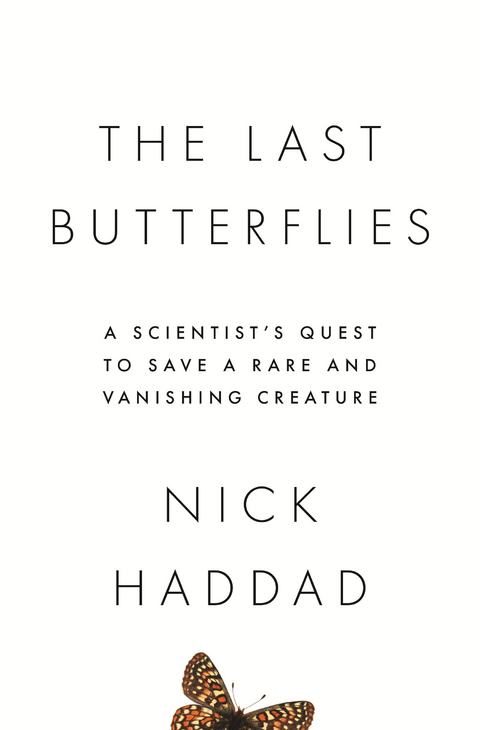
The Last Butterflies (eBook)
Princeton University Press (Verlag)
978-0-691-18962-8 (ISBN)

Nick Haddad is a professor and senior terrestrial ecologist in the Department of Integrative Biology and the W. K. Kellogg Biological Station at Michigan State University. He lives in Kalamazoo, Michigan. Twitter @nickmhaddad
A remarkable look at the rarest butterflies, how global changes threaten their existence, and how we can bring them back from near-extinctionMost of us have heard of such popular butterflies as the Monarch or Painted Lady. But what about the Fender's Blue? Or the St. Francis' Satyr? Because of their extreme rarity, these butterflies are not well-known, yet they are remarkable species with important lessons to teach us. The Last Butterflies spotlights the rarest of these creatures-some numbering no more than what can be held in one hand. Drawing from his own first-hand experiences, Nick Haddad explores the challenges of tracking these vanishing butterflies, why they are disappearing, and why they are worth saving. He also provides startling insights into the effects of human activity and environmental change on the planet's biodiversity.Weaving a vivid and personal narrative with ideas from ecology and conservation, Haddad illustrates the race against time to reverse the decline of six butterfly species. Many scientists mistakenly assume we fully understand butterflies' natural histories. Yet, as with the Large Blue in England, we too often know too little and the conservation consequences are dire. Haddad argues that a hands-off approach is not effective and that in many instances, like for the Fender's Blue and Bay Checkerspot, active and aggressive management is necessary. With deliberate conservation, rare butterflies can coexist with people, inhabit urban fringes, and, in the case of the St. Francis' Satyr, even reside on bomb ranges and military land. Haddad shows that through the efforts to protect and restore butterflies, we might learn how to successfully confront conservation issues for all animals and plants.A moving account of extinction, recovery, and hope, The Last Butterflies demonstrates the great value of these beautiful insects to science, conservation, and people.
Nick Haddad is a professor and senior terrestrial ecologist in the Department of Integrative Biology and the W. K. Kellogg Biological Station at Michigan State University. He lives in Kalamazoo, Michigan. Twitter @nickmhaddad
| Erscheint lt. Verlag | 25.6.2019 |
|---|---|
| Verlagsort | Princeton |
| Sprache | englisch |
| Themenwelt | Sachbuch/Ratgeber ► Natur / Technik ► Naturführer |
| Naturwissenschaften ► Biologie ► Ökologie / Naturschutz | |
| Naturwissenschaften ► Biologie ► Zoologie | |
| Schlagworte | 1935 Labor Day hurricane • Agriculture • Atlantic Ocean • Baltimore checkerspot • barrier island • biodiversity • biologist • Biology • Biomass (ecology) • Butterfly • Butterfly Cluster • butterfly conservation • Butterfly count • butterfly house • Butterfly net • butterfly watching • captive breeding • Caterpillar • CITES • climate change • common species • conservation biology • conservation genetics • conservation status • Critically endangered • Crystal skipper • deforestation • Diapause • Drought • Dry season • Ecology • ecosystem • Effective population size • Elliott Key • Endangered Species • Endangered Species Act • Entomology • extinction • female • Fender's blue butterfly • Field guide • Florida Keys • genetic diversity • Grassland • grazing • Habitat Conservation • habitat destruction • habitat fragmentation • Herbicide • Herbivore • honey bee • Hurricane Andrew • Inbreeding • insect • insecticide • instar • Invasive species • Invertebrate • Large blue • larva • Lepidoptera • lepidopterist • lupinus • Mammal • metapopulation • Miami blue • Microorganism • monarch butterfly • Monarch Butterfly Biosphere Reserve • Mosquito control • Myrmica • National Park Service • national wildlife refuge • Neonicotinoid • nitrogen • North America • North Carolina State University • nutrient • Papilio cresphontes • Passenger pigeon • Pesticide • Pieris rapae • Population decline • Population Growth • Population Size • Scientist • Sea Level Rise • Serpentine soil • Shrub • Small population size • Soil • South America • storm surge • Swallowtail butterfly • threatened species • United States Fish and Wildlife Service • urbanization • Vanessa cardui • Xerces Blue • year |
| ISBN-10 | 0-691-18962-5 / 0691189625 |
| ISBN-13 | 978-0-691-18962-8 / 9780691189628 |
| Informationen gemäß Produktsicherheitsverordnung (GPSR) | |
| Haben Sie eine Frage zum Produkt? |
 PDF (Wasserzeichen)
Größe: 4,2 MB
DRM: Digitales Wasserzeichen
Dieses eBook enthält ein digitales Wasserzeichen und ist damit für Sie personalisiert. Bei einer missbräuchlichen Weitergabe des eBooks an Dritte ist eine Rückverfolgung an die Quelle möglich.
Dateiformat: PDF (Portable Document Format)
Mit einem festen Seitenlayout eignet sich die PDF besonders für Fachbücher mit Spalten, Tabellen und Abbildungen. Eine PDF kann auf fast allen Geräten angezeigt werden, ist aber für kleine Displays (Smartphone, eReader) nur eingeschränkt geeignet.
Systemvoraussetzungen:
PC/Mac: Mit einem PC oder Mac können Sie dieses eBook lesen. Sie benötigen dafür einen PDF-Viewer - z.B. den Adobe Reader oder Adobe Digital Editions.
eReader: Dieses eBook kann mit (fast) allen eBook-Readern gelesen werden. Mit dem amazon-Kindle ist es aber nicht kompatibel.
Smartphone/Tablet: Egal ob Apple oder Android, dieses eBook können Sie lesen. Sie benötigen dafür einen PDF-Viewer - z.B. die kostenlose Adobe Digital Editions-App.
Buying eBooks from abroad
For tax law reasons we can sell eBooks just within Germany and Switzerland. Regrettably we cannot fulfill eBook-orders from other countries.
 EPUB (Adobe DRM)
Kopierschutz: Adobe-DRM
Adobe-DRM ist ein Kopierschutz, der das eBook vor Mißbrauch schützen soll. Dabei wird das eBook bereits beim Download auf Ihre persönliche Adobe-ID autorisiert. Lesen können Sie das eBook dann nur auf den Geräten, welche ebenfalls auf Ihre Adobe-ID registriert sind.
Details zum Adobe-DRM
Dateiformat: EPUB (Electronic Publication)
EPUB ist ein offener Standard für eBooks und eignet sich besonders zur Darstellung von Belletristik und Sachbüchern. Der Fließtext wird dynamisch an die Display- und Schriftgröße angepasst. Auch für mobile Lesegeräte ist EPUB daher gut geeignet.
Systemvoraussetzungen:
PC/Mac: Mit einem PC oder Mac können Sie dieses eBook lesen. Sie benötigen eine
eReader: Dieses eBook kann mit (fast) allen eBook-Readern gelesen werden. Mit dem amazon-Kindle ist es aber nicht kompatibel.
Smartphone/Tablet: Egal ob Apple oder Android, dieses eBook können Sie lesen. Sie benötigen eine
Geräteliste und zusätzliche Hinweise
Buying eBooks from abroad
For tax law reasons we can sell eBooks just within Germany and Switzerland. Regrettably we cannot fulfill eBook-orders from other countries.
aus dem Bereich