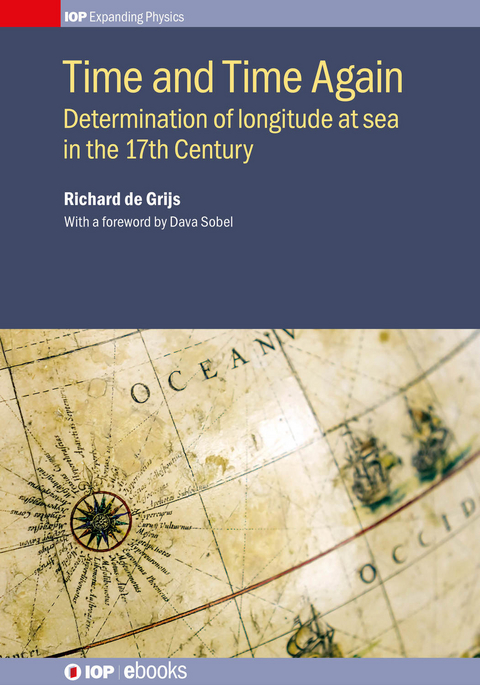
Time and Time Again (eBook)
Institute of Physics Publishing (Verlag)
978-0-7503-1194-6 (ISBN)
scholars played in the development of instruments and technology in the 17th Century that would allow sailors to accurately and precisely determine their
position, in particular longitude, using the motions of the Sun/stars together
with accurate time pieces.
Determination of one’s longitude at sea has perplexed sailors for many centuries. The significant uptake of world trade in the 17th and 18th Centuries rendered the increasingly urgent need to solve the ‘longitude problem’, an issue of strategic national importance. Historical accounts of these efforts often focus almost exclusively on John Harrison’s role in 18th-Century Britain. This book starts instead from Galileo Galilei’s late-16th-Century development of an accurate pendulum clock, which was first achieved in practice in the mid-17th-Century by Christiaan Huygens in the Dutch Republic. It
is primarily based on collections of letters that have not been combined into a
single volume before. Extensive introductory chapters on the history of
map making, the establishment of the world’s reference meridian at Greenwich
Observatory, and the rise of the scientific enterprise provide the appropriate
context for non-expert readers to fully engage with the book’s main subject
matter
Richard de Grijs has been a professor at the Kavli Institute for Astronomy and Astrophysics at Peking University in China since 2009. He was the founding director (2012–2016) of the East Asian Regional Office of Astronomy for Development, and has held the role of Discipline Scientist (Astrophysics) at the International Space Science Institute – Beijing since 2015. His research focuses on many aspects of star cluster physics, and he is also currently engaged in a number of research projects related to the history of astronomy, with special emphasis on the 17th Century.
1 - Changing times
2 - Global development of mathematical geography
3 - Early insights inspired by Galileo Galilei
4 - The importance of high-precision timekeeping
5 - The long road to a practical marine timepiece
6 - The merits of horology versus astronomy
EPILOGUE - Zero longitude
| Erscheint lt. Verlag | 22.11.2017 |
|---|---|
| Reihe/Serie | IOP Expanding Physics |
| IOP Expanding Physics | |
| IOP Expanding Physics | |
| IOP Expanding Physics | |
| ISSN | ISSN |
| Zusatzinfo | With figures in colour and black and white |
| Verlagsort | Bristol |
| Sprache | englisch |
| Themenwelt | Naturwissenschaften |
| ISBN-10 | 0-7503-1194-0 / 0750311940 |
| ISBN-13 | 978-0-7503-1194-6 / 9780750311946 |
| Informationen gemäß Produktsicherheitsverordnung (GPSR) | |
| Haben Sie eine Frage zum Produkt? |
 EPUB (Adobe DRM)
Kopierschutz: Adobe-DRM
Adobe-DRM ist ein Kopierschutz, der das eBook vor Mißbrauch schützen soll. Dabei wird das eBook bereits beim Download auf Ihre persönliche Adobe-ID autorisiert. Lesen können Sie das eBook dann nur auf den Geräten, welche ebenfalls auf Ihre Adobe-ID registriert sind.
Details zum Adobe-DRM
Dateiformat: EPUB (Electronic Publication)
EPUB ist ein offener Standard für eBooks und eignet sich besonders zur Darstellung von Belletristik und Sachbüchern. Der Fließtext wird dynamisch an die Display- und Schriftgröße angepasst. Auch für mobile Lesegeräte ist EPUB daher gut geeignet.
Systemvoraussetzungen:
PC/Mac: Mit einem PC oder Mac können Sie dieses eBook lesen. Sie benötigen eine
eReader: Dieses eBook kann mit (fast) allen eBook-Readern gelesen werden. Mit dem amazon-Kindle ist es aber nicht kompatibel.
Smartphone/Tablet: Egal ob Apple oder Android, dieses eBook können Sie lesen. Sie benötigen eine
Geräteliste und zusätzliche Hinweise
Buying eBooks from abroad
For tax law reasons we can sell eBooks just within Germany and Switzerland. Regrettably we cannot fulfill eBook-orders from other countries.
aus dem Bereich