


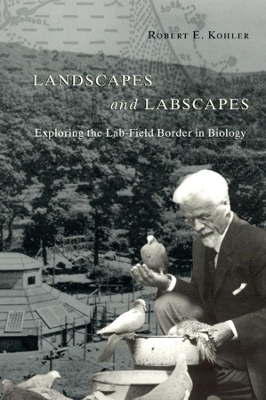
Landscapes and Labscapes – Exploring the Lab–Field Border in Biology
Seiten
2002
University of Chicago Press (Verlag)
978-0-226-45010-0 (ISBN)
University of Chicago Press (Verlag)
978-0-226-45010-0 (ISBN)
In "Landscapes and Labscapes" Robert E. Kohler explores the people, places and practices of field biology in the United States from the 1890s to the 1950s. Using historical frontiers as models, Kohler shows how biologists created vigorous new border sciences of ecology and evolutionary biology.
What is it like to do field biology in a world that exalts experiments and laboratories? How have field biologists assimilated laboratory values and practices and crafted an exact, quantitative science without losing their naturalist souls? In "Landscapes and Labscapes", Robert E. Kohler explores the people, places and practices of field biology in the United States from the 1890s to the 1950s. He takes readers into the fields and forests where field biologists learned to count and measure nature and to read the imperfect records of "nature's experiments". He shows how field researchers use nature's particularities to develop "practices of place" that achieve in nature what laboratory researchers can only do with simplified experiments. Using historical frontiers as models, Kohler shows how biologists created vigorous new border sciences of ecology and evolutionary biology.
What is it like to do field biology in a world that exalts experiments and laboratories? How have field biologists assimilated laboratory values and practices and crafted an exact, quantitative science without losing their naturalist souls? In "Landscapes and Labscapes", Robert E. Kohler explores the people, places and practices of field biology in the United States from the 1890s to the 1950s. He takes readers into the fields and forests where field biologists learned to count and measure nature and to read the imperfect records of "nature's experiments". He shows how field researchers use nature's particularities to develop "practices of place" that achieve in nature what laboratory researchers can only do with simplified experiments. Using historical frontiers as models, Kohler shows how biologists created vigorous new border sciences of ecology and evolutionary biology.
Robert E. Kohler is professor of the history and sociology of science at the University of Pennsylvania. He is the author of Lords of the Fly: Drosophila Genetics and the Experimental Life, published by the University of Chicago Press.
| Erscheint lt. Verlag | 8.7.2003 |
|---|---|
| Sprache | englisch |
| Maße | 165 x 231 mm |
| Gewicht | 516 g |
| Themenwelt | Naturwissenschaften ► Biologie |
| ISBN-10 | 0-226-45010-4 / 0226450104 |
| ISBN-13 | 978-0-226-45010-0 / 9780226450100 |
| Zustand | Neuware |
| Informationen gemäß Produktsicherheitsverordnung (GPSR) | |
| Haben Sie eine Frage zum Produkt? |
Mehr entdecken
aus dem Bereich



aus dem Bereich
Ein aktueller Blick auf das Mosaik der Menschwerdung
Buch | Hardcover (2025)
Springer (Verlag)
CHF 69,95
Wegweiser vom Honigtau zum Waldhonig
Buch | Hardcover (2024)
Leopold Stocker Verlag
CHF 36,40
Warum gesunde Böden das Klima retten, deinen Körper heilen und die …
Buch | Hardcover (2025)
Wiley-VCH (Verlag)
CHF 41,95


