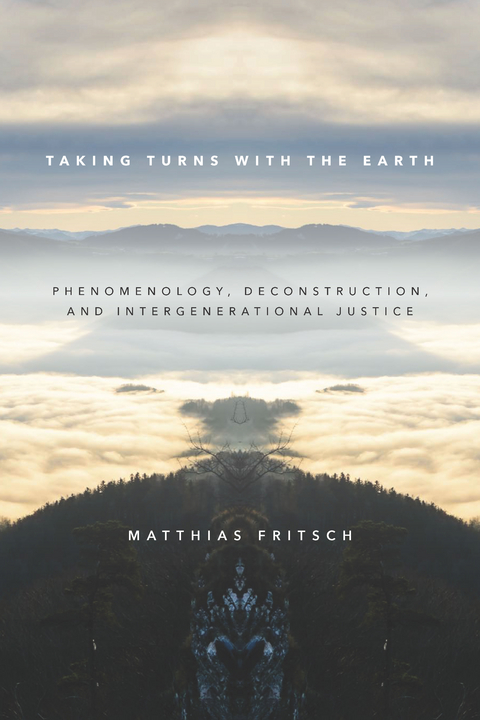
Taking Turns with the Earth (eBook)
280 Seiten
Stanford University Press (Verlag)
978-1-5036-0696-8 (ISBN)
The environmental crisis, one of the great challenges of our time, tends to disenfranchise those who come after us. Arguing that as temporary inhabitants of the earth, we cannot be indifferent to future generations, this book draws on the resources of phenomenology and poststructuralism to help us conceive of moral relations in connection with human temporality. Demonstrating that moral and political normativity emerge with generational time, the time of birth and death, this book proposes two related models of intergenerational and environmental justice. The first entails a form of indirect reciprocity, in which we owe future people both because of their needs and interests and because we ourselves have been the beneficiaries of peoples past; the second posits a generational taking of turns that Matthias Fritsch applies to both our institutions and our natural environment, in other words, to the earth as a whole. Offering new readings of key philosophers, and emphasizing the work of Emmanuel Levinas and Jacques Derrida in particular, Taking Turns with the Earth disrupts human-centered notions of terrestrial appropriation and sharing to give us a new continental philosophical account of future-oriented justice.
Matthias Fritsch is Professor of Philosophy at Concordia University.
Contents and Abstracts1Ontological Problems and Methods in Intergenerational Justice chapter abstractThis chapter begins by reviewing the so-called ontological problems that affect relations with future people, from the nonexistence challenge and poor epistemic access to problems affecting interaction and world constitution. It is then argued that ontological problems call for ontological solutions—here, investigations of moral agents' being in relation to time and world. Drawing on phenomenological sources, the chapter provides a first sketch of the book's overarching claim that justice becomes an issue for human beings to the extent we are generational beings who are noncontingently subject to birth and death. Birth and death, the argument continues, link us to previous and subsequent generations in ways that are socially and morally relevant. If we take this into account, the dead and the unborn will appear less absent and more (albeit "spectrally") present. The chapter ends by outlining possible responses to many of the ontological problems.2Levinas's "Being-for-Beyond-My-Death" chapter abstractThe second chapter elaborates the constitutive role of natality and mortality, sketched in the previous chapter, in much greater detail, with particular focus on Levinas. In the wake of Heidegger and others, Levinas argues that, in accessing the finite time that is co-disclosive of agency, I necessarily encounter the mortal, vulnerable other whose face demands that I let the other live. Agency is co-constituted by a futural demand to let others have possibilities for life beyond my death. Thus, the demand from actual future people on the living comes to be seen as exemplary of moral normativity. However, Levinas insufficiently links this futural responsibility to debts to previous others (including mothers), drawing legitimate feminist and Derridean critiques of his "fecundity" and "paternity." The chapter concludes that the moral demand cannot just be futural but must also be related to gifts from predecessors.3Asymmetrical Reciprocity and the Gift in Mauss and Derrida chapter abstractTaking off from the insight offered at the end of the previous chapter, this chapter elaborates indirect, asymmetrical reciprocity as a model of intergenerational justice. This notion is meant to capture the idea that indebtedness to preceding others plays a role in giving to future others, no matter how asymmetrical and altruistic the gift to future people is taken to be. With this goal in view, the chapter connects Derrida's critical reading of Levinas to economic literature on intergenerational transfers, specifically economists who draw on the premodern, indigenous notion of the gift, as famously elaborated by the anthropologist Marcel Mauss. The chapter distinguishes four (ideal) types of intergenerational three-party reciprocities and concludes that the notion of the gift points to the enabling conditions of economic activity. Both gifts of nature and benefits from nonpresent generations belong to these conditions, conditions that are too often "externalized" by market economies.4Double Turn-Taking among Generations and with Earth chapter abstractWith this topic of collectively shared goods in mind, the fourth chapter presents turn-taking as the second model of intergenerational justice that elaborates the "spectral" presence of nonpresent generations. Taking turns is more appropriate than reciprocity when the "object" of intergenerational sharing, in particular the natural environment and democratic institutions, is quasi-holistic and organically interrelated, such that it cannot easily be divided into parts nor can parts be substituted for one another. Drawing on Derrida's work on time and democracy, this model's distinct advantages are discussed in view of answering the question as to what a fair turn with earth and future people might be. The chapter concludes by showing that quasi-holistic objects such as earth and climate necessarily precede and outlive generations, and thus are not indifferent to, but co-constitutive of, the very being of generations, the subjects of sharing by turn-taking.5Interment chapter abstractTo avoid the humanism that takes the earth to be an indifferent object of intergenerational sharing, the final chapter complicates taking turns by arguing that the earth, understood as the history and habitat of life, for its part turns human beings about. We do not only have human generations taking turns with the earth, but individuals being born of the earth into a generation, while returning to the earth upon death. Humans are both "interred'" (agonistically belonging to a larger time and space here called the earth) and "interring" (responsible for returning others to the earth, as in burial).
| Erscheint lt. Verlag | 2.10.2018 |
|---|---|
| Zusatzinfo | 1 figure |
| Sprache | englisch |
| Themenwelt | Geisteswissenschaften ► Philosophie ► Allgemeines / Lexika |
| Naturwissenschaften ► Biologie ► Ökologie / Naturschutz | |
| Sozialwissenschaften ► Politik / Verwaltung ► Politische Theorie | |
| Schlagworte | Deconstruction • Derrida • Future Generations • Intergenerational Justice • Levinas • Phenomenology • Reciprocity • taking turns |
| ISBN-10 | 1-5036-0696-1 / 1503606961 |
| ISBN-13 | 978-1-5036-0696-8 / 9781503606968 |
| Informationen gemäß Produktsicherheitsverordnung (GPSR) | |
| Haben Sie eine Frage zum Produkt? |
 EPUB (Adobe DRM)
Kopierschutz: Adobe-DRM
Adobe-DRM ist ein Kopierschutz, der das eBook vor Mißbrauch schützen soll. Dabei wird das eBook bereits beim Download auf Ihre persönliche Adobe-ID autorisiert. Lesen können Sie das eBook dann nur auf den Geräten, welche ebenfalls auf Ihre Adobe-ID registriert sind.
Details zum Adobe-DRM
Dateiformat: EPUB (Electronic Publication)
EPUB ist ein offener Standard für eBooks und eignet sich besonders zur Darstellung von Belletristik und Sachbüchern. Der Fließtext wird dynamisch an die Display- und Schriftgröße angepasst. Auch für mobile Lesegeräte ist EPUB daher gut geeignet.
Systemvoraussetzungen:
PC/Mac: Mit einem PC oder Mac können Sie dieses eBook lesen. Sie benötigen eine
eReader: Dieses eBook kann mit (fast) allen eBook-Readern gelesen werden. Mit dem amazon-Kindle ist es aber nicht kompatibel.
Smartphone/Tablet: Egal ob Apple oder Android, dieses eBook können Sie lesen. Sie benötigen eine
Geräteliste und zusätzliche Hinweise
Buying eBooks from abroad
For tax law reasons we can sell eBooks just within Germany and Switzerland. Regrettably we cannot fulfill eBook-orders from other countries.
aus dem Bereich