


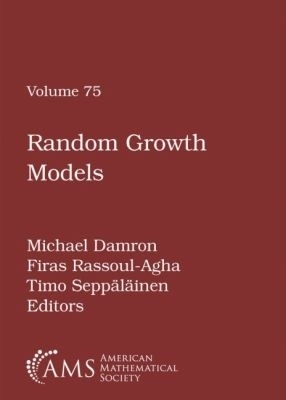
Random Growth Models
Seiten
2018
American Mathematical Society (Verlag)
978-1-4704-3553-0 (ISBN)
American Mathematical Society (Verlag)
978-1-4704-3553-0 (ISBN)
- Titel z.Zt. nicht lieferbar
- Versandkostenfrei
- Auch auf Rechnung
- Artikel merken
Based on lectures delivered at the 2017 AMS Short Course “Random Growth Models”, held in 2017. The articles give an introduction to the most-studied models; first- and last-passage percolation, the Eden model of cell growth, and particle systems, focusing on the main research questions and leading up to the celebrated Kardar-Parisi-Zhang equation.
The study of random growth models began in probability theory about 50 years ago, and today this area occupies a central place in the subject. The considerable challenges posed by these models have spurred the development of innovative probability theory and opened up connections with several other parts of mathematics, such as partial differential equations, integrable systems, and combinatorics. These models also have applications to fields such as computer science, biology, and physics.
This volume is based on lectures delivered at the 2017 AMS Short Course ``Random Growth Models'', held January 2-3, 2017 in Atlanta, GA.
The articles in this book give an introduction to the most-studied models; namely, first- and last-passage percolation, the Eden model of cell growth, and particle systems, focusing on the main research questions and leading up to the celebrated Kardar-Parisi-Zhang equation. Topics covered include asymptotic properties of infection times, limiting shape results, fluctuation bounds, and geometrical properties of geodesics, which are optimal paths for growth.
The study of random growth models began in probability theory about 50 years ago, and today this area occupies a central place in the subject. The considerable challenges posed by these models have spurred the development of innovative probability theory and opened up connections with several other parts of mathematics, such as partial differential equations, integrable systems, and combinatorics. These models also have applications to fields such as computer science, biology, and physics.
This volume is based on lectures delivered at the 2017 AMS Short Course ``Random Growth Models'', held January 2-3, 2017 in Atlanta, GA.
The articles in this book give an introduction to the most-studied models; namely, first- and last-passage percolation, the Eden model of cell growth, and particle systems, focusing on the main research questions and leading up to the celebrated Kardar-Parisi-Zhang equation. Topics covered include asymptotic properties of infection times, limiting shape results, fluctuation bounds, and geometrical properties of geodesics, which are optimal paths for growth.
Michael Damron, Georgia Institute of Technology, Atlanta, GA. Firas Rassoul-Agha, University of Utah, Salt Lake City, UT. Timo Seppalainen, University of Wisconsin, Madison, WI.
M. Damron, Random growth models: Shape and convergence rate
J. Hanson, Infinite geodesics, asymptotic directions, and Busemann functions in first-passage percolation
P. Sosoe, Fluctuations in first-passage percolation
F. Rassoul-Agha, Busemann functions, geodesics, and the competition interface for directed last-passage percolation
T. Seppalainen, The corner growth model with exponential weights
I. Corwin, Exactly solving the KPZ equation
Index.
| Erscheinungsdatum | 01.11.2018 |
|---|---|
| Reihe/Serie | Proceedings of Symposia in Applied Mathematics |
| Verlagsort | Providence |
| Sprache | englisch |
| Maße | 178 x 254 mm |
| Gewicht | 639 g |
| Themenwelt | Mathematik / Informatik ► Mathematik ► Wahrscheinlichkeit / Kombinatorik |
| Naturwissenschaften ► Physik / Astronomie | |
| ISBN-10 | 1-4704-3553-5 / 1470435535 |
| ISBN-13 | 978-1-4704-3553-0 / 9781470435530 |
| Zustand | Neuware |
| Informationen gemäß Produktsicherheitsverordnung (GPSR) | |
| Haben Sie eine Frage zum Produkt? |
Mehr entdecken
aus dem Bereich



aus dem Bereich
Stochastik: von Abweichungen bis Zufall
Buch | Softcover (2025)
De Gruyter (Verlag)
CHF 48,90
Buch | Softcover (2024)
Springer Spektrum (Verlag)
CHF 69,95


