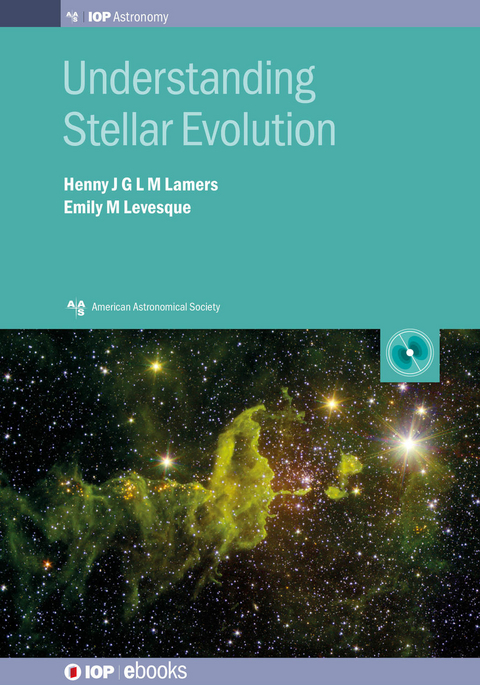
Understanding Stellar Evolution (eBook)
270 Seiten
Institute of Physics Publishing (Verlag)
978-0-7503-1278-3 (ISBN)
Evolution is based on a series of graduate-level courses taught at the
University of Washington since 2004. It
describes the structure and evolution of stars, with emphasis on the basic
physical principles and the interplay between the different processes inside
stars. Based on these principles, the evolution of low- and high-mass stars is
explained from their formation to their death.
Understanding Stellar
Evolution is based on a series of graduate-level courses taught at the
University of Washington since 2004, and is written for physics and astronomy students and for anyone with a physics
background who is interested in stars. It describes the structure and evolution of stars, with emphasis on the
basic physical principles and the interplay between the different processes
inside stars, such as nuclear reactions, energy transport, chemical mixing,
pulsation, mass loss and rotation. Based on these principles, the evolution of
low- and high-mass stars is explained from their formation to their death. In addition to homework exercises for each
chapter, the text contains a large number of questions that are meant to stimulate
the understanding of the physical principles. An extensive set of accompanying
lecture slides is available for teachers in both Keynote® and PowerPoint® formats.
Short versionHenny J G L M Lamers is Professor Emeritus in Astrophysics at Utrecht University and the University of Amsterdam. He is a member of the Netherlands Royal Academy of Arts and Sciences, and an Honorary member of the American Astronomical Society. Emily Levesque is an Assistant Professor of Astronomy at the University of Washington in Seattle. Her research accolades include a 2017 Alfred P Sloan fellowship in physics and 2014 Annie Jump Cannon research prize from the American Astronomical Society. Long versionHenny J G L M Lamers is Professor Emeritus in Astrophysics at Utrecht University and the University of Amsterdam. He is a member of the Netherlands Royal Academy of Arts and Sciences, an Honorary member of the American Astronomical Society, Honorary Brittingham Chair at the University of Wisconsin (1989), Nominee Teacher of the Year of the Utrecht University, and received the Schmeits Award for Astronomy in the Netherlands (1980). He is author/editor of nine professional astronomy books and author of four popular astronomy books. Emily Levesque is an Assistant Professor of Astronomy at the University of Washington in Seattle. Her research accolades include a 2017 Alfred P Sloan fellowship in physics and 2014 Annie Jump Cannon research prize from the American Astronomical Society. She was both an Einstein and Hubble postdoctoral fellow at the University of Colorado, and received her PhD in astronomy from the University of Hawaii and her SB in physics from the Massachusetts Institute of Technology.
1 - Stars: setting the stage
2 - Observations of stellar parameters
3 - Hydrostatic equilibrium and its consequences
4 - Gas physics of stars
5 - Opacities in stars
6 - Radiative energy transfer
7 - Convective energy transport
8 - Nuclear fusion
9 - Stellar timescales
10 - Calculating stellar evolution
11 - Polytropic stars
12 - Star formation
13 - H fusion in the core: the main sequence phase
14 - Principles of post main sequence evolution
15 - Stellar winds and mass loss
16 - Shell H fusion in low mass stars: the red giant
phase
17 - Helium fusion in low mass stars: horizontal
branch stars
18 - Double shell fusion: Asymptotic Giant Brach
stars
19 - Post-AGB evolution and planetary nebulae
20 - White dwarfs and neutron stars
21 - Pulsating stars
22 - Observations of massive stars: evidence for
evolution with mass loss
23 - Evolution of massive stars of 8 – 25 Mʘ
24 - The evolution of massive stars of 25 – 120 Mʘ
: dominated by mass loss
25 - Rotation and stellar evolution
26 - Late evolution stages of massive stars
27 - Supernovae
28 - Principles of close binary evolution
29 - Close binaries: examples of evolution with mass
transfer
30 - Chemical yields: products of stellar evolution
Appendix A - Physical and astronomical constants
Appendix B - Stellar parameters
Appendix C - Solar Model
Appendix D - Main sequence from ZAMS to TAMS
Appendix E - Acronyms
| Erscheint lt. Verlag | 15.12.2017 |
|---|---|
| Reihe/Serie | AAS-IOP Astronomy |
| AAS-IOP Astronomy | |
| AAS-IOP Astronomy | |
| AAS-IOP Astronomy | |
| IOP ebooks | |
| IOP ebooks | |
| ISSN | ISSN |
| Zusatzinfo | With figures in colour and black and white |
| Verlagsort | Bristol |
| Sprache | englisch |
| Themenwelt | Naturwissenschaften |
| ISBN-10 | 0-7503-1278-5 / 0750312785 |
| ISBN-13 | 978-0-7503-1278-3 / 9780750312783 |
| Informationen gemäß Produktsicherheitsverordnung (GPSR) | |
| Haben Sie eine Frage zum Produkt? |
 EPUB (Adobe DRM)
Kopierschutz: Adobe-DRM
Adobe-DRM ist ein Kopierschutz, der das eBook vor Mißbrauch schützen soll. Dabei wird das eBook bereits beim Download auf Ihre persönliche Adobe-ID autorisiert. Lesen können Sie das eBook dann nur auf den Geräten, welche ebenfalls auf Ihre Adobe-ID registriert sind.
Details zum Adobe-DRM
Dateiformat: EPUB (Electronic Publication)
EPUB ist ein offener Standard für eBooks und eignet sich besonders zur Darstellung von Belletristik und Sachbüchern. Der Fließtext wird dynamisch an die Display- und Schriftgröße angepasst. Auch für mobile Lesegeräte ist EPUB daher gut geeignet.
Systemvoraussetzungen:
PC/Mac: Mit einem PC oder Mac können Sie dieses eBook lesen. Sie benötigen eine
eReader: Dieses eBook kann mit (fast) allen eBook-Readern gelesen werden. Mit dem amazon-Kindle ist es aber nicht kompatibel.
Smartphone/Tablet: Egal ob Apple oder Android, dieses eBook können Sie lesen. Sie benötigen eine
Geräteliste und zusätzliche Hinweise
Buying eBooks from abroad
For tax law reasons we can sell eBooks just within Germany and Switzerland. Regrettably we cannot fulfill eBook-orders from other countries.
aus dem Bereich