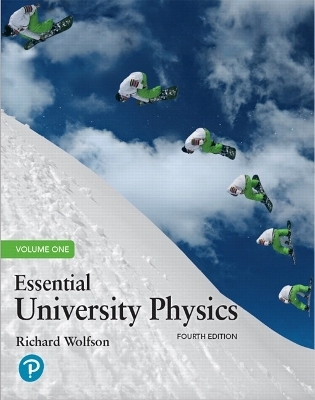
Essential University Physics, Volume 1
Pearson (Verlag)
978-0-13-498855-9 (ISBN)
0134988558 / 9780134988559: Volume 1 contains Chapters 1–19
Focus on the fundamentals and help students see connections between problem types
Richard Wolfson’s Essential University Physics is a concise and progressive calculus-based physics textbook that offers clear writing, great problems, and relevant real-life applications in an affordable and streamlined text. The book teaches sound problem-solving strategies and emphasizes conceptual understanding, using features such as annotated figures and step-by-step problem-solving strategies. Realizing students have changed a great deal over time while the fundamentals of physics have changed very little, Wolfson makes physics relevant and alive for students by sharing the latest physics applications in a concise and captivating style.
The 4th Edition incorporates research from instructors, reviewers, and thousands of students to expand the book’s problem sets and consistent problem-solving strategy. A new problem type guides students to see patterns, make connections between problems that can be solved using similar steps, and apply those steps when working problems on homework and exams. New digital tools and the interactive Pearson eText increase student interactivity to help them develop confidence in solving problems, deepen their conceptual understanding, and strengthen quantitative-reasoning skills.
Essential University Physics is offered as two paperback volumes available together or for sale individually.
Also available with Mastering Physics
By combining trusted author content with digital tools and a flexible platform, Mastering personalizes the learning experience and improves results for each student.Now providing a fully integrated experience, the eText is linked to every problem within Mastering for seamless integration between homework problems, practice problems, textbook, worked examples, and more.
Note: You are purchasing a standalone product; Mastering Physics does not come packaged with this content. Students, if interested in purchasing this title with Mastering Physics , ask your instructor for the correct package ISBN and Course ID. Instructors, contact your Pearson representative for more information.
If you would like to purchase both volumes of the physical text and Mastering Physics, search for:
0134989287 / 9780134989280 Essential University Physics Plus Mastering Physics with Pearson eText -- Access Card Package
Package consists of:
0134988558 / 9780134988559 Essential University Physics: Volume 1
0134988566 / 9780134988566 Essential University Physics: Volume 2
0135159695 / 9780135159699 Mastering Physics with Pearson eText -- ValuePack Access Card -- for Essential University Physics
About our author R ichard Wolfson is the Benjamin F. Wissler Professor of Physics at Middlebury College, where he has taught since 1976. He did undergraduate work at MIT and Swarthmore College, and he holds an M.S. from the University of Michigan and Ph.D. from Dartmouth. His ongoing research on the Sun’s corona and climate change has taken him to sabbaticals at the National Center for Atmospheric Research in Boulder, Colorado; St. Andrews University in Scotland; and Stanford University. Rich is a committed and passionate teacher. This is reflected in his many publications for students and the general public, including the video series Einstein’s Relativity and the Quantum Revolution: Modern Physics for Nonscientists (The Teaching Company, 1999), Physics in Your Life (The Teaching Company, 2004), Physics and Our Universe: How It All Works (The Teaching Company, 2011), and Understanding Modern Electronics(The Teaching Company, 2014); books Nuclear Choices: A Citizen’s Guide to Nuclear Technology (MIT Press, 1993), Simply Einstein: Relativity Demystified (W. W. Norton, 2003), and Energy, Environment, and Climate(W. W. Norton, 3rd edition 2018); and articles for Scientific American and the World Book Encyclopedia. Outside of his research and teaching, Rich enjoys hiking, canoeing, gardening, cooking, and watercolor painting.
Essential University Physics, 4th Edition is available in 3 versions:
Full Version, All Chapters: Chs 1-39
Volume 1: Chs 1-19
Volume 2: Chs 20-39
Doing Physics
1.1 Realms of Physics
1.2 Measurements and Units
1.3 Working with Numbers
1.4 Strategies for Learning Physics
PART ONE: MECHANICS
Motion in a Straight Line
2.1 Average Motion
2.2 Instantaneous Velocity
2.3 Acceleration
2.4 Constant Acceleration
2.5 The Acceleration of Gravity
2.6 When Acceleration Isn't Constant
Motion in Two and Three Dimensions
3.1 Vectors
3.2 Velocity and Acceleration Vectors
3.3 Relative Motion
3.4 Constant Acceleration
3.5 Projectile Motion
3.6 Uniform Circular Motion
Force and Motion
4.1 The Wrong Question
4.2 Newton's First and Second Laws
4.3 Forces
4.4 The Force of Gravity
4.5 Using Newton's Second Law
4.6 Newton's Third Law
Using Newton's Laws
5.1 Using Newton's Second Law
5.2 Multiple Objects
5.3 Circular Motion
5.4 Friction
5.5 Drag Forces
Energy, Work, and Power
6.1 Energy
6.2 Work
6.3 Forces That Vary
6.4 Kinetic Energy
6.5 Power
Conservation of Energy
7.1 Conservative and Nonconservative Forces
7.2 Potential Energy
7.3 Conservation of Mechanical Energy
7.4 Nonconservative Forces
7.5 Conservation of Energy
7.6 Potential-Energy Curves
Gravity
8.1 Toward a Law of Gravity
8.2 Universal Gravitation
8.3 Orbital Motion
8.4 Gravitational Energy
8.5 The Gravitational Field
Systems of Particles
9.1 Center of Mass
9.2 Momentum
9.3 Kinetic Energy of a System
9.4 Collisions
9.5 Totally Inelastic Collisions
9.6 Elastic Collisions
Rotational Motion
10.1 Angular Velocity and Acceleration
10.2 Torque
10.3 Rotational Inertia and the Analog of Newton's Law
10.4 Rotational Energy
10.5 Rolling Motion
Rotational Vectors and Angular Momentum
11.1 Angular Velocity and Acceleration Vectors
11.2 Torque and the Vector Cross Product
11.3 Angular Momentum
11.4 Conservation of Angular Momentum
11.5 Gyroscopes and Precession
Static Equilibrium
12.1 Conditions for Equilibrium
12.2 Center of Gravity
12.3 Examples of Static Equilibrium
12.4 Stability
PART TWO: OSCILLATIONS, WAVES, AND FLUIDS
Oscillatory Motion
13.1 Describing Oscillatory Motion
13.2 Simple Harmonic Motion
13.3 Applications of Simple Harmonic Motion
13.4 Circular Motion and Harmonic Motion
13.5 Energy in Simple Harmonic Motion
13.6 Damped Harmonic Motion
13.7 Driven Oscillations and Resonance
14. Wave Motion
14.1 Waves and Their Properties
14.2 Wave Math
14.3 Waves on a String
14.4 Wave Energy
14.5 Sound Waves
14.6 Interference
14.7 Reflection and Refraction
14.8 Standing Waves
14.9 The Doppler Effect and Shock Waves
Fluid Motion
15.1 Density and Pressure
15.2 Hydrostatic Equilibrium
15.3 Archimedes' Principle and Buoyancy
15.4 Fluid Dynamics
15.5 Applications of Fluid Dynamics
15.6 Viscosity and Turbulence
PART THREE: THERMODYNAMICS
Temperature and Heat
16.1 Heat, Temperature, and Thermodynamic Equilibrium
16.2 Heat Capacity and Specific Heat
16.3 Heat Transfer
16.4 Thermal-Energy Balance
The Thermal Behavior of Matter
17.1 Gases
17.2 Phase Changes
17.3 Thermal Expansion
Heat, Work, and the First Law of Thermodynamics
18.1 The First Law of Thermodynamics
18.2 Thermodynamic Processes
18.3 Specific Heats of an Ideal Gas
The Second Law of Thermodynamics
19.1 Reversibility and Irreversibility
19.2 The Second Law of Thermodynamics
19.3 Applications of the Second Law
19.4 Entropy and Energy Quality
PART FOUR: ELECTROMAGNETISM
Electric Charge, Force, and Field
20.1 Electric Charge
20.2 Coulomb's Law
20.3 The Electric Field
20.4 Fields of Charge Distributions
20.5 Matter in Electric Fields
Gauss's Law
21.1 Electric Field Lines
21.2 Electric Field and Electric Flux
21.3 Gauss's Law
21.4 Using Gauss's Law
21.5 Fields of Arbitrary Charge Distributions
21.6 Gauss's Law and Conductors
Electric Potential
22.1 Electric Potential Difference
22.2 Calculating Potential Difference
22.3 Potential Difference and the Electric Field
22.4 Charged Conductors
Electrostatic Energy and Capacitors
23.1 Electrostatic Energy
23.2 Capacitors
23.3 Using Capacitors
23.4 Energy in the Electric Field
Electric Current
24.1 Electric Current
24.2 Conduction Mechanisms
24.3 Resistance and Ohm's Law
24.4 Electric Power
24.5 Electrical Safety
Electric Circuits
25.1 Circuits, Symbols, and Electromotive Force
25.2 Series and Parallel Resistors
25.3 Kirchhoff's Laws and Multiloop Circuits
25.4 Electrical Measurements
25.5 Capacitors in Circuits
Magnetism: Force and Field
26.1 What Is Magnetism?
26.2 Magnetic Force and Field
26.3 Charged Particles in Magnetic Fields
26.4 The Magnetic Force on a Current
26.5 Origin of the Magnetic Field
26.6 Magnetic Dipoles
26.7 Magnetic Matter
26.8 Ampère's Law
Electromagnetic Induction
27.1 Induced Currents
27.2 Faraday's Law
27.3 Induction and Energy
27.4 Inductance
27.5 Magnetic Energy
27.6 Induced Electric Fields
Alternating-Current Circuits
28.1 Alternating Current
28.2 Circuit Elements in AC Circuits
28.3 LC Circuits
28.4 Driven RLC Circuits and Resonance
28.5 Power in AC Circuits
28.6 Transformers and Power Supplies
Maxwell's Equations and Electromagnetic Waves
29.1 The Four Laws of Electromagnetism
29.2 Ambiguity in Ampère's Law
29.3 Maxwell's Equations
29.4 Electromagnetic Waves
29.5 Properties of Electromagnetic Waves
29.6 The Electromagnetic Spectrum
29.7 Producing Electromagnetic Waves
29.8 Energy and Momentum in Electromagnetic Waves
PART FIVE: OPTICS
Reflection and Refraction
30.1 Reflection
30.2 Refraction
30.3 Total Internal Reflection
30.4 Dispersion
Images and Optical Instruments
31.1 Images with Mirrors
31.2 Images with Lenses
31.3 Refraction in Lenses: The Details
31.4 Optical Instruments
Interference and Diffraction
32.1 Coherence and Interference
32.2 Double-Slit Interference
32.3 Multiple-Slit Interference and Diffraction Gratings
32.4 Interferometry
32.5 Huygens' Principle and Diffraction
32.6 The Diffraction Limit
PART SIX: MODERN PHYSICS
Relativity
33.1 Speed c Relative to What?
33.2 Matter, Motion, and the Ether
33.3 Special Relativity
33.4 Space and Time in Relativity
33.5 Simultaneity Is Relative
33.6 The Lorentz Transformations
33.7 Energy and Momentum in Relativity
33.8 Electromagnetism and Relativity
33.9 General Relativity
Particles and Waves
34.1 Toward Quantum Theory
34.2 Blackbody Radiation
34.3 Photons
34.4 Atomic Spectra and the Bohr Atom
34.5 Matter Waves
34.6 The Uncertainty Principle
34.7 Complementarity
Quantum Mechanics
35.1 Particles, Waves, and Probability
35.2 The Schrödinger Equation
35.3 Particles and Potentials
35.4 Quantum Mechanics in Three Dimensions
35.5 Relativistic Quantum Mechanics
Atomic Physics
36.1 The Hydrogen Atom
36.2 Electron Spin
36.3 The Exclusion Principle
36.4 Multielectron Atoms and the Periodic Table
36.5 Transitions and Atomic Spectra
Molecules and Solids
37.1 Molecular Bonding
37.2 Molecular Energy Levels
37.3 Solids
37.4 Superconductivity
Nuclear Physics
38.1 Elements, Isotopes, and Nuclear Structure
38.2 Radioactivity
38.3 Binding Energy and Nucleosynthesis
38.4 Nuclear Fission
38.5 Nuclear Fusion
From Quarks to the Cosmos
39.1 Particles and Forces
39.2 Particles and More Particles
39.3 Quarks and the Standard Model
39.4 Unification
39.5 The Evolving Universe
APPENDICES
A. Mathematics
B. The International System of Units (SI)
C. Conversion Factors
D. The Elements
E. Astrophysical Data
Answers to Odd-Numbered Problems
| Erscheinungsdatum | 28.01.2019 |
|---|---|
| Sprache | englisch |
| Themenwelt | Naturwissenschaften ► Physik / Astronomie |
| ISBN-10 | 0-13-498855-8 / 0134988558 |
| ISBN-13 | 978-0-13-498855-9 / 9780134988559 |
| Zustand | Neuware |
| Informationen gemäß Produktsicherheitsverordnung (GPSR) | |
| Haben Sie eine Frage zum Produkt? |
aus dem Bereich