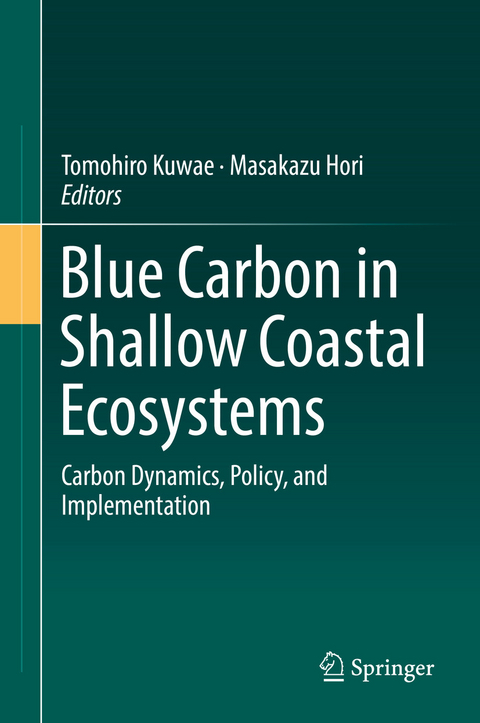
Blue Carbon in Shallow Coastal Ecosystems (eBook)
XII, 373 Seiten
Springer Singapore (Verlag)
9789811312953 (ISBN)
This book presents a comprehensive and innovative understanding of the role of shallow coastal ecosystems in carbon cycling, particularly marine carbon sequestration. Incorporating a series of forward-looking chapters, the book combines thorough reviews of the global literature and regional assessments-mainly around the Indo-Pacific region and Japan-with global perspectives to provide a thorough assessment of carbon cycling in shallow coastal systems. It advocates the expansion of blue-carbon ecosystems (mangroves, seagrass meadows, and salt marshes) into macroalgal beds, tidal flats, coral reefs, and urbanized shallow waters, demonstrating the potential of these ecosystems as new carbon sinks. Moreover, it discusses not only topics that are currently the focus of blue-carbon studies, i.e., sedimentary carbon stock and accumulation rate, but also CO2 gas exchange between the atmosphere and shallow coastal ecosystems, carbon storage in the water column as refractory organic carbon, and off-site carbon storage. Including highly original contributions, this comprehensive work inspires research beyond the specific regions covered by the chapters. The suite of new concepts and approaches is refreshing and demonstrates that blue-carbon research is indeed a vibrant new field of research, providing deep insights into neglected aspects of carbon cycling in the marine environment. At the same time the book provides guidance for policy makers to deliver benefits to society, for example the inclusion of blue carbon as a carbon offset scheme or the Nationally Determined Contribution (NDC) in the Paris Agreement, and also for building resilience in coastal socio-ecosystems through better management. This book is intended for all those interested in the science and management of coastal ecosystems.
This book presents a comprehensive and innovative understanding of the role of shallow coastal ecosystems in carbon cycling, particularly marine carbon sequestration. Incorporating a series of forward-looking chapters, the book combines thorough reviews of the global literature and regional assessments-mainly around the Indo-Pacific region and Japan-with global perspectives to provide a thorough assessment of carbon cycling in shallow coastal systems. It advocates the expansion of blue-carbon ecosystems (mangroves, seagrass meadows, and salt marshes) into macroalgal beds, tidal flats, coral reefs, and urbanized shallow waters, demonstrating the potential of these ecosystems as new carbon sinks. Moreover, it discusses not only topics that are currently the focus of blue-carbon studies, i.e., sedimentary carbon stock and accumulation rate, but also CO2 gas exchange between the atmosphere and shallow coastal ecosystems, carbon storage in the water column as refractory organic carbon, and off-site carbon storage. Including highly original contributions, this comprehensive work inspires research beyond the specific regions covered by the chapters. The suite of new concepts and approaches is refreshing and demonstrates that blue-carbon research is indeed a vibrant new field of research, providing deep insights into neglected aspects of carbon cycling in the marine environment. At the same time the book provides guidance for policy makers to deliver benefits to society, for example the inclusion of blue carbon as a carbon offset scheme or the Nationally Determined Contribution (NDC) in the Paris Agreement, and also for building resilience in coastal socio-ecosystems through better management. This book is intended for all those interested in the science and management of coastal ecosystems.
Dr. Tomohiro Kuwae is the Group Head of the Coastal and Estuarine Environment Research Group, Port and Airport Research Institute (PARI), National Institute of Maritime, Port and Aviation Technology, Japan. He received his Master’s and Doctoral degrees in Applied Biosciences from Kyoto University and was an Adjunct Professor at Kumamoto University. His research interests include biogeochemical cycling in shallow coastal waters, especially carbon dioxide sequestration and carbon storage in shallow coastal ecosystems; fundamental ecology such as food-web structure and function; and the conservation, restoration, and creation of coastal ecosystems.Dr. Masakazu Hori is a Senior Researcher at the Coastal Macrophyte Ecosystem Research Group, National Research Institute of Fisheries and Environment of Inland Sea (FEIS), Japan Fisheries Research and Education Agency (FRA). He received a Ph. D. in Marine Environments and Resources from the Graduate School of Fisheries Science, Hokkaido University. He worked as a Research Fellow at the University of Tokyo and an adjunct instructor at Hiroshima University. He specializes in community and ecosystem ecology, including plant–animal interactions, food-web analyses, ecosystem services, and social-ecological systems in shallow coastal ecosystems.
| Erscheint lt. Verlag | 3.9.2018 |
|---|---|
| Zusatzinfo | XII, 373 p. 152 illus., 64 illus. in color. |
| Verlagsort | Singapore |
| Sprache | englisch |
| Themenwelt | Naturwissenschaften ► Biologie ► Ökologie / Naturschutz |
| Naturwissenschaften ► Geowissenschaften ► Geografie / Kartografie | |
| Naturwissenschaften ► Geowissenschaften ► Geologie | |
| Schlagworte | Carbon Sequestration • Climate Change Management • Coastal environmental • Costal ecology • Seagrass meadows • Shallow coastal ecosystems |
| ISBN-13 | 9789811312953 / 9789811312953 |
| Informationen gemäß Produktsicherheitsverordnung (GPSR) | |
| Haben Sie eine Frage zum Produkt? |
 PDF (Wasserzeichen)
DRM: Digitales Wasserzeichen
Dieses eBook enthält ein digitales Wasserzeichen und ist damit für Sie personalisiert. Bei einer missbräuchlichen Weitergabe des eBooks an Dritte ist eine Rückverfolgung an die Quelle möglich.
Dateiformat: PDF (Portable Document Format)
Mit einem festen Seitenlayout eignet sich die PDF besonders für Fachbücher mit Spalten, Tabellen und Abbildungen. Eine PDF kann auf fast allen Geräten angezeigt werden, ist aber für kleine Displays (Smartphone, eReader) nur eingeschränkt geeignet.
Systemvoraussetzungen:
PC/Mac: Mit einem PC oder Mac können Sie dieses eBook lesen. Sie benötigen dafür einen PDF-Viewer - z.B. den Adobe Reader oder Adobe Digital Editions.
eReader: Dieses eBook kann mit (fast) allen eBook-Readern gelesen werden. Mit dem amazon-Kindle ist es aber nicht kompatibel.
Smartphone/Tablet: Egal ob Apple oder Android, dieses eBook können Sie lesen. Sie benötigen dafür einen PDF-Viewer - z.B. die kostenlose Adobe Digital Editions-App.
Buying eBooks from abroad
For tax law reasons we can sell eBooks just within Germany and Switzerland. Regrettably we cannot fulfill eBook-orders from other countries.
aus dem Bereich