


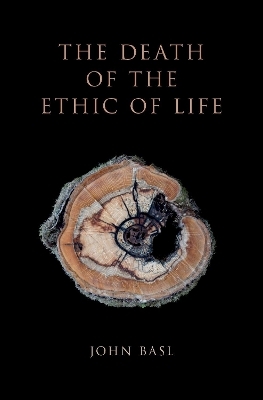
The Death of the Ethic of Life
Seiten
2019
Oxford University Press Inc (Verlag)
978-0-19-092387-7 (ISBN)
Oxford University Press Inc (Verlag)
978-0-19-092387-7 (ISBN)
Many subscribe to an Ethic of Life, an ethical perspective on which all living things are deserving of some level of moral concern. Within philosophy, the Ethic of Life has been clarified, developed, and rigorously defended; it has also found its strongest critics. Currently, the debate is at a standstill. This book ends this stalemate by proving that the Ethic of Life must be abandoned.
Many subscribe to an Ethic of Life, an ethical perspective on which all living things deserve some level of moral concern. Within philosophy, the Ethic of Life has been clarified, developed, and rigorously defended; yet it has also found its harshest critics. Between biocentrists, those that endorse the Ethic of Life, and those that accept a more restricted view of moral status, the debate has reached a standstill, with few new resources for shifting or complicating it.
In The Death of the Ethic of Life, John Basl seeks to end this comfortable stalemate by emphasizing a simple truth: the well-being of non-sentient beings, such as plants, species, and ecosystems, is morally significant only to the extent that it matters to sentient beings. Basl first develops a version of The Ethic of Life that best meets traditional challenges: the Ethic, if it is to survive criticism, must be able to explain how it is that all living things have a welfare or a good of their own. The best hope of offering such an explanation is to ground that welfare in teleology or goal-directedness, and then to ground that goal-directedness in the workings of natural selection. While a naturalistic account of teleology is crucial to defending an Ethic of Life, it is also its downfall. This Ethic ultimately entails that not only are ecosystems and collectives morally considerable, but so, too, are artifacts: everything from can openers to computers. Basl shows that evaluation of the resources for distinguishing artifacts from organisms forces us to abandon, for good, the Ethic of Life.
The Death of the Ethic of Life provides not only a new answer to a fundamental question in environmental ethics, but a new way to conceive of fundamental concepts and issues in debates over who or what matters from the moral point of view, with wide-ranging implications in the philosophy of technology and bioethics.
Many subscribe to an Ethic of Life, an ethical perspective on which all living things deserve some level of moral concern. Within philosophy, the Ethic of Life has been clarified, developed, and rigorously defended; yet it has also found its harshest critics. Between biocentrists, those that endorse the Ethic of Life, and those that accept a more restricted view of moral status, the debate has reached a standstill, with few new resources for shifting or complicating it.
In The Death of the Ethic of Life, John Basl seeks to end this comfortable stalemate by emphasizing a simple truth: the well-being of non-sentient beings, such as plants, species, and ecosystems, is morally significant only to the extent that it matters to sentient beings. Basl first develops a version of The Ethic of Life that best meets traditional challenges: the Ethic, if it is to survive criticism, must be able to explain how it is that all living things have a welfare or a good of their own. The best hope of offering such an explanation is to ground that welfare in teleology or goal-directedness, and then to ground that goal-directedness in the workings of natural selection. While a naturalistic account of teleology is crucial to defending an Ethic of Life, it is also its downfall. This Ethic ultimately entails that not only are ecosystems and collectives morally considerable, but so, too, are artifacts: everything from can openers to computers. Basl shows that evaluation of the resources for distinguishing artifacts from organisms forces us to abandon, for good, the Ethic of Life.
The Death of the Ethic of Life provides not only a new answer to a fundamental question in environmental ethics, but a new way to conceive of fundamental concepts and issues in debates over who or what matters from the moral point of view, with wide-ranging implications in the philosophy of technology and bioethics.
John Basl is Assistant Professor of Philosophy at Northeastern University. He works in normative philosophy and applied ethics, with emphasis on the ethical and epistemological challenges raised by emerging technologies. He is the co-editor of Designer Biology: The Ethics of Intensively Engineering Biological and Ecological Systems (Lexington Books, 2013).
Preface
Chapter 1: Biocentrism
Chapter 2: Challenges to Biocentrism
Chapter 3: The Etiological Account of Teleological Welfare
Chapter 4: The Strategy of Exclusion and the Problem of Collectives
Chapter 5: The Strategy of Exclusion and the Problem of Artifacts
Chapter 6: The Moral Irrelevance of Biological Welfare
Chapter 7: Conclusion
| Erscheinungsdatum | 21.02.2019 |
|---|---|
| Verlagsort | New York |
| Sprache | englisch |
| Maße | 241 x 157 mm |
| Gewicht | 454 g |
| Themenwelt | Geisteswissenschaften ► Philosophie ► Allgemeines / Lexika |
| Geisteswissenschaften ► Philosophie ► Ethik | |
| Naturwissenschaften ► Biologie | |
| ISBN-10 | 0-19-092387-3 / 0190923873 |
| ISBN-13 | 978-0-19-092387-7 / 9780190923877 |
| Zustand | Neuware |
| Informationen gemäß Produktsicherheitsverordnung (GPSR) | |
| Haben Sie eine Frage zum Produkt? |
Mehr entdecken
aus dem Bereich



aus dem Bereich
die letzten Jahre der Philosophie und der Beginn einer neuen …
Buch | Hardcover (2024)
Klett-Cotta (Verlag)
CHF 39,20


