


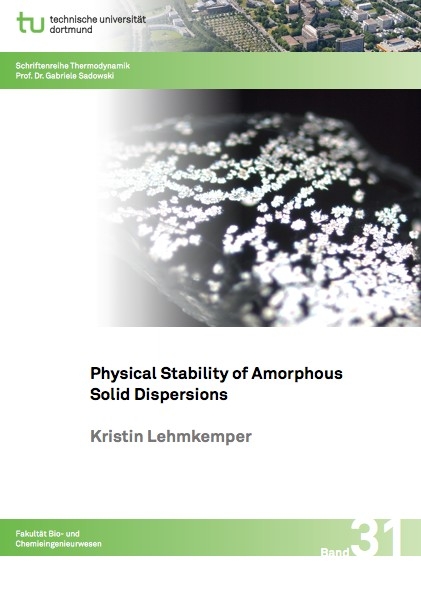
Physical Stability of Amorphous Solid Dispersions
Seiten
2018
Dr. Hut (Verlag)
978-3-8439-3706-1 (ISBN)
Dr. Hut (Verlag)
978-3-8439-3706-1 (ISBN)
- Keine Verlagsinformationen verfügbar
- Artikel merken
Poorly water-soluble active pharmaceutical ingredients (APIs) can be dissolved in amorphous polymers for improving their bioavailability. The physical stability against API crystallization of such so-called amorphous solid dispersions (ASDs) mainly depends on the API solubility in the excipients and the glass-transition temperature of the amorphous formulation.
In this work, thermodynamic models were used for predicting the phase diagrams and thus the physical stability of ASD systems at dry and humid conditions. In a model comparison, especially the API solubility in excipients calculated with the Perturbed-Chain Statistical Associating Fluid Theory (PC-SAFT) showed a very good agreement with experimental data. The glass-transition temperatures were calculated using the Gordon-Taylor or the Kwei equation. The models were further used for investigating the impact of different excipients and excipient blends on the physical stability of ASDs.
The predictions agreed with results of six to 24 month-long stability studies. Thus, the used models are suitable for predicting the long-term physical stability of ASDs in dependence of the storage conditions and the ASD composition allowing an effective design of physically-stable ASD formulations while reducing cost-intensive stability studies to a minimum.
In this work, thermodynamic models were used for predicting the phase diagrams and thus the physical stability of ASD systems at dry and humid conditions. In a model comparison, especially the API solubility in excipients calculated with the Perturbed-Chain Statistical Associating Fluid Theory (PC-SAFT) showed a very good agreement with experimental data. The glass-transition temperatures were calculated using the Gordon-Taylor or the Kwei equation. The models were further used for investigating the impact of different excipients and excipient blends on the physical stability of ASDs.
The predictions agreed with results of six to 24 month-long stability studies. Thus, the used models are suitable for predicting the long-term physical stability of ASDs in dependence of the storage conditions and the ASD composition allowing an effective design of physically-stable ASD formulations while reducing cost-intensive stability studies to a minimum.
| Erscheinungsdatum | 02.09.2018 |
|---|---|
| Reihe/Serie | Thermodynamik |
| Verlagsort | München |
| Sprache | englisch |
| Maße | 148 x 210 mm |
| Gewicht | 288 g |
| Themenwelt | Naturwissenschaften ► Physik / Astronomie ► Thermodynamik |
| Technik | |
| Schlagworte | amorphous solid dispersion • physical stability • Thermodynamic model |
| ISBN-10 | 3-8439-3706-0 / 3843937060 |
| ISBN-13 | 978-3-8439-3706-1 / 9783843937061 |
| Zustand | Neuware |
| Informationen gemäß Produktsicherheitsverordnung (GPSR) | |
| Haben Sie eine Frage zum Produkt? |
Mehr entdecken
aus dem Bereich
aus dem Bereich
Von Energie und Entropie zu Wärmeübertragung und Phasenübergängen
Buch | Softcover (2023)
De Gruyter Oldenbourg (Verlag)
CHF 83,90
zur Materialproblematik der modernen Elektronik
Buch | Hardcover (2025)
Alfred Kröner Verlag
CHF 27,85


