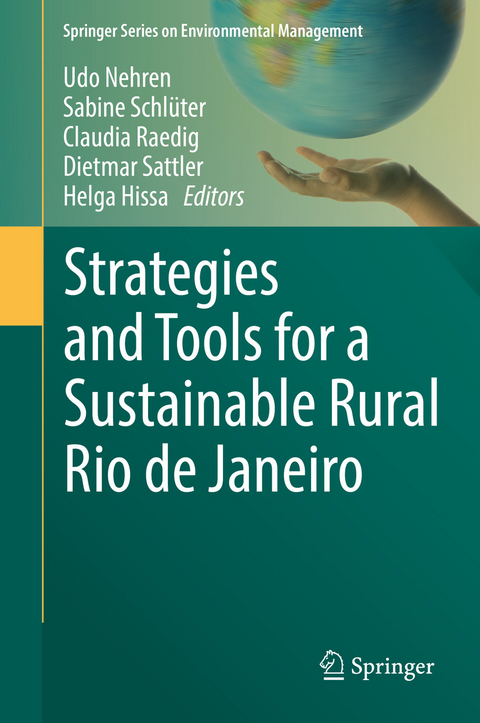
Strategies and Tools for a Sustainable Rural Rio de Janeiro (eBook)
XXXII, 513 Seiten
Springer International Publishing (Verlag)
978-3-319-89644-1 (ISBN)
This book is a compilation of recent developments in land, ecosystem, and water management in the Brazilian state of Rio de Janeiro. The state is located in the biodiversity hotspot of the Atlantic Forest (Mata Atlântica), a biome characterized by high biological diversity and endemism. At the same time the state of Rio de Janeiro emerged to one of the economic hubs in Latin America. This development process has been accompanied by population growth, industrialization, urbanization, as well as consumption and degradation of land and water resources. In the past years many efforts have been made to stop or at least slow down these degradation processes and restore degraded environments with the overall goal to bring together sustainable management of natural resources, nature conservation, and economic development.
An overview is provided of the different strategies and tools that have been developed in the fields of agriculture, ecosystem management and biodiversity, integrated water management, land restoration, disaster risk reduction and climate change adaptation, as well as environmental governance and economic instruments. This book covers a wide spectrum from applied research to science-policy interfaces, planning concepts, and technical tools and has a model character for other rural areas in Latin America. Target groups are scientists, practitioners, policy makers and graduate students in the field of environmental management. The different chapters are written by researchers and practitioners of the German-Brazilian project INTECRAL (Integrated Eco Technologies and Services for a Sustainable Rural Rio de Janeiro), the rural development program Rio Rural under the state secretary for agriculture and animal husbandry, as well as invited scientists from Brazilian universities and research institutes. It bridges existing gaps between science, policies, and practice in rural development.
Udo Nehren is a senior researcher and lecturer in Physical Geography and Ecosystem Management at the Institute for Technology and Resources Management in the Tropics and Subtropics, TH Köln - University of Applied Sciences, Germany. He received a PhD degree in Geography from Leipzig University, Germany and a habilitation in Geography from University of Passau, Germany. His research emphasizes landscape evolution, ecosystem-based disaster risk reduction and adaptation, and ecosystem management with regional foci in Latin America and Southeast Asia. Udo Nehren is author and editor of books and articles related to these topics and one of the developers of the Massive Open Online Course 'Disasters and Ecosystems: Resilience in a Changing Climate'.
Sabine Schlüter is a professor and senior researcher in Environment and Resource Economics at the Institute for Technology and Resources Management in the Tropics and Subtropics at TH Köln - University of Applied Sciences, Germany. She holds a PhD in Agricultural Sciences from the University of Bonn, Germany. Her research areas include valuation of environmental goods/services, farm system analysis, regional sector modeling, irrigation management/governance and food production chain analysis.
Claudia Raedig gained her PhD degree in Biology from Leipzig University, Germany. She works as a senior researcher and lecturer in the field of Biodiversity and Connectivity Conservation at the Institute for Technology and Resources Management in the Tropics and Subtropics at TH Köln - University of Applied Sciences, Germany. Her research focuses on connectivity conservation management, particularly on the development of strategies for enhancing connectivity for biodiversity conservation in tropical and coastal ecosystems in Southeast Asia and Latin America.
Helga Hissa is a senior soil researcher at EMBRAPA - the Brazilian Agricultural Research Corporation working at the Secretariat of Agriculture, Livestock, Food Supply and Fisheries of the State of Rio de Janeiro where she acts as technical coordinator of the Sustainable Rural Development Program - Rio Rural. She also leads projects in the area of Sustainable Agriculture and Ecosystems Services with support of the Global Environment Facility, World Bank, Inter-American Development Bank and the United Agency for Food and Agriculture. She is an agronomist engineer and earned a MSc degree in Soil Sciences from the Rural University of Rio de Janeiro, Brazil. Her work focuses on conservation agriculture, ecosystem services, and environment-agriculture integrated policies aiming at sustainability of conservation agriculture by smallholders.
Udo Nehren is a senior researcher and lecturer in Physical Geography and Ecosystem Management at the Institute for Technology and Resources Management in the Tropics and Subtropics, TH Köln - University of Applied Sciences, Germany. He received a PhD degree in Geography from Leipzig University, Germany and a habilitation in Geography from University of Passau, Germany. His research emphasizes landscape evolution, ecosystem-based disaster risk reduction and adaptation, and ecosystem management with regional foci in Latin America and Southeast Asia. Udo Nehren is author and editor of books and articles related to these topics and one of the developers of the Massive Open Online Course “Disasters and Ecosystems: Resilience in a Changing Climate”. Sabine Schlüter is a professor and senior researcher in Environment and Resource Economics at the Institute for Technology and Resources Management in the Tropics and Subtropics at TH Köln - University of Applied Sciences, Germany. She holds a PhD in Agricultural Sciences from the University of Bonn, Germany. Her research areas include valuation of environmental goods/services, farm system analysis, regional sector modeling, irrigation management/governance and food production chain analysis. Claudia Raedig gained her PhD degree in Biology from Leipzig University, Germany. She works as a senior researcher and lecturer in the field of Biodiversity and Connectivity Conservation at the Institute for Technology and Resources Management in the Tropics and Subtropics at TH Köln - University of Applied Sciences, Germany. Her research focuses on connectivity conservation management, particularly on the development of strategies for enhancing connectivity for biodiversity conservation in tropical and coastal ecosystems in Southeast Asia and Latin America. Dietmar Sattler is a biologist and senior researcher at the Institute of Geography, Leipzig University, Germany. He holds a PhD degree in Botany and Urban Ecology from the Leipzig University. His research emphasizes tropical forest fragmentation and carbon stock assessment, forest conservation strategies, and the assessment and rehabilitation of land degradation. He coordinated and participated in several international research and development projects mainly in Brazil with a focus on sustainable land use management and biodiversity conservation. Helga Hissa is a senior soil researcher at EMBRAPA – the Brazilian Agricultural Research Corporation working at the Secretariat of Agriculture, Livestock, Food Supply and Fisheries of the State of Rio de Janeiro where she acts as technical coordinator of the Sustainable Rural Development Program - Rio Rural. She also leads projects in the area of Sustainable Agriculture and Ecosystems Services with support of the Global Environment Facility, World Bank, Inter-American Development Bank and the United Agency for Food and Agriculture. She is an agronomist engineer and earned a MSc degree in Soil Sciences from the Rural University of Rio de Janeiro, Brazil. Her work focuses on conservation agriculture, ecosystem services, and environment-agriculture integrated policies aiming at sustainability of conservation agriculture by smallholders.
Strategies and tools for a sustainable rural Rio de Janeiro 1. Rio de Janeiro in times of global change (U. Nehren, H.Hissa, S. Schlüter, C. Raedig, D. Sattler) 2. Land use history of Rio de Janeiro (R. Scheel‐Ybert [not yet confirmed], U. Nehren, A. Kirchner, J. Heinrich) 3. Rural development in the state of Rio de Janeiro: The RioRural Programme (H. Hissa, N. Teixeira, M. Costa) 4. The German‐Brazilian project INTECRAL (S. Schlüter) Agricultural Management 5. Challenges and opportunities for a competitive sustainable agriculture in Rio de Janeiro (S. Schlüter, H. Hissa, N. Teixera, J. Torrico, H. Gaese) 6. Soil and water conservation management (J.M.G. Monteiro, R.B. Prado, A.P. Turetta, A. Schuler, E.C.C Fidalgo) 7. From design to implementation: A participatory appraisal for silvopastoral systems (SSPs) in Italva, Rio de Janeiro, Brazil (B. Quintana, L.A. Antunes, A. Pedraza) 8. Towards good agricultural practices (GAP) in smallholders' dairy production systems from an animal welfare perspective (M.L. Espinel, S. Schlüter, C. M. Resende) 9. Adequate harvesting technology for sugar cane producers in Rio de Janeiro (C.‐F. Gaese; Carlos Frederico Veiga, J. M. Ferreira, T. Meyer) Managing Ecosystems and Biodiversity 10. Integrating biodiversity conservation into ecosystem management in Rio de Janeiro (A. Piratelli, C. Raedig, J. Wesenberg) 11. Connectivity conservation management: linking private protected areas (C. Raedig, L. V. Guzmán Wolfhard) 12. Mapping and monitoring of protected riverine forest with Unmanned Aerial Vehicles (UAV) (G. Meier, L. Esquivel) 13. Bio‐indicator based hydromorphological assessment for watercourse development (D. Birnbaum, G. Meier) 14. Use of native tree species for ecological restoration and rehabilitation measures – a review (D. Sattler, P. Pena Rodrigues, C. Raedig, A. Hebner) 15. Value chains of native tree species using the example of C. echinata (S. Lichtenberg) Integrated Water Management 16. Integrated water resources management (L. Ribbe) 17. Eco‐hydrological modelling and scenario impact assessment in rural Rio de Janeiro (A. Künne, J. Santos, S. Kralisch, P. Selsam) 18. Service‐based software tools for eco‐hydrological system assessment (S. Kralisch, C. Schwartze, P. Selsam, F. Zander, A. Künne, J. Santos) 19. Reuse‐oriented decentralized wastewater and sewage sludge treatment for Small Urbanized Rural Settlement in Latin‐America. Lessons Learnt from Brazil (J. Cardona) 20. A tool to assess the impact of different land uses on surface water quality: WQI. (S. Penedo, R. Prado, A. Künne) 21. Developing a Methodology for community‐based water quality measurement (A. Gautam, J. Ramirez, M. Costa, L. Ribbe) Land restoration, disaster risk reduction and climate change adaptation 22. Land degradation, natural hazards and climate change: challenges for restoration, rehabilitation and adaptation (U. Nehren, D. Sattler, A.J. Teixeira Guerra [not yet confirmed]) 23. Rehabilitation of degraded sloped pastures ‐ lessons learned in Itaocara, RJ (R. Seliger, D. Sattler, A. Soares da Silva) 24. Ecosystem‐based approaches for disaster risk reduction and climate change adaptation (W. Lange, S. Sandholz, M. Becher, J. Viezzer, U. Nehren) 25. A multi‐criteria tool for site prioritization for land restoration and rehabilitation (F. Naegeli, E. Fidalgo) 26. Disaster risk reduction and local perception in flood risk areas. Study case in Nova Friburgo and Sao Fidelis municipalities, RJ‐Brazil (A. Bustillos, L. Ribbe, M. Evers) Environmental governance and economic instruments 27. Governance framework for environmental services provision in RJ (P. May) 28. Promoting sustainable agriculture and productivity gains: how to enhance the mitigation potential of the Rio de Janeiro Rural Development Program, Brazil (V. Rodriguez Osuna, D. Gaydarova, R. Wollenweber, J. Monteiro) 29. Emissions reduction opportunities by improving land use management in Rural Rio de Janeiro" (L. Noriega, F. Saraiva, D. Gaydarova‐Itrib) 30. Innovation and alternative income generation (O. Torres and U. Dornberger) 31. Conclusions and Outlook chapter (C. Raedig, H. Hissa, S. Schlüter, D. Sattler, U. Nehren)
| Erscheint lt. Verlag | 16.8.2018 |
|---|---|
| Reihe/Serie | Springer Series on Environmental Management | Springer Series on Environmental Management |
| Zusatzinfo | XXXII, 513 p. 125 illus., 113 illus. in color. |
| Verlagsort | Cham |
| Sprache | englisch |
| Themenwelt | Sachbuch/Ratgeber ► Natur / Technik ► Natur / Ökologie |
| Naturwissenschaften ► Geowissenschaften ► Geografie / Kartografie | |
| Schlagworte | Atlantic Forest • biodiversity hotspot • ecosystem management and biodiversity • Environmental Geography • Intecral • Rio de Janeiro state • science policy interface • sustainable management of natural resources • sustainable rural development |
| ISBN-10 | 3-319-89644-X / 331989644X |
| ISBN-13 | 978-3-319-89644-1 / 9783319896441 |
| Informationen gemäß Produktsicherheitsverordnung (GPSR) | |
| Haben Sie eine Frage zum Produkt? |
 PDF (Wasserzeichen)
DRM: Digitales Wasserzeichen
Dieses eBook enthält ein digitales Wasserzeichen und ist damit für Sie personalisiert. Bei einer missbräuchlichen Weitergabe des eBooks an Dritte ist eine Rückverfolgung an die Quelle möglich.
Dateiformat: PDF (Portable Document Format)
Mit einem festen Seitenlayout eignet sich die PDF besonders für Fachbücher mit Spalten, Tabellen und Abbildungen. Eine PDF kann auf fast allen Geräten angezeigt werden, ist aber für kleine Displays (Smartphone, eReader) nur eingeschränkt geeignet.
Systemvoraussetzungen:
PC/Mac: Mit einem PC oder Mac können Sie dieses eBook lesen. Sie benötigen dafür einen PDF-Viewer - z.B. den Adobe Reader oder Adobe Digital Editions.
eReader: Dieses eBook kann mit (fast) allen eBook-Readern gelesen werden. Mit dem amazon-Kindle ist es aber nicht kompatibel.
Smartphone/Tablet: Egal ob Apple oder Android, dieses eBook können Sie lesen. Sie benötigen dafür einen PDF-Viewer - z.B. die kostenlose Adobe Digital Editions-App.
Buying eBooks from abroad
For tax law reasons we can sell eBooks just within Germany and Switzerland. Regrettably we cannot fulfill eBook-orders from other countries.
aus dem Bereich