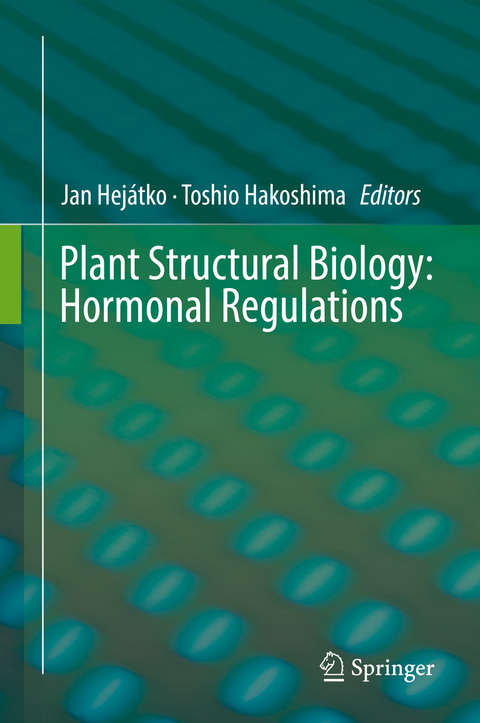
Plant Structural Biology: Hormonal Regulations (eBook)
VIII, 322 Seiten
Springer-Verlag
978-3-319-91352-0 (ISBN)
After decades of dominance of genetics and genomics, the importance of structural biology is growing exponentially in the field of plant biology. The main objectives of this new book series is to “demystify” structural biology for plant researchers and to provide important insights into the basic molecular mechanisms underlying plant development through the diverse approaches utilized by structural biologists. The book series starts with a theme dedicated to hormonal signaling that has benefited from the application of structural biology. “Plant Structural Biology: Hormonal Regulations” provides up-to-date knowledge of the structural aspects of hormonal signal recognition, signal transduction, hormonal control of downstream regulatory pathways and hormonal crosstalk. The most distinctive features of this book as well as future titles is/will be to provide overview of cutting-edge research in the field of plant structural biology, and to serve as a compendium of various approaches that could be applied to problems being solved in modern plant biology. Last but not least, we hope this book will facilitate and broaden the community of (not only) plant scientists who are interested in structural biology approaches and tools. For these reasons, the style of this series is concise and general, in order to avoiding unnecessary details. Explanatory boxes describing the basics of specific approaches (e.g. X-ray crystallography, NMR, SAXS, molecular dynamics simulations, etc.) are included.
Jan Hejatko obtained his Ph.D. in genetics and molecular biology at Masaryk University, Brno, Czech Republic under the supervision of Bretislav Brzobohaty and in the Max-Planck Institute for Plant Breeding, Cologne, Germany in the group of Klaus Palme. He continues his work in the field of hormonal signaling and hormonal regulation of plant development as a research group leader and associated professor at CEITEC - Central European Institute of Technology and National Centre for Biomolecular Research, Faculty of Science, Masaryk University. He is mainly interested in multi-step phosphorelay signaling, signal recognition, specificity and signal integration in plants.Toshio Hakoshima obtained his Ph.D. in physical chemistry and pharmaceutical sciences at Osaka University, Suita, Japan, followed by postdoctoral research work on structural biology supervised by Alexander Rich at Massachusetts Institute of Technology. In 1982, he joined the Osaka University faculty and continued his work on molecular recognition in protein-nucleic acid systems as an associated professor. In 1994, he moved to Nara Institute of Science and Technology as a professor of structural biology. He was promoted to the Dean of Graduate School of Biological Sciences (2013-2016) and then Executive Director/Vice President of the institute since 2017. He is interested in molecular recognition in signal transduction in the fields of medical science and plant biology and protein engineering of enzymes producing bioplastics.
Part I. Introduction.- 1. Overview of Proteins in the Plant Hormone Signaling.- 2. Overview of Protein Degradation in the Plant Hormone Signaling.- 3. Structural Insight into Recognition of Plant Peptide Hormones by Receptors.- Part II. Nuclear receptors.- 4. Auxin.- 5. Structural Biology of Jasmonic Acid Metabolism and Responses in Plants.- 6. Gibberellin.- 7. Strigolactone Signaling Proteins.- 8. Abscisic acid Signaling and Biosynthesis: protein structures and molecular probes.- Part III. Transmembrane Receptors.- 9. Brassinosteroid Sensing and Signaling in Plants.- 10. Cytokinin and Ethylene Signaling.- Part IV. Appendix: Method Guidance.- 11. X-Ray Crystallography.- 12. Nuclear Magnetic Resonance.- 13. Structural Biology Using Electron Microscopy.- 14. Biological Small-Angle X-ray Scattering (SAXS).- 15. Computational Molecular Modeling Techniques of Biomacromolecular Systems.
| Erscheint lt. Verlag | 17.8.2018 |
|---|---|
| Zusatzinfo | VIII, 322 p. 98 illus., 78 illus. in color. |
| Verlagsort | Cham |
| Sprache | englisch |
| Themenwelt | Naturwissenschaften ► Biologie ► Botanik |
| Naturwissenschaften ► Chemie | |
| Schlagworte | Arabidopsis • Molecular Biology • molecular dynamics simulations • NMR • plant development • Protein Structure • SAXS • signal transduction • X-ray crystallography |
| ISBN-10 | 3-319-91352-2 / 3319913522 |
| ISBN-13 | 978-3-319-91352-0 / 9783319913520 |
| Informationen gemäß Produktsicherheitsverordnung (GPSR) | |
| Haben Sie eine Frage zum Produkt? |
 PDF (Wasserzeichen)
DRM: Digitales Wasserzeichen
Dieses eBook enthält ein digitales Wasserzeichen und ist damit für Sie personalisiert. Bei einer missbräuchlichen Weitergabe des eBooks an Dritte ist eine Rückverfolgung an die Quelle möglich.
Dateiformat: PDF (Portable Document Format)
Mit einem festen Seitenlayout eignet sich die PDF besonders für Fachbücher mit Spalten, Tabellen und Abbildungen. Eine PDF kann auf fast allen Geräten angezeigt werden, ist aber für kleine Displays (Smartphone, eReader) nur eingeschränkt geeignet.
Systemvoraussetzungen:
PC/Mac: Mit einem PC oder Mac können Sie dieses eBook lesen. Sie benötigen dafür einen PDF-Viewer - z.B. den Adobe Reader oder Adobe Digital Editions.
eReader: Dieses eBook kann mit (fast) allen eBook-Readern gelesen werden. Mit dem amazon-Kindle ist es aber nicht kompatibel.
Smartphone/Tablet: Egal ob Apple oder Android, dieses eBook können Sie lesen. Sie benötigen dafür einen PDF-Viewer - z.B. die kostenlose Adobe Digital Editions-App.
Buying eBooks from abroad
For tax law reasons we can sell eBooks just within Germany and Switzerland. Regrettably we cannot fulfill eBook-orders from other countries.
aus dem Bereich