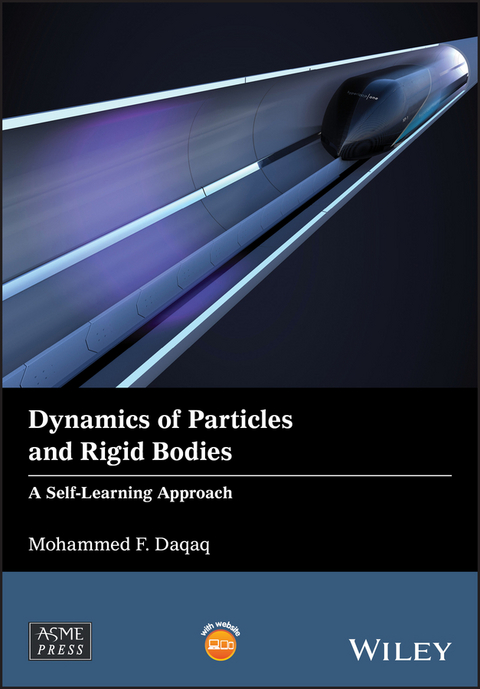
Dynamics of Particles and Rigid Bodies (eBook)
John Wiley & Sons (Verlag)
978-1-119-46319-1 (ISBN)

A unique approach to teaching particle and rigid body dynamics using solved illustrative examples and exercises to encourage self-learning
The study of particle and rigid body dynamics is a fundamental part of curricula for students pursuing graduate degrees in areas involving dynamics and control of systems. These include physics, robotics, nonlinear dynamics, aerospace, celestial mechanics and automotive engineering, among others. While the field of particle and rigid body dynamics has not evolved significantly over the past seven decades, neither have approaches to teaching this complex subject. This book fills the void in the academic literature by providing a uniquely stimulating, 'flipped classroom' approach to teaching particle and rigid body dynamics which was developed, tested and refined by the author and his colleagues over the course of many years of instruction at both the graduate and undergraduate levels.
Complete with numerous solved illustrative examples and exercises to encourage self-learning in a flipped-classroom environment, Dynamics of Particles and Rigid Bodies: A Self-Learning Approach:
- Provides detailed, easy-to-understand explanations of concepts and mathematical derivations
- Includes numerous flipped-classroom exercises carefully designed to help students comprehend the material covered without actually solving the problem for them
- Features an extensive chapter on electromechanical modelling of systems involving particle and rigid body motion
- Provides examples from the state-of-the-art research on sensing, actuation, and energy harvesting mechanisms
- Offers access to a companion website featuring additional exercises, worked problems, diagrams and a solutions manual
Mohammed F. Daqaq, PhD, is a Global Network Associate Professor of Mechanical Engineering at New York University, Abu Dhabi. His research focuses on the application of various nonlinear phenomena to improve the performance of micro-power generation systems, micro-electromechanical systems, and vibration assisted manufacturing processes. He serves as an Associate Editor of the ASME Journal of Vibration and Acoustics and as a Subject Editor of the Journal Nonlinear Dynamics.
A unique approach to teaching particle and rigid body dynamics using solved illustrative examples and exercises to encourage self-learning The study of particle and rigid body dynamics is a fundamental part of curricula for students pursuing graduate degrees in areas involving dynamics and control of systems. These include physics, robotics, nonlinear dynamics, aerospace, celestial mechanics and automotive engineering, among others. While the field of particle and rigid body dynamics has not evolved significantly over the past seven decades, neither have approaches to teaching this complex subject. This book fills the void in the academic literature by providing a uniquely stimulating, flipped classroom approach to teaching particle and rigid body dynamics which was developed, tested and refined by the author and his colleagues over the course of many years of instruction at both the graduate and undergraduate levels. Complete with numerous solved illustrative examples and exercises to encourage self-learning in a flipped-classroom environment, Dynamics of Particles and Rigid Bodies: A Self-Learning Approach: Provides detailed, easy-to-understand explanations of concepts and mathematical derivations Includes numerous flipped-classroom exercises carefully designed to help students comprehend the material covered without actually solving the problem for them Features an extensive chapter on electromechanical modelling of systems involving particle and rigid body motion Provides examples from the state-of-the-art research on sensing, actuation, and energy harvesting mechanisms Offers access to a companion website featuring additional exercises, worked problems, diagrams and a solutions manual Ideal as a textbook for classes in dynamics and controls courses, Dynamics of Particles and Rigid Bodies: A Self-Learning Approach is a godsend for students pursuing advanced engineering degrees who need to master this complex subject. It will also serve as a handy reference for professional engineers across an array of industrial domains.
Mohammed F. Daqaq, PhD, is a Global Network Associate Professor of Mechanical Engineering at New York University, Abu Dhabi. His research focuses on the application of various nonlinear phenomena to improve the performance of micro-power generation systems, micro-electromechanical systems, and vibration assisted manufacturing processes. He serves as an Associate Editor of the ASME Journal of Vibration and Acoustics and as a Subject Editor of the Journal Nonlinear Dynamics.
List of Figures
-
- Figure I.1 Aristotle.
- Figure I.2 Isaac Newton.
- Figure I.3 Leonhard Euler.
- Figure I.4 Joseph‐Louis Lagrange.
- Figure I.5 Projection of a vector into its different components along the unit vectors of a Cartesian coordinate system.
- Figure I.6 Graphical representation of the sum of two vectors.
- Figure I.7 Graphical representation of the Gauss divergence theorem.
- Figure I.8 Graphical representation of Stokes' theorem.
-
- Figure 1.1 Schematic of a simple pendulum.
- Figure 1.2 A 1‐2‐3 rotation performed to orient the ‐frame in the unit coordinates of the ‐frame.
- Figure 1.3 Relationship between the unit vectors of the ‐frame and the unit vectors of the ‐frame.
- Figure 1.4 Kinematics of a particle in an inertial frame.
- Figure 1.5 Kinematics of a particle in a rotating frame.
- Figure 1.6 Time rate of change of the unit vectors as a result of their rotation.
- Figure 1.7 Kinematics of a simple pendulum.
- Figure 1.8 Two‐dimensional motion of a particle.
- Figure 1.9 A rocket detected by a radar station.
- Figure 1.10 Description of the motion of a particle in a cylindrical coordinate system.
- Figure 1.11 Motion on a helix.
- Figure 1.12 Exercise 1.4.
- Figure 1.13 Exercise 1.6.
- Figure 1.14 Exercise 1.7.
- Figure 1.15 Exercise 1.8.
- Figure 1.16 Exercise 1.9.
- Figure 1.17Figure 1.17 Exercise 1.10.
- Figure 1.18Figure 1.18 Exercise 1.11.
-
- Figure 2.1 Schematic of a simple pendulum.
- Figure 2.2Figure 2.2 Frames used to describe the motion of the pendulum in Example 2.1.
- Figure 2.3 Free‐body diagram of the simple pendulum.
- Figure 2.4 Projectile motion.
- Figure 2.5 Free‐body diagram of a projectile in motion.
- Figure 2.6 Particle sliding along a smooth surface of radius .
- Figure 2.7 Free‐body diagram of a particle sliding along a circular surface.
- Figure 2.8 Influence of the Earth's rotation on projectile dynamics.
- Figure 2.9 Graphical representation of stiffness (spring) and viscous damping (dashpot).
- Figure 2.10 A spherical pendulum with an elastic cable.
- Figure 2.11 Coordinate system used to describe the kinematics/dynamics of the spherical pendulum.
- Figure 2.12 Free‐body diagram of a spherical pendulum.
- Figure 2.13 A method to obtain the static friction coefficient, .
- Figure 2.14 Motion of a particle in a rotating pipe with friction.
- Figure 2.15 Free‐body diagram of a particle moving inside a pipe.
- Figure 2.16 A schematic of a gantry crane.
- Figure 2.17 Free‐body diagram of a gantry crane.
- Figure 2.18 Two particles interacting due to Newton's law of gravitation.
- Figure 2.19 Dynamics of two particles with mutual gravitational interactions.
- Figure 2.20 Free‐body diagram of two particles with mutual gravitational interactions.
- Figure 2.21 Exercise 2.1.
- Figure 2.22 Exercise 2.2.
- Figure 2.23 Exercise 2.5.
- Figure 2.24 Exercise 2.6.
- Figure 2.25 Exercise 2.7.
- Figure 2.26 Exercise 2.8.
- Figure 2.27 Exercise 2.9.
- Figure 2.28 Exercise 2.10.
- Figure 2.29 Exercise 2.11.
- Figure 2.30 Exercise 2.14.
-
- Figure 3.1 Center of mass, , of particles.
- Figure 3.2 Center of mass, , of a continuous volume.
- Figure 3.3 Moment of inertia of one particle about a set of axes whose origin is located at .
- Figure 3.4 Example 3.1.
- Figure 3.5 Thin plate of area density .
- Figure 3.6 Parallel axis theorem.
- Figure 3.7 Thin plate of area density .
- Figure 3.8 Parallel axis theorem implemented on the thin plate of area density .
- Figure 3.9 Rotation of the inertia matrix for a triangular shape.
- Figure 3.10 General formula for a single rotation.
- Figure 3.11 Six degrees of freedom of a rigid body clearly illustrated using ship motion.
- Figure 3.12 Planar rigid‐body dynamics.
- Figure 3.13 Planar motion of a compound pendulum.
- Figure 3.14 Free‐body diagram of a compound pendulum.
- Figure 3.15 Free‐body diagram showing the internal forces.
- Figure 3.16 Schematic of a falling ladder released from rest at .
- Figure 3.17 Free‐body diagram of a falling ladder.
- Figure 3.18 A sphere rolling on a spherical surface.
- Figure 3.19 Free‐body diagram of the rolling sphere.
- Figure 3.20 Steering a motorcycle follows Euler's rotational equations.
- Figure 3.21 Non‐planar motion of a T‐shaped rod.
- Figure 3.22 Free body diagram of the T‐shaped rod.
- Figure 3.23 A top undergoing constant precession motion.
- Figure 3.24 Free‐body diagram.
- Figure 3.25 Rotating rod which loses contact with the horizontal surface.
- Figure 3.26 Free‐body diagram....
| Erscheint lt. Verlag | 13.8.2018 |
|---|---|
| Reihe/Serie | Wiley-ASME Press Series |
| Wiley-ASME Press Series | Wiley-ASME Press Series |
| Sprache | englisch |
| Themenwelt | Naturwissenschaften ► Physik / Astronomie ► Mechanik |
| Technik ► Maschinenbau | |
| Schlagworte | advanced dynamics • angular momentum of particles • applied dynamics • applied dynamics examples • applied dynamics exercises • Applied Mathematics in Engineering • Attitude Dynamics • Control Systems Technology • dynamics concepts • dynamics derivations • dynamics in aerospace engineering • dynamics in mechanical engineering • Dynamics Theory • Electrical & Electronics Engineering • electromechanical modeling of systems involving particle and rigid body motion • Elektrotechnik u. Elektronik • Engineering Dynamics • Euler angles • Festkörpermechanik • laws of kinematics • legrangian mechanics • linear momentum of particles • <p>dynamics • Maschinenbau • Mathematics • Mathematik • Mathematik in den Ingenieurwissenschaften • mechanical engineering • micro-electromechanical systems • motion of charged bodies in an electrical field • motion of rigid bodies in a three-dimensional space • particle and rigid body dynamics of energy harvesting systems</p> • particle dynamics • particle dynamics mathematics • quaternions • Regelungstechnik • Rigid Body Dynamics • rigid body mathematics • solid mechanics • surface linear motions • vectoral approach to rigid body dynamics |
| ISBN-10 | 1-119-46319-X / 111946319X |
| ISBN-13 | 978-1-119-46319-1 / 9781119463191 |
| Informationen gemäß Produktsicherheitsverordnung (GPSR) | |
| Haben Sie eine Frage zum Produkt? |
 EPUB (Adobe DRM)
Kopierschutz: Adobe-DRM
Adobe-DRM ist ein Kopierschutz, der das eBook vor Mißbrauch schützen soll. Dabei wird das eBook bereits beim Download auf Ihre persönliche Adobe-ID autorisiert. Lesen können Sie das eBook dann nur auf den Geräten, welche ebenfalls auf Ihre Adobe-ID registriert sind.
Details zum Adobe-DRM
Dateiformat: EPUB (Electronic Publication)
EPUB ist ein offener Standard für eBooks und eignet sich besonders zur Darstellung von Belletristik und Sachbüchern. Der Fließtext wird dynamisch an die Display- und Schriftgröße angepasst. Auch für mobile Lesegeräte ist EPUB daher gut geeignet.
Systemvoraussetzungen:
PC/Mac: Mit einem PC oder Mac können Sie dieses eBook lesen. Sie benötigen eine
eReader: Dieses eBook kann mit (fast) allen eBook-Readern gelesen werden. Mit dem amazon-Kindle ist es aber nicht kompatibel.
Smartphone/Tablet: Egal ob Apple oder Android, dieses eBook können Sie lesen. Sie benötigen eine
Geräteliste und zusätzliche Hinweise
Buying eBooks from abroad
For tax law reasons we can sell eBooks just within Germany and Switzerland. Regrettably we cannot fulfill eBook-orders from other countries.
aus dem Bereich