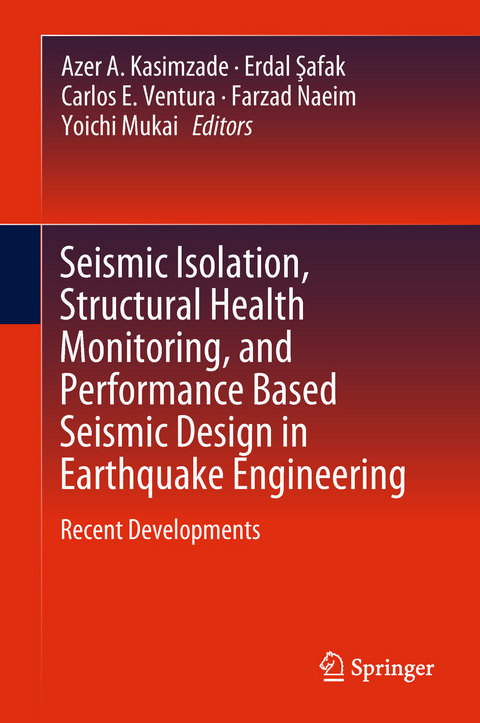
Seismic Isolation, Structural Health Monitoring, and Performance Based Seismic Design in Earthquake Engineering (eBook)
VIII, 364 Seiten
Springer International Publishing (Verlag)
978-3-319-93157-9 (ISBN)
This book features chapters based on selected presentations from the International Congress on Advanced Earthquake Resistance of Structures, AERS2016, held in Samsun, Turkey, from 24 to 28 October 2016.
It covers the latest advances in three widely popular research areas in Earthquake Engineering: Performance-Based Seismic Design, Seismic Isolation Systems, and Structural Health Monitoring.
The book shows the vulnerability of high-rise and seismically isolated buildings to long periods of strong ground motions, and proposes new passive and semi-active structural seismic isolation systems to protect against such effects. These systems are validated through real-time hybrid tests on shaking tables.
Structural health monitoring systems provide rapid assessment of structural safety after an earthquake and allow preventive measures to be taken, such as shutting down the elevators and gas lines, before damage occurs. Using the vibration data from instrumented tall buildings, the book demonstrates that large, distant earthquakes and surface waves, which are not accounted for in most attenuation equations, can cause long-duration shaking and damage in tall buildings.
The overview of the current performance-based design methodologies includes discussions on the design of tall buildings and the reasons common prescriptive code provisions are not sufficient to address the requirements of tall-building design. In addition, the book explains the modelling and acceptance criteria associated with various performance-based design guidelines, and discusses issues such as selection and scaling of ground motion records, soil-foundation-structure interaction, and seismic instrumentation and peer review needs.
The book is of interest to a wide range of professionals in earthquake engineering, including designers, researchers, and graduate students.
Carlos Ventura is a Civil Engineer with specializations in structural dynamics and earthquake engineering. Since 1992, he has been a faculty member of the Department of Civil Engineering at the University of British Columbia (UBC), Canada. He is currently the Director of the Earthquake Engineering Research Facility (EERF) at UBC, and the author of more than 450 papers and reports on earthquake engineering, structural dynamics and modal testing. Dr. Ventura has conducted research on earthquakes and structural dynamics for more than thirty years. Two of his most significant contributions in recent years are the development and implementation of a seismic structural health monitoring program for bridges in BC - the BCSIMS project - and the first network-based earthquake early warning system for schools and public institutions in BC, the BC-EEWN project. These two projects have contributed in a very significant manner to the seismic risk reduction efforts in British Columbia. In addition to his academic activities, Dr. Ventura is a recognized international consultant on structural vibrations and safety of large Civil Engineering structures. He is a member of the Canadian Academy of Engineering and of the Engineering Institute of Canada, and Fellow of Engineers Canada. He is also a member of several national and international professional societies, advisory committees and several building and bridge code committees.
Farzad Naeim is the President of Farzad Naeim, Inc. and CEO of Mehrain Naeim International, Inc., in Irvine, California. Prior to founding these firms, he was Technical Director at John A. Martin & Associates (JAMA) and its legal counsel. He regularly managed and facilitated activities of internal teams of experts in research and development activities, special seismic studies, and the design of specialized computer applications. For over 34 years Farzad's mission has been to take the best technology available and develop it into tailor-made computing facilities, design methodologies, analysis software, and earthquake-resistant design technologies. He developed an international reputation for cutting edge engineering and computer technology, and was awarded grants by such diverse agencies as the Earthquake Engineering Research Institute (EERI), the Federal Emergency Management Agency (FEMA), the County of Los Angeles, the California Strong Motion Instrumentation Program, Applied Technology Council (ATC), and the United States Geological Survey (USGS), for studying various damage characteristics of earthquakes and their impact on seismic design practice. He has served as Editor-in-Chief of Earthquake Spectra, President of EERI, inaugural Chair of the Governance Board of the U.S. Network for Earthquake Engineering Simulation (NEES), and as Chair of the 10th U.S. National Conference on Earthquake Engineering. He has also served as the President of the Los Angeles Tall Buildings Structural Design Council (LATBSDC) and, since 2005, has chaired LATBSDC committee in charge of the development of performance-based design guidelines for seismic design of tall buildings.
Yoichi Mukai graduated from the Faculty of Engineering at Osaka University in 1991 and finished his master degree at the Graduate School of Engineering, Osaka University in 1993. After completion of his master degree, he was appointed as a research associate at the Department of Architectural Engineering at Osaka University and as an associate professor in 2002. He received his Ph.D. in Engineering from Osaka University in 2001. His doctoral thesis focused on performance evaluation and application of active response control systems for building structures and it is a result of Dr. Mukai's strong research background on structural response control and control theory. Dr. Mukai was appointed as an associate professor at the Department of Residential Environment, Nara Women's University in 2005. He has been appointed as an associate professor at Graduate School of Engineering, Kobe University since 2011 and he has been vice chair for research projects at the Resilient Structure Research Center (ReSRC), Kobe University since 2016. In 2014, Dr. Mukai was a visiting scholar at the Department of Civil Engineering and Mechanical Engineering at Columbia University in New York City. His research interests focus on the evaluation and monitoring of the structural dynamic mechanisms of actual constructions, as well as on the control of their anti-seismic properties and their protecting building properties against large earthquakes. He is currently working on operating various kinds of real-time hybrid tests on the shaking table to develop and investigate advanced response control systems for building structures.Azer Arastunoglu Kasimzade is currently the Head of the Civil Engineering Department and head of the Earthquake Engineering Research facility of Ondokuz Mayis University in Samsun, Turkey. He received his PhD. and D.Sc. degrees in structural mechanics from Moscow Civil Engineering University in the Russian Federation respectively in 1983 and 1991. In 1991 he was a short-term visiting scholar at New Jersey Institute of Technology, Department of Civil & Environmental Engineering and at Princeton University, Department of Civil Engineering & Operation Research, New Jersey, USA. In the period 1992-1995 he was a professor at the Civil Engineering University, Department of Structural Mechanics. From 1978 to 1995 Kasimzade worked as Engineer and Consulting Engineer on national and international projects related to the development, structural modelling, testing, analysis and design of offshore petrol-gas production platforms in the Soviet Union Main Research & Project Institute Gipromorneftegaz, Mingazprom. Since 1995, he is a professor at Ondokuz Mayis University, Turkey, and is the Head of the Structural Mechanics group. In 2012-2013 he was appointed NATO project director for Science for Peace and Security Project, by the NATO Emerging Security Challenges Division. In 2014-2015 Kasimzade was visiting professor at the Department of Architecture, Kobe University, Japan. In October 2016 he was the chair of the “International Congress on Advanced Earthquake Resistant Structures-AERS2016”.He is a member of several national and international professional societies and advisory committees, the author of monographs, books and more than 110 papers and reports on structural modelling, earthquake engineering, seismic isolation, modal testing and system identification.Since 2008 Erdal Safak has been Head of the Earthquake Engineering Department of Kandilli Observatory and Earthquake Research Institute of Bogazici University in Istanbul, Turkey. From 1984 to 2006 he was a Researcher and Section Head at the U.S. Geological Survey’s Earthquake Research Group in the United States, and held part-time Professorship positions at Stanford University in California, Colorado School of Mines in Colorado, and at George Washington University in Washington DC. In 1973 and 1975 he received his BS and MS degrees from Istanbul Technical University, and in 1980 a PhD. degree from the University of Illinois at Urbana-Champaign in the US. He has published more than 40 refereed journal papers and more than 100 conference papers on subjects related to earthquake and wind induced response of structures, including seismic hazard and risk analysis, ground motion modeling, site amplification, structural instrumentation, data analysis, and system identification. Carlos Ventura is a Civil Engineer with specializations in structural dynamics and earthquake engineering. Since 1992, he has been a faculty member of the Department of Civil Engineering at the University of British Columbia (UBC), Canada. He is currently the Director of the Earthquake Engineering Research Facility (EERF) at UBC, and the author of more than 450 papers and reports on earthquake engineering, structural dynamics and modal testing. Dr. Ventura has conducted research on earthquakes and structural dynamics for more than thirty years. Two of his most significant contributions in recent years are the development and implementation of a seismic structural health monitoring program for bridges in BC - the BCSIMS project - and the first network-based earthquake early warning system for schools and public institutions in BC, the BC-EEWN project. These two projects have contributed in a very significant manner to the seismic risk reduction efforts in British Columbia. In addition to his academic activities, Dr. Ventura is a recognized international consultant on structural vibrations and safety of large Civil Engineering structures. He is a member of the Canadian Academy of Engineering and of the Engineering Institute of Canada, and Fellow of Engineers Canada. He is also a member of several national and international professional societies, advisory committees and several building and bridge code committees.Farzad Naeim is the President of Farzad Naeim, Inc. and CEO of Mehrain Naeim International, Inc., in Irvine, California. Prior to founding these firms, he was Technical Director at John A. Martin & Associates (JAMA) and its legal counsel. He regularly managed and facilitated activities of internal teams of experts in research and development activities, special seismic studies, and the design of specialized computer applications. For over 34 years Farzad’s mission has been to take the best technology available and develop it into tailor-made computing facilities, design methodologies, analysis software, and earthquake-resistant design technologies. He developed an international reputation for cutting edge engineering and computer technology, and was awarded grants by such diverse agencies as the Earthquake Engineering Research Institute (EERI), the Federal Emergency Management Agency (FEMA), the County of Los Angeles, the California Strong Motion Instrumentation Program, Applied Technology Council (ATC), and the United States Geological Survey (USGS), for studying various damage characteristics of earthquakes and their impact on seismic design practice. He has served as Editor-in-Chief of Earthquake Spectra, President of EERI, inaugural Chair of the Governance Board of the U.S. Network for Earthquake Engineering Simulation (NEES), and as Chair of the 10th U.S. National Conference on Earthquake Engineering. He has also served as the President of the Los Angeles Tall Buildings Structural Design Council (LATBSDC) and, since 2005, has chaired LATBSDC committee in charge of the development of performance-based design guidelines for seismic design of tall buildings. Yoichi Mukai graduated from the Faculty of Engineering at Osaka University in 1991 and finished his master degree at the Graduate School of Engineering, Osaka University in 1993. After completion of his master degree, he was appointed as a research associate at the Department of Architectural Engineering at Osaka University and as an associate professor in 2002. He received his Ph.D. in Engineering from Osaka University in 2001. His doctoral thesis focused on performance evaluation and application of active response control systems for building structures and it is a result of Dr. Mukai's strong research background on structural response control and control theory. Dr. Mukai was appointed as an associate professor at the Department of Residential Environment, Nara Women's University in 2005. He has been appointed as an associate professor at Graduate School of Engineering, Kobe University since 2011 and he has been vice chair for research projects at the Resilient Structure Research Center (ReSRC), Kobe University since 2016. In 2014, Dr. Mukai was a visiting scholar at the Department of Civil Engineering and Mechanical Engineering at Columbia University in New York City. His research interests focus on the evaluation and monitoring of the structural dynamic mechanisms of actual constructions, as well as on the control of their anti-seismic properties and their protecting building properties against large earthquakes. He is currently working on operating various kinds of real-time hybrid tests on the shaking table to develop and investigate advanced response control systems for building structures.
Preface 5
Contents 7
Seismic Isolation Systems 9
1 New Structural Seismic Isolation System 10
Abstract 10
1.1 Introduction 11
1.2 Governing Equations of Motion of the SFSSI System 15
1.3 Mathematical Model of Base Isolator 20
1.4 Governing Equation of Motion of Traditional LCRB/LRB Base-Isolated and Fixed Base Buildings 24
1.5 SFSSI System’s Free Vibration 25
1.6 Hysteretic Damping Model of Isolator 26
1.7 Solution Method of Equation of Motion 27
1.8 Numerical Study 28
1.9 Conclusions 55
Acknowledgements 55
Appendix 56
References 60
2 Development of Resilient Seismic Response Control with a Semi-active System 62
Abstract 62
2.1 Introduction 63
2.2 Special Feature and Function of Shaking Table 64
2.2.1 Basic Performance of Shaking Table 64
2.2.2 Function of Shaking Table as an Real-Time Hybrid Simulator 68
2.3 Feature of Semi-active Control Device and Test Specimen of Building Model 69
2.3.1 Mechanical Design of Newly Proposed Semi-active Damper 70
2.3.2 Performance Test of the Designed MR-RIM Damper 72
2.3.3 Test Specimen of Building Model for Shaking Table Experiments 74
2.4 RTHS Test for Semi-active Control System by Using Shaking Table 76
2.4.1 Outline of RTHS Test 76
2.4.2 Structural Design of Testing Model for Mid-Story Isolated Building 78
2.5 Semi-active Control Law 80
2.5.1 Basis of Proposed Control Law 81
2.5.2 Rule to Adjust Supplying Current for the MR Fluid According to Ground Velocity 82
2.5.3 Reproducibility and Validity of RTHS Test 83
2.5.3.1 Comparing the Results from RTHS Test and Pure Numerical Analysis 83
2.5.4 Reproducibility of Shaking Table Motion on RTHS Test 84
2.6 Conclusions 89
Acknowledgements 89
References 89
3 Horasan Mortar Bearings in Base Isolation with Centuries Experiences 91
Abstract 91
3.1 Introduction 92
3.2 Problem Identification 95
3.3 The Discovery of Restoring Mechanism Phenomenon of Earthquake and Its Application 98
3.4 Frictional Model for the Pure Friction (P-F) Seismic Isolation System 100
3.5 Four-Storey Building’s Mathematical Model with Frictional Bearing 106
3.6 Assessment of the NSI Device’s Material Stress–Strain Range 117
3.7 Conclusions 123
Appendix 124
References 130
New Developments on Structural Health Monitoring and Earthquake Early Warning Systems for Performance Assessment of Structures 134
4 BC Earthquake Early Warning System, a Program for Seismic Structural Health Monitoring of Infrastructure 135
Abstract 135
4.1 Introduction 135
4.2 Description of BCSIMS 136
4.3 Description of BC-EEWN 138
4.4 Integrating the EEW System and the SHM Program 140
4.4.1 Major Challenges 142
4.4.2 Proposing Framework 143
4.4.3 Client-Oriented Automated Deciding Concept (Cadence) 144
4.5 Conclusions 146
Acknowledgements 146
References 146
5 Structural Health Monitoring: Lessons Learned 148
Abstract 148
5.1 Introduction 149
5.2 SHM Networks in Istanbul 149
5.2.1 SHM Networks in Historical Structures 149
5.2.2 SHM Networks in Lifelines 150
5.2.3 SHM Networks in Buildings 151
5.3 Real-Time Analysis of SHM Data 152
5.4 Lessons Learned from SHM Data 155
5.4.1 Response of Long-Period Structures to Distant Large Earthquakes 155
5.4.2 Damping in Tall Buildings and Masonry Structures 156
5.4.3 Influence of Environmental Conditions on Structural Response 158
5.4.4 Amplitude and Duration Dependence of Modal Frequency 163
5.4.5 Structural Response During Explosions 164
5.4.6 Long-Term Deformation Monitoring 165
5.5 Conclusions 166
Acknowledgements 166
References 167
6 Earthquake Performance of Hagia Sophia 168
Abstract 168
6.1 Introduction 168
6.2 Past Earthquake Damages and Structural Interventions 169
6.3 Current Structure 172
6.4 Construction Materials 175
6.5 Structural Analysis 177
6.6 Ambient Vibration Testing and Strong Motion Instrumentation 183
6.7 Expected Earthquake Performance 187
6.8 Earthquake Retrofit and Strengthening 189
6.9 Conclusions 191
Acknowledgements 192
References 193
7 Recent Studies on Earthquake Performance Assessment of Hagia Sophia in Istanbul 197
Abstract 197
7.1 Introduction 197
7.2 Building History 198
7.3 Structural Analyses 199
7.4 Material Properties 199
7.5 Structural Monitoring 200
7.5.1 Accelerometric Network 200
7.5.2 Tiltmeters 202
7.5.3 Long-Term Deformation Monitoring 203
7.6 Subsurface Conditions 203
7.7 Strengthening Alternatives 203
7.8 Shake Table Model 204
7.9 Conclusions 204
References 205
8 Evaluation of Historical Merzifon Dönerta? Mosque with a Single Dome in Terms of Its Structure 207
Abstract 207
8.1 Introduction 207
8.2 The Architectural and Historical Features of the Mosque 208
8.3 Structural Analysis 209
8.3.1 Three-Dimensional Numerical Model 209
8.3.2 Self-load Analysis 210
8.3.3 Modal Analysis 212
8.3.4 Response Spectrum Analysis 214
8.4 Conclusions 216
References 217
9 Analytical and Experimental Modal Analysis of a Model Cold Formed Steel (CFS) Structures Using Microtremor Excitation 218
Abstract 218
9.1 Introduction 219
9.2 Modal Parameter Extractions 220
9.3 Description of Model (CFS) Structure 222
9.4 Analytical Modal Analysis of Model (CFS) Structure 222
9.5 Experimental Modal Analysis of Model (CFS) Structure 224
9.6 Conclusions 230
References 230
10 Optimal Estimation Example the Dynamic Parameters from Ambient Vibration for Modal Identification 233
Abstract 233
10.1 Introduction 234
10.2 Determination of Approximate Values of System Characteristic Matrices 235
10.3 System Characteristic Matrices Optimal Definite 238
10.4 Analytical Modal Analysis of Model Aluminum Structure 241
10.5 Experimental Modal Analysis of Model Aluminum Structure 242
10.6 Conclusion 244
References 244
Performance Based Seismic Design 247
11 Performance-Based Seismic Design of Tall Buildings—A USA Perspective 248
Abstract 248
11.1 Introduction 248
11.2 What Is a Tall Building? 249
11.3 Are Tall Buildings Particularly Vulnerable to Earthquake Ground Motions? 249
11.4 Should Tall Buildings Be Treated like Other Buildings? 250
11.5 Why Performance-Based Design Is a Necessity for Tall Buildings? 251
11.6 What Is Involved in Performance-Based Design of Tall Buildings? 253
11.7 Establishment of Performance Objectives 253
11.8 The Component-Based Approach 254
11.9 The System-Based Approach 256
11.10 Design Procedures 258
11.11 Evaluation Procedures 259
11.12 Analysis Methods 259
11.13 Modeling Criteria 261
11.14 Acceptability Criteria 264
11.15 Ground Motion Record Selection and Scaling 268
11.16 Peer Review Requirements 269
11.17 Instrumentation and Structural Health Monitoring 270
11.18 Conclusion 271
Acknowledgements 271
References 271
12 Performance-Based Evaluation of Hydrocarbon Steel Pipes Under Internal Pressure 274
Abstract 274
12.1 Introduction 275
12.2 Performance-Based Evaluation 275
12.2.1 Describing Limit States Under Internal Pressure 276
12.2.2 Developing Fragility Curves 276
12.2.3 Finite Element Analysis 277
12.3 Case Study 277
12.3.1 Material Properties and Limit States 277
12.3.2 Fragility Curves 278
12.3.3 3D Nonlinear Finite Element Analysis 278
12.3.3.1 Calibration Test 279
12.3.3.2 Nonlinear Finite Element Analyses 282
12.4 Conclusions 282
References 283
13 Seismic Energy Demands of Inverted V-Braced Frames 284
Abstract 284
13.1 Introduction 285
13.2 Evaluation of the Seismic Energy Demands in Parametric Study 286
13.2.1 Design of the Structures 286
13.2.2 Seismic Response of the SCBFs 289
13.3 Conclusion 289
Acknowledgements 291
References 292
14 A New Approach to Improving Seismic Safety Based on the Energy Theory of Reinforced Concrete Resistance 293
Abstract 293
14.1 Introduction 294
14.2 General Statements 294
14.3 The Basic Hypotheses 295
14.4 Deformation of Reinforced Concrete Beam with a Crack 297
14.5 Constructive Measures 301
14.6 Conclusions 303
References 303
15 Free Flexural Vibrations of Axially Loaded Timoshenko Beams with Internal Viscous Damping Using Dynamic Stiffness Formulation and Differential Transformation 304
Abstract 304
15.1 Introduction 304
15.2 The Mathematical Model and Formulation 306
15.3 The Differential Transform Method (DTM) 310
15.3.1 Application of DTM for Solving Equations of Motion 311
15.4 Dynamic Stiffness Formulation 315
15.5 Numerical Analysis and Discussions 317
15.6 Conclusions 323
References 323
16 Behavior of RC Square Column Strengthening with CFRP Strips Subjected to Low Velocity Lateral Impact Loading 326
Abstract 326
16.1 Introduction 326
16.2 Experimental Program 327
16.3 Experimental Results 331
16.4 Conclusions 331
References 338
17 Strain-Based Seismic Performance Evaluation of Prefabricated Structures 340
Abstract 340
17.1 Introduction 341
17.2 Structural Properties of Industrial Buildings 342
17.3 Structural Analysis of the Buildings 344
17.4 Seismic Performance Evaluation of the Buildings According to TEC 2007 345
17.5 Conclusions 349
References 350
18 Influence of Polypropylene Fibers on the Shear Strength of RC Beams Without Stirrups 352
Abstract 352
18.1 Introduction 353
18.2 Shear Strength of Beams 353
18.3 Experimental Program, Results and Discussion 355
18.3.1 Experimental Program 355
18.3.2 Experimental Results and Discussion 357
18.3.3 Comparison of Load–Deflection Relationships of Beams 359
18.4 Conclusions 360
Acknowledgements 360
References 360
| Erscheint lt. Verlag | 13.8.2018 |
|---|---|
| Zusatzinfo | VIII, 364 p. 195 illus., 116 illus. in color. |
| Verlagsort | Cham |
| Sprache | englisch |
| Themenwelt | Naturwissenschaften ► Physik / Astronomie |
| Technik ► Bauwesen | |
| Technik ► Maschinenbau | |
| Schlagworte | AERS 2016 • Earthquake Early Warning Systems • Earthquake resistant structures • Performance based earthquake engineering • Seismic Isolation of Structures • Structural Health Monitoring |
| ISBN-10 | 3-319-93157-1 / 3319931571 |
| ISBN-13 | 978-3-319-93157-9 / 9783319931579 |
| Informationen gemäß Produktsicherheitsverordnung (GPSR) | |
| Haben Sie eine Frage zum Produkt? |
 PDF (Wasserzeichen)
DRM: Digitales Wasserzeichen
Dieses eBook enthält ein digitales Wasserzeichen und ist damit für Sie personalisiert. Bei einer missbräuchlichen Weitergabe des eBooks an Dritte ist eine Rückverfolgung an die Quelle möglich.
Dateiformat: PDF (Portable Document Format)
Mit einem festen Seitenlayout eignet sich die PDF besonders für Fachbücher mit Spalten, Tabellen und Abbildungen. Eine PDF kann auf fast allen Geräten angezeigt werden, ist aber für kleine Displays (Smartphone, eReader) nur eingeschränkt geeignet.
Systemvoraussetzungen:
PC/Mac: Mit einem PC oder Mac können Sie dieses eBook lesen. Sie benötigen dafür einen PDF-Viewer - z.B. den Adobe Reader oder Adobe Digital Editions.
eReader: Dieses eBook kann mit (fast) allen eBook-Readern gelesen werden. Mit dem amazon-Kindle ist es aber nicht kompatibel.
Smartphone/Tablet: Egal ob Apple oder Android, dieses eBook können Sie lesen. Sie benötigen dafür einen PDF-Viewer - z.B. die kostenlose Adobe Digital Editions-App.
Buying eBooks from abroad
For tax law reasons we can sell eBooks just within Germany and Switzerland. Regrettably we cannot fulfill eBook-orders from other countries.
aus dem Bereich