


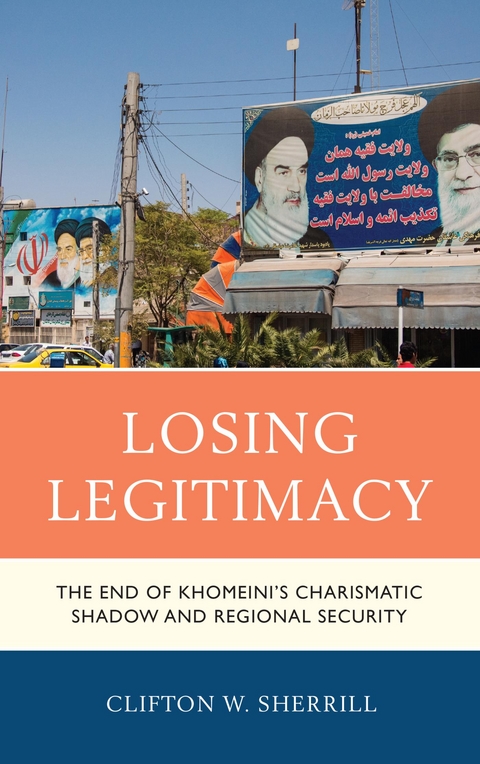
Losing Legitimacy (eBook)
260 Seiten
Lexington Books (Verlag)
978-1-4985-6415-1 (ISBN)

This book contends that the transition of leadership from Ayatollah Ali Khamenei will result in a crisis of legitimacy for the Islamic Republic of Iran. Using Max Weber's typology of legitimacy, the book explains that the Islamic Republic's legitimacy was based on the charismatic authority of the regime's founder, Ayatollah Ruhollah Khomeini. Since Khomeini's death in 1989, the regime has failed to develop the rule of law necessary for legal-rational authority. Moreover, it abandoned the logical underpinnings justifying clerical rule when a mid-ranking cleric rather than a Grand Ayatollah was placed in the position of Supreme Leader. With neither a legal basis nor a traditional basis of authority, the new leader relied extensively on the cover of Khomeini's charismatic shadow for legitimacy. After nearly four decades, this shadow is fading. Not only will Khamenei's successor lack the same direct ties to Khomeini, but the demographic and societal changes in Iran have made the charisma of Khomeini a historical concept rather than a viscerally felt experience. First the book analyzes the likely succession scenarios, finding the most probable outcome is the appointment of a hardline conservative backed by the regime's security forces. Next, the regime's economic, political, and social failures are presented, in order to explain why the new leader is likely to try to return to a traditional basis of legitimacy - religion. Thereafter, the book explains how this hardliner focus on religion is likely to result in an aggressive Iranian foreign policy toward the United States, Israel, and Saudi Arabia, impacting the region's security.
Clifton W. Sherrill is associate professor of political science at Troy University.
Chapter One: The Basis of Regime Legitimacy Chapter Two: Succession ScenariosChapter Three: Domestic Failures of the RegimeChapter Four: The Loss of Legitimacy and Foreign PolicyChapter Five: The Global StageChapter Six: The Regional StageChapter Seven: Conclusion
| Zusatzinfo | 2 Illustrations including: - 1 Maps; - 1 Tables. |
|---|---|
| Verlagsort | Lanham |
| Sprache | englisch |
| Themenwelt | Naturwissenschaften |
| Sozialwissenschaften ► Politik / Verwaltung ► Europäische / Internationale Politik | |
| Sozialwissenschaften ► Soziologie ► Spezielle Soziologien | |
| Schlagworte | Ali Khamenei • Diversionary theory • Iranian foreign policy • Iranian succession • Islamic Republic of Iran • Middle Eastern security • Political legitimacy • Post-Khamenei • supreme leader • velayat-e faqih |
| ISBN-10 | 1-4985-6415-1 / 1498564151 |
| ISBN-13 | 978-1-4985-6415-1 / 9781498564151 |
| Informationen gemäß Produktsicherheitsverordnung (GPSR) | |
| Haben Sie eine Frage zum Produkt? |
 EPUB (Adobe DRM)
Kopierschutz: Adobe-DRM
Adobe-DRM ist ein Kopierschutz, der das eBook vor Mißbrauch schützen soll. Dabei wird das eBook bereits beim Download auf Ihre persönliche Adobe-ID autorisiert. Lesen können Sie das eBook dann nur auf den Geräten, welche ebenfalls auf Ihre Adobe-ID registriert sind.
Details zum Adobe-DRM
Dateiformat: EPUB (Electronic Publication)
EPUB ist ein offener Standard für eBooks und eignet sich besonders zur Darstellung von Belletristik und Sachbüchern. Der Fließtext wird dynamisch an die Display- und Schriftgröße angepasst. Auch für mobile Lesegeräte ist EPUB daher gut geeignet.
Systemvoraussetzungen:
PC/Mac: Mit einem PC oder Mac können Sie dieses eBook lesen. Sie benötigen eine
eReader: Dieses eBook kann mit (fast) allen eBook-Readern gelesen werden. Mit dem amazon-Kindle ist es aber nicht kompatibel.
Smartphone/Tablet: Egal ob Apple oder Android, dieses eBook können Sie lesen. Sie benötigen eine
Geräteliste und zusätzliche Hinweise
Buying eBooks from abroad
For tax law reasons we can sell eBooks just within Germany and Switzerland. Regrettably we cannot fulfill eBook-orders from other countries.


