


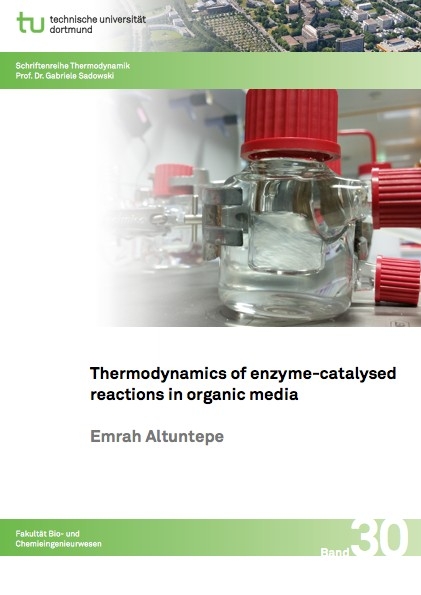
Thermodynamics of enzyme-catalysed reactions in organic media
Seiten
2018
Dr. Hut (Verlag)
978-3-8439-3684-2 (ISBN)
Dr. Hut (Verlag)
978-3-8439-3684-2 (ISBN)
- Keine Verlagsinformationen verfügbar
- Artikel merken
This work provides experimental data and thermodynamic modeling on phase and reaction equilibria of esterification mixtures in organic media. The acids levulinic and succinic acid were esterified with short chain alcohols. Candida antarctica Lipase B immobilized on acrylic resin was used as catalyst.
Liquid-liquid and vapor-liquid equilibria were measured for the binary systems consisting of reactants, products and solvents. The measured data and phase equilibria reported in literature were accurately modeled using PC-SAFT. For this purpose, pure-component PC-SAFT parameters, which were not already reported in literature, were adjusted to experimental literature pure-component data. Applying binary interaction parameters allowed precise phase-equilibrium modeling of the binary systems under investigation.
Prior to reaction equilibrium experiments, enzyme activity in the organic reaction medium was assured. It emerged, that a small amount of water in the initial reaction mixture enhanced enzyme activity and shortened equilibration time. Reaction-equilibrium experiments were performed for varying initial contents of acid and water in the reaction mixtures. This allowed calculating the apparent equilibrium constant Kx as function of concentration and temperature. Kx was shown to depend strongly on the content of water and acid as well as on temperature. It could be concluded that increasing the concentration of acid shifted the reaction equilibrium towards the products. Water had a strong effect on equilibrium, Kx increases with increasing initial water content. The concentration dependence of Kx values was explained by the activity coefficients of the reacting agents. PC-SAFT yielded Kγ values between 5 and 150. Thus, the esterification mixtures were highly non-ideal. Combining Kx and PC-SAFT predicted Kγ allowed determining Kth and the standard Gibbs energy of reaction as function of temperature. These values were shown to be in very good agreement with results obtained from formation property calculations.
A method was suggested to predict maximum yield of the esterification reactions depending on initial reactant compositions. For that purpose, standard Gibbs energy of reaction obtained from formation properties was used as input. Further, activity coefficients of the reacting agents were predicted with PC-SAFT. The accuracy of the so-obtained predictions was validated by reaction experiments, and the results were in very good agreement.
Liquid-liquid and vapor-liquid equilibria were measured for the binary systems consisting of reactants, products and solvents. The measured data and phase equilibria reported in literature were accurately modeled using PC-SAFT. For this purpose, pure-component PC-SAFT parameters, which were not already reported in literature, were adjusted to experimental literature pure-component data. Applying binary interaction parameters allowed precise phase-equilibrium modeling of the binary systems under investigation.
Prior to reaction equilibrium experiments, enzyme activity in the organic reaction medium was assured. It emerged, that a small amount of water in the initial reaction mixture enhanced enzyme activity and shortened equilibration time. Reaction-equilibrium experiments were performed for varying initial contents of acid and water in the reaction mixtures. This allowed calculating the apparent equilibrium constant Kx as function of concentration and temperature. Kx was shown to depend strongly on the content of water and acid as well as on temperature. It could be concluded that increasing the concentration of acid shifted the reaction equilibrium towards the products. Water had a strong effect on equilibrium, Kx increases with increasing initial water content. The concentration dependence of Kx values was explained by the activity coefficients of the reacting agents. PC-SAFT yielded Kγ values between 5 and 150. Thus, the esterification mixtures were highly non-ideal. Combining Kx and PC-SAFT predicted Kγ allowed determining Kth and the standard Gibbs energy of reaction as function of temperature. These values were shown to be in very good agreement with results obtained from formation property calculations.
A method was suggested to predict maximum yield of the esterification reactions depending on initial reactant compositions. For that purpose, standard Gibbs energy of reaction obtained from formation properties was used as input. Further, activity coefficients of the reacting agents were predicted with PC-SAFT. The accuracy of the so-obtained predictions was validated by reaction experiments, and the results were in very good agreement.
| Erscheinungsdatum | 01.08.2018 |
|---|---|
| Reihe/Serie | Thermodynamik |
| Verlagsort | München |
| Sprache | englisch |
| Maße | 148 x 210 mm |
| Gewicht | 313 g |
| Themenwelt | Naturwissenschaften ► Physik / Astronomie ► Thermodynamik |
| Technik | |
| Schlagworte | PC-SAFT • Reaction equilibrium • water activity |
| ISBN-10 | 3-8439-3684-6 / 3843936846 |
| ISBN-13 | 978-3-8439-3684-2 / 9783843936842 |
| Zustand | Neuware |
| Informationen gemäß Produktsicherheitsverordnung (GPSR) | |
| Haben Sie eine Frage zum Produkt? |
Mehr entdecken
aus dem Bereich

aus dem Bereich
Hauptsätze, Prozesse, Wärmeübertragung
Buch | Softcover (2023)
De Gruyter Oldenbourg (Verlag)
CHF 69,90
Von Energie und Entropie zu Wärmeübertragung und Phasenübergängen
Buch | Softcover (2023)
De Gruyter Oldenbourg (Verlag)
CHF 83,90


