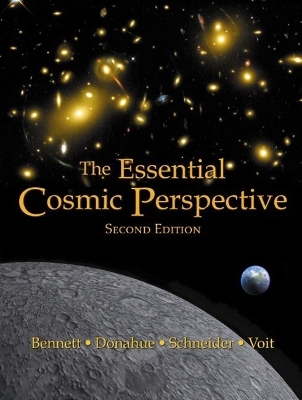
The Essential Cosmic Perspective
Pearson Education (US)
978-0-8053-8584-7 (ISBN)
- Titel erscheint in neuer Auflage
- Artikel merken
Jeffrey Bennett received a B.A. in biophysics from the University of California at San Diego in 1981 and a Ph.D. in astrophysics from the University of Colorado in 1987. He currently spends most of his time as a teacher, speaker, and writer. He has taught extensively at all levels, including having founded and run a science summer school for elementary and middle school children. At the college level, he has taught more than 50 college courses in astronomy, physics, mathematics, and education. He served two years as a visiting senior scientist at NASA headquarters, where he helped create numerous programs for science education. He also proposed the idea for and helped develop the Voyage Scale Model Solar System, which opened in 2001 on the National Mall in Washington, D.C. Besides his astronomy textbooks, he has written college-level textbooks in astronomy, mathematics, and statistics, and a book for the general public, On the Cosmic Horizon (Addison-Wesley, 2001). He also recently completed his first children's book, Max Goes to the Moon (Big Kid Science, 2003). When not working, he enjoys participating in masters swimming and in the daily adventures of life with his wife, Lisa, his children Grant and Brooke, and his dog, Max. Megan Donahue is an astronomer at the Space Telescope Science Institute in Baltimore, Maryland. After growing up in rural Nebraska, she obtained an S.B. in physics from the Massachusetts Institute of Technology in 1985 and a Ph.D. in astrophysics from the University of Colorado in 1990. Her thesis on intergalactic galaxies won the Robert J. Trumpler Award (1993). She continued her research as a Carnegie Fellow at the Observatories of the Carnegie Institution in Pasadena, California, and later was an Institute Fellow at the Space Telescope Science Institute. She is an active observer, using ground-based telescopes, the Hubble Space Telescope, and orbiting X-ray telescopes. Her research focuses on questions of galaxy evolution, the nature of intergalactic space, large-scale structure formation, dark matter, and the fate of the universe. She married Mark Voit while in graduate school and they are the parents of two children, Michaela and Sebastian. Nicholas Schneider is an associate professor in the Department of Astrophysical and Planetary Sciences at the University of Colorado and a researcher in the Laboratory for Atmospheric and Space Physics. He received his B.A. in physics and astronomy from Dartmouth College in 1979 and his Ph.D. in planetary science from the University of Arizona in 1988. In 1991, he received the National Science Foundation's Presidential Young Investigator Award. His research interests include planetary atmospheres and planetary astronomy, with a focus on the odd case of Jupiter's moon Io. He enjoys teaching at all levels and is active in efforts to improve undergraduate astronomy education. Off the job, he enjoys exploring the outdoors with his family and figuring out how things work. Mark Voit is an astronomer in the Office of Public Outreach at the Space Telescope Science Institute. He earned his A.B. in physics at Princeton University in 1983 and his Ph.D. in astrophysics at the University of Colorado in 1990. He continued his studies at the California Institute of Technology, where he was Research Fellow in theoretical astrophysics. NASA then awarded him a Hubble Fellowship, under which he conducted research at the Johns Hopkins University. His research interests range from interstellar processes in our own galaxy to the clustering of galaxies in the early universe. Occasionally he escapes to the outdoors, where he and his wife, Megan Donahue, enjoy running, hiking, orienteering, and playing with their children. Mark is also author of the popular book Hubble Space Telescope: New Views of the Universe.
I. DEVELOPING PERSPECTIVE.
1. Our Place in the Universe.
2. Discovering the Universe for Yourself.
II. KEY CONCEPTS FOR ASTRONOMY.
3. The Science of Astronomy.
4. A Universe of Matter and Energy.
5. Universal Motion.
6. Telescopes and Spacecraft.
III. LEARNING FROM OTHER WORLDS.
7. Formation of the Solar System.
8. The Terrestrial Worlds.
9. Jovian Planet Systems.
10. Remnants of Rock and Ice: Asteroids, Comets, and Pluto.
11. Planet Earth and Its Lessons on Life in the Universe.
IV. STELLAR ALCHEMY.
12. Our Star.
13. Stars.
14. Star Stuff.
15. The Bizarre Stellar Graveyard.
V. GALAXIES AND BEYOND.
16. Our Galaxy.
17. A Universe of Galaxies.
18. Dark Matter and the Fate of the Universe.
19. The Beginning of Time.
20. Interstellar Travel and the Search for Extraterrestrial Civilizations.
APPENDIXES.
Appendix A: Useful Numbers.
Appendix B: Useful Formulas.
Appendix C: A Few Mathematical Skills.
Appendix D: The Periodic Table of the Elements.
Appendix E: Planetary Data.
Appendix F: Stellar Data.
Appendix G: Galaxy Data.
Appendix H: Selected Astronomical Web Sites.
Appendix I: The 88 Constellations.
Appendix J: Star Charts.
Glossary.
Acknowledgments & Credits.
Index.
| Erscheint lt. Verlag | 8.8.2003 |
|---|---|
| Verlagsort | Upper Saddle River |
| Sprache | englisch |
| Gewicht | 1165 g |
| Themenwelt | Naturwissenschaften ► Physik / Astronomie ► Astronomie / Astrophysik |
| ISBN-10 | 0-8053-8584-3 / 0805385843 |
| ISBN-13 | 978-0-8053-8584-7 / 9780805385847 |
| Zustand | Neuware |
| Informationen gemäß Produktsicherheitsverordnung (GPSR) | |
| Haben Sie eine Frage zum Produkt? |
aus dem Bereich