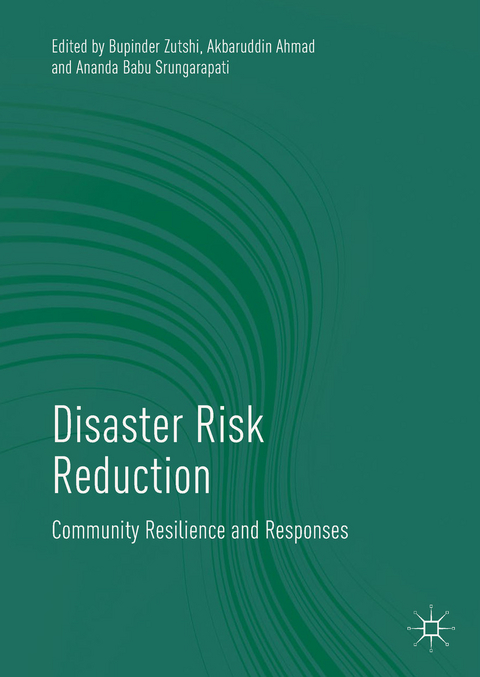
Disaster Risk Reduction (eBook)
361 Seiten
Springer Singapore (Verlag)
978-981-10-8845-2 (ISBN)
This book discusses the interconnected, complex and emerging risks in today's societies and deliberates on the various aspects of disaster risk reduction strategies especially through community resilience and responses. It consists of selected papers presented at the World Congress on Disaster Management, which focused on community resilience and responses towards disaster risk reduction based on South Asian experiences, and closely examines the coordinated research activities involving all stakeholders, especially the communities at risk. Further, it narrates the experiences of disaster risk-reduction in different communities that have policy implications for mitigation of future disaster risks in the societies affected by these types of disasters. Written from the social science perspective to disasters rather than an engineering approach, the book helps development and governance institutions to prioritize disasters as a problem of development rather than being parallel to it.
Bupinder Zutshi is Professor, Centre for the Study of Regional Development and Registrar, Director Admissions and Controller of Examinations with the Jawaharlal Nehru University, New Delhi, India. He has more than 37 years of teaching and research experience at post-graduate and research level. Has published 7 books, completed more than dozen research projects and written several research articles (more than 35) in several research journals of repute, published from India and abroad. Has organized and also participated/ presented research papers in several national and international seminars and conferences. His major research interest is issues related to human settlements and their changing habitat. He also works on issues related to demographic changes and their consequences on population composition and population characteristics. He has written books on consequences of Bt Cotton cultivation (Bt Cotton cultivation in India: Illusions of Success, Wisdom Publication, 2012), food security among marginalized communities, status of elementary and higher education (Status of Elementary Education in India, Pentagon Press, 2012), child labour situation (Globalisation, Development and Child Rights, co-edited with Kailash Satyarthi, Shipra Publications, New Delhi, 2006; In The Name of Child Labour: Eradication and Evaluation Programme, co-Ed, Shipra Publication, New Delhi, 2002; Child Labour: Rehabilitation In India, BPR Publishers, 2003 ), disability population - their status and need assessments. He has completed several research projects sponsored by national and international organizations, on topics such as Knowledge, Attitude, Behavior, Belief and Practices (KABBP) of electorates in Uttar Pradesh, migration and human trafficking, child education, child labour, non-formal education, gender studies and disability studies. Many of his research projects have been sponsored by UN Women (UNIFEM), UNESCO (New Delhi), International Bureau of Education (IBE, Geneva), United Nations High Commissioner for Human Rights (Geneva), Ford Foundation (New Delhi), International Labour Organization (New Delhi), the Policy Science Centre, Inc.USA (supported by the Learning and Research Program on Culture and Poverty of the World Bank), US AID, Global March Against Child Labour, National Human Rights Commission of India, Election Commission of India and Indian Council for Social Science and Research.
This book discusses the interconnected, complex and emerging risks in today's societies and deliberates on the various aspects of disaster risk reduction strategies especially through community resilience and responses. It consists of selected papers presented at the World Congress on Disaster Management, which focused on community resilience and responses towards disaster risk reduction based on South Asian experiences, and closely examines the coordinated research activities involving all stakeholders, especially the communities at risk. Further, it narrates the experiences of disaster risk-reduction in different communities that have policy implications for mitigation of future disaster risks in the societies affected by these types of disasters. Written from the social science perspective to disasters rather than an engineering approach, the book helps development and governance institutions to prioritize disasters as a problem of development rather than being parallel to it.
Bupinder Zutshi, Professor, Centre for the Study of Regional Development, Jawaharlal Nehru University, New Delhi, India. Prof. Zutshi has more than 38 years of teaching and research experience at post-graduate and research level. He has published 7 books, completed more than dozen research projects and written several research articles in research journals of repute published from India and abroad. He has organized several national and international seminars and conferences. His major research interests are issues related to human settlements and their changing habitat, disaster risk and vulnerability of human settlements. Other research interests are issues related to demographic changes and their consequences on population composition and population characteristics, education and child labour issues, studies on tribal communities. He has completed several research projects sponsored by national and international organizations, which includes UN Women (UNIFEM), UNESCO (New Delhi), International Bureau of Education (IBE, Geneva), United Nations High Commissioner for Human Rights (Geneva), Ford Foundation (New Delhi), International Labour Organization (New Delhi), National Human Rights Commission of India, Election Commission of India and Indian Council for Social Science and Research. Prof. Dr. Akbaruddin Ahmad is the Director and Professor Bircham International University, Spain and Vice Chancellor, Darul Ihsan University, Bangladesh and Chairman of Bangladesh's leading civil society think tank, Policy Research Centre.bd.(PRC.bd). At present he is involved as the Chairman, Network of Asia Pacific Schools and Institute of Public Administration and Governance (NAPSIPAG) earlier headquartered at the Jawharlal Nehru University (JNU), New Delhi, now transferred to Colombo. He is also the Editor-in-Chief, Finance World Ltd. a weekly tabloid and Chairman, Royal Resort the only heritage resort in Bangladesh that manages the famous heritage palaces and mosque of the Nawab Bahadur Syed Nawab Ali Chowdhury, the co-founder of the Dhaka University. He is the General Body Member of the Federation of Bangladesh Chambers of Commerce and Industry (FBCCI). He is a reputed educationist and financial expert. He is a commerce graduate from the Dhaka University and obtained his MBA in Banking from the Edward University, USA and PhD in Banking & Finance from the Bircham International University, Spain. He is an outstanding scholar, management specialist with exposure in management of educational institutions of higher learning, financial institutions, banks and civil society think tank. Prof. Dr. Akbaruddin Ahmad is widely traveled and attended national, regional and international conferences, seminars and presented papers on disaster management, disaster law, financial sector reforms and tourism and authored several books and technical papers. He is a prolific writer and regular contributor to national dailies and peer reviewed national and international journals. He delivered lectures in BBA and MBA Programs. He has worked as a Senior Consultant for the World Bank/USAID for the Financial Sector Reform Project (FSRP) for the restructuring of four nationalized commercial banks and the Bangladesh Bank. He was also “IT” Advisor for Janata Bank, Rupali Bank and the Bangladesh Computer Council. Prof. Ahmad worked as the Vice-Chairman, International Information Systems Inc., Lowell, Mass., USA and Managing Director, Jeraisy Computer Services & Riyadh House Est., Saudi Arabia. He also worked as Senior Consultant, KPMG/ Rahman Rahman & Huq, Chartered Accountants. He has set up several schools, college, madrasahs as donor and founder and involved in several socio-cultural, religious and economic activities. Dr. Ananda Babu Srungarapati is a societal awareness specialist, and a scholar. As the founder President of DMICS (Disaster Management Initiatives and Convergence Society), he has so far conducted Ten National and International Conferences and Two World Congresses on Disaster Management. He has recently edited and published ‘Together for a Safer World’, proceedings of the Second World Congress on Disaster Management. Dr. Ananda Babu’s PhD Thesis – Rethinking the Subaltern: Babu Jagjivan Ram and the Dialectic of Marginality from the Department of English, Osmania University, reflects his clarity of thinking and conviction of courage in matters of social justice and general well being of Indian society.
Chapter 1: The struggles of women: An Experience from the flood prone area.- Chapter 2: Innovative use of Technology (GIS) forStructural Inequality and Disaster Risk Reduction: An Indian Experience Disaster Risk Reduction- a case study.- Chapter 3: Bridging the Gap Between Academicians & Bureaucrats- the NYSAF Way.- Chapter 4: Recovery after Disasters- Problems and Prospects: The Case of Koslanda -Meeriyabedda Landslide in Sri Lanka.- Chapter 5: Indigenous Knowledge and Practices in Disaster Management: Experie.- Chapter 6: Nces of the Coastal People of Bangladesh.- Chapter 7: Mainstreaming Nuclear Disaster Risk Reduction in India.- Chapter 8: Integrating disaster management content in to social work curriculum-voices of social work students.- Chapter 9: Coordination Does Matter for Effective Disaster Management in the Coastal Areas in Bangladesh.- Chapter 10: Cyclone Aila: Immediate Challenges and Impact on Socio-Economy.- Chapter 11: Post-traumatic Stress Disorder and Depression among the Survivors of Nepal Earthquake: A Need Assessment Study.- Chapter 12: Linking Gender vulnerability and Disasters.- Chapter 13: A Sociological Perspective on ‘Institutional Coordination’ for Disaster Risk Reduction in India.
| Erscheint lt. Verlag | 10.7.2018 |
|---|---|
| Zusatzinfo | XXX, 361 p. 35 illus., 7 illus. in color. |
| Verlagsort | Singapore |
| Sprache | englisch |
| Themenwelt | Naturwissenschaften ► Biologie ► Ökologie / Naturschutz |
| Sozialwissenschaften ► Pädagogik ► Sozialpädagogik | |
| Sozialwissenschaften ► Soziologie | |
| Technik | |
| Schlagworte | Community Resilience • community response • disaster management • Disaster Recovery • Disaster Risk-reduction • Indigenous knowledge • innovative technology • Mapping Disaster Vulnerability • Structural Inequalities |
| ISBN-10 | 981-10-8845-4 / 9811088454 |
| ISBN-13 | 978-981-10-8845-2 / 9789811088452 |
| Informationen gemäß Produktsicherheitsverordnung (GPSR) | |
| Haben Sie eine Frage zum Produkt? |
 PDF (Wasserzeichen)
DRM: Digitales Wasserzeichen
Dieses eBook enthält ein digitales Wasserzeichen und ist damit für Sie personalisiert. Bei einer missbräuchlichen Weitergabe des eBooks an Dritte ist eine Rückverfolgung an die Quelle möglich.
Dateiformat: PDF (Portable Document Format)
Mit einem festen Seitenlayout eignet sich die PDF besonders für Fachbücher mit Spalten, Tabellen und Abbildungen. Eine PDF kann auf fast allen Geräten angezeigt werden, ist aber für kleine Displays (Smartphone, eReader) nur eingeschränkt geeignet.
Systemvoraussetzungen:
PC/Mac: Mit einem PC oder Mac können Sie dieses eBook lesen. Sie benötigen dafür einen PDF-Viewer - z.B. den Adobe Reader oder Adobe Digital Editions.
eReader: Dieses eBook kann mit (fast) allen eBook-Readern gelesen werden. Mit dem amazon-Kindle ist es aber nicht kompatibel.
Smartphone/Tablet: Egal ob Apple oder Android, dieses eBook können Sie lesen. Sie benötigen dafür einen PDF-Viewer - z.B. die kostenlose Adobe Digital Editions-App.
Buying eBooks from abroad
For tax law reasons we can sell eBooks just within Germany and Switzerland. Regrettably we cannot fulfill eBook-orders from other countries.
aus dem Bereich