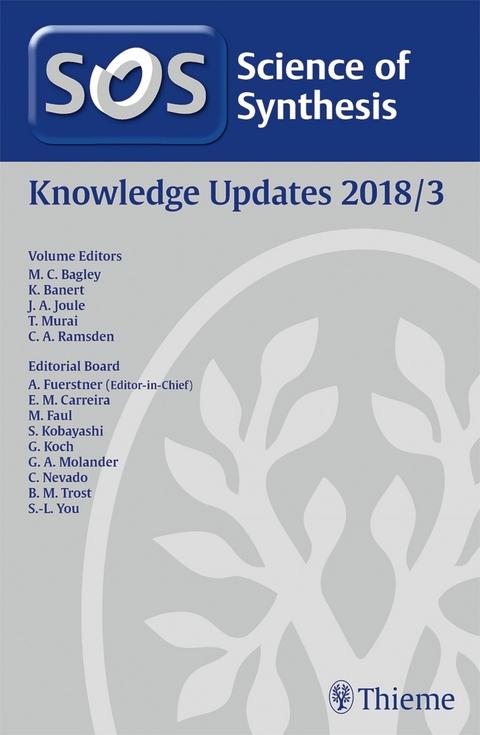
Science of Synthesis: Knowledge Updates 2018 Vol. 3 (eBook)
Thieme (Verlag)
978-3-13-242322-0 (ISBN)
Science of Synthesis: Knowledge Updates 2018/3 1
Title Page 7
Copyright 8
Preface 9
Abstracts 11
Overview 17
Table of Contents 19
10.2 Product Class 2: Benzo[c]furan and Its Derivatives 35
10.2.1 Product Subclass 1: Benzo[c]furans 35
10.2.1.1 Synthesis by Ring-Closure Reactions 46
10.2.1.1.1 Annulation to an Arene 46
10.2.1.1.1.1 Formation of One O—C and One C—C Bond 46
10.2.1.1.1.1.1 Method 1: From Aromatic Ketimines and Aldehydes by Rhenium Catalysis 46
10.2.1.1.1.1.1.1 Variation 1: From Ketimines and Benzyl Alcohol 48
10.2.1.1.1.2 Formation of One O—C Bond 49
10.2.1.1.1.2.1 Method 1: From 2-Alkynylbenzyl Alcohols or Their Derivatives 49
10.2.1.1.1.2.1.1 Variation 1: From 2-Alkynylbenzyl Alcohols Using a Palladium Catalyst 49
10.2.1.1.1.2.1.2 Variation 2: From 2-Alkynylbenzyl Alcohols or O-Silylated Derivatives and an Aryl Iodide Using a Palladium Catalyst 51
10.2.1.1.1.2.1.3 Variation 3: From 2-Ethynylbenzyl Alcohols via Carbocyclization with Aryl Iodides and Carbon Monoxide Using a Palladium Catalyst under Basic Conditions 53
10.2.1.1.1.2.2 Method 2: From (2-Alkynylaryl)aldehydes and Ketones and Fischer Carbene Complexes 55
10.2.1.1.1.2.2.1 Variation 1: From (2-Alkynylaryl)aldehydes or 2-Alkynylaryl Ketones and Fischer Carbene Complexes 55
10.2.1.1.1.2.2.2 Variation 2: From 2-Alkynylaldehydes and Chromium–Dicyanocarbene Complexes 58
10.2.1.1.1.2.2.3 Variation 3: From 2-Enynylbenzaldehydes and a Chromium–Carbene Complex 59
10.2.1.1.1.2.2.4 Variation 4: From 2-Ethynyl-N,N-dimethylbenzamide and a Fischer Carbene Complex 60
10.2.1.1.1.2.3 Method 3: From 2-Ethynylbenzoyl–Rhenium Complexes 61
10.2.1.1.1.2.4 Method 4: From 2-Alkynylbenzaldehydes by Palladium-Catalyzed Cycloreduction 63
10.2.1.1.1.2.5 Method 5: From Bis(2-aroylphenyl)acetylenes by Photochemical Exocyclic [2 + 2 + 2] Cycloaddition 64
10.2.1.1.1.2.6 Method 6: From 2-Alkenylbenzaldehydes 65
10.2.1.1.1.2.7 Method 7: From Acetals of 2-(Hydroxymethyl)benzaldehydes 66
10.2.1.1.1.2.8 Method 8: From 2-Acylbenzyl Alcohols 67
10.2.1.1.1.2.9 Method 9: From 1,2-Diacylbenzenes 69
10.2.1.1.1.2.9.1 Variation 1: Reduction with Borohydrides 69
10.2.1.1.1.2.9.2 Variation 2: Reduction with Dissolving Metals 70
10.2.1.1.1.2.9.3 Variation 3: From Phthalaldehyde and Trialkyl Phosphites Promoted by Lewis Acids 72
10.2.1.1.1.2.9.4 Variation 4: From Phthalaldehyde and Triethylsilane with a Scandium Catalyst 74
10.2.1.1.1.2.9.5 Variation 5: From 2-Aroylbenzaldehydes with Arylmagnesium Reagents 75
10.2.1.1.1.2.9.6 Variation 6: From 2-Benzoylbenzaldehyde with Arylboronic Acids Using Palladium or Rhodium Catalysts 76
10.2.1.1.1.2.9.7 Variation 7: From 2-Benzoylbenzaldehydes and Trimethylsilyl Cyanide 78
10.2.1.1.1.2.9.8 Variation 8: From 2-Acylbenzaldehydes and Potassium Cyanide 79
10.2.1.1.1.2.9.9 Variation 9: From 2-(Alkynylacyl)benzaldehydes 80
10.2.1.1.1.2.10 Method 10: From 2-Acylbenzyl Sulfoxides 81
10.2.1.1.1.2.10.1 Variation 1: From 2-Acylbenzyl Sulfoxides via Pummerer Reaction 81
10.2.1.1.1.2.10.2 Variation 2: From 2-Carbamoylbenzyl Sulfoxides via Pummerer Reaction 82
10.2.1.1.1.2.11 Method 11: From Methyl 2-Formylbenzoates 84
10.2.1.1.1.2.12 Method 12: From Derivatives of 2-(Diazomethyl)benzoic Acid 86
10.2.1.1.1.2.12.1 Variation 1: From Alkyl 2-(Diazomethyl)benzoates 86
10.2.1.1.1.2.12.2 Variation 2: From a 2-(Diazomethyl)benzamide 88
10.2.1.1.1.2.12.3 Variation 3: From 2-(Diazomethyl)benzamides and Intramolecular Diels–Alder Cycloaddition Reactions 88
10.2.1.1.1.2.13 Method 13: From 2-(Halomethyl)benzamides 90
10.2.1.1.2 Annulation to a Furan Ring 90
10.2.1.1.2.1 Method 1: From Furan-3,4-dicarbaldehydes via Addition to Conjugated Alkenes 91
10.2.1.1.2.2 Method 2: From Furan-3,4-dicarbaldehydes via Aldol Condensations 93
10.2.1.1.2.3 Method 3: From Dimethyl Furan-3,4-dicarboxylate via Claisen Condensation 93
10.2.1.2 Synthesis by Ring Transformation 94
10.2.1.2.1 Method 1: Retro-Diels–Alder Reactions 94
10.2.1.2.1.1 Variation 1: Flash-Vacuum Pyrolysis of 1,2,3,4-Tetrahydro-1,4-epoxynaphthalenes 94
10.2.1.2.1.2 Variation 2: Thermal Decomposition of Pyranone or Cyclopentadienone Adducts with 1,4-Dihydro-1,4-epoxynaphthalene 95
10.2.1.2.1.3 Variation 3: From Benzyne/Oxazole Cycloadducts 96
10.2.1.2.1.4 Variation 4: From 1,4-Dihydro-1,4-epoxynaphthalene/3,6-Di-(pyridin-2-yl)-1,2,4,5-tetrazine Adducts 98
10.2.1.2.1.5 Variation 5: Ring-Selective Generation of Benzo[c]furans from Unsymmetrically Substituted Diepoxyanthracenes 101
10.2.1.2.1.6 Variation 6: From Benzobisoxadisiloles or Benzotrisoxadisiloles 102
10.2.1.2.2 Method 2: From 3,4-Dihydro-1H-benzo[d][1,2]oxazines via Hemiaminals 103
10.2.1.2.3 Method 3: From Indenone Derivatives 106
10.2.1.2.4 Method 4: Transformation of a 2H-Indene Ring 107
10.2.1.3 Aromatization 108
10.2.1.3.1 Method 1: From 3a,7a-Dihydrobenzo[c]furan-1,3-diones 108
10.2.1.3.2 Method 2: From 5,6-Dihydrobenzo[c]furan-4,7-diones 109
10.2.1.3.3 Method 3: From Benzo[c]furan-1(3H)-ones by Deprotonation 110
10.2.1.3.3.1 Variation 1: From Benzo[c]furan-1(3H)-ones by Deprotonation and Silylation 112
10.2.1.3.4 Method 4: From Benzo[c]furan-1(3H)-ones by Reduction/Elimination 115
10.2.1.3.5 Method 5: From Benzo[c]furan-1(3H)-ones and Grignard Reagents 116
10.2.1.3.6 Method 6: From Benzo[c]furan-1(3H)-ones and Organolithium Reagents 121
10.2.1.3.7 Method 7: From 1,3-Dihydrobenzo[c]furan-1-ols 122
10.2.1.3.7.1 Variation 1: Acid-Catalyzed Dehydration of 1,3-Dihydrobenzo[c]furan-1-ols 123
10.2.1.3.7.2 Variation 2: From a Silylated Hemiacetal with Metal Fluorides 128
10.2.1.3.7.3 Variation 3: Dehydration by Thermolysis 129
10.2.1.3.8 Method 8: From 1-Alkoxy-1,3-dihydrobenzo[c]furans 130
10.2.1.3.8.1 Variation 1: Via Base-Promoted 1,4-Elimination 130
10.2.1.3.8.2 Variation 2: Via Acid-Catalyzed 1,4-Elimination 134
10.2.1.3.8.3 Variation 3: Via Palladium-Catalyzed Reaction under Neutral Conditions 138
10.2.1.3.9 Method 9: From 1,1-Dimethoxy-1,3-dihydrobenzo[c]furan 138
10.2.1.3.10 Method 10: From 1,3-Dihydrobenzo[c]furan-1-amines 140
10.2.1.3.11 Method 11: From 1-Alkylidene-1,3-dihydrobenzo[c]furans 141
10.2.1.3.12 Method 12: By Aromatization of the Benzene Ring 144
10.2.1.3.12.1 Variation 1: By Dehydrogenation of Partially Hydrogenated Areno[c]furans 144
10.2.1.3.12.2 Variation 2: From a 5,6-Dibromo-4,5,6,7-tetrahydrobenzo[c]furan by Dehydrobromination 145
10.2.1.3.12.3 Variation 3: By Dehydration of the Partially Reduced Arene Ring of Hydroxyareno[c]furans 146
10.2.1.3.12.4 Variation 4: From 6,7-Dihydrobenzo[c]furan-4(5H)-ones by Dehydrogenation 148
10.2.1.3.12.5 Variation 5: From Benzo[c]furan-4,7-diones by Reduction 149
10.2.1.3.13 Method 13: From 4,5-Diaroylcyclohexenes 149
10.2.1.3.14 Method 14: From 1,2-Diaroylcyclohexadienes 151
10.2.1.4 Synthesis by Substituent Modification 151
10.2.1.4.1 Method 1: Giving Benzo[c]furans Substituted on the Furan Ring 151
10.2.2 Product Subclass 2: Benzo[c]furan-1(3H)-ones 156
10.2.2.1 Synthesis by Ring-Closure Reactions: Annulation to an Arene 161
10.2.2.1.1 By Formation of One O—C and One C—C Bond 161
10.2.2.1.1.1 With Formation of 1—2 and 1—7a Bonds 161
10.2.2.1.1.1.1 Method 1: From Benzyl Alcohols via Lithiation/Carbonylation 161
10.2.2.1.1.1.2 Method 2: From Benzyl Alcohols via Thallation/Carbonylation 161
10.2.2.1.1.1.3 Method 3: From 2-Halo- or 2-[(Trifluoromethylsulfonyl)oxy]benzyl Alcohols via Carbonylation 162
10.2.2.1.1.1.3.1 Variation 1: With Use of a Palladium Catalyst and Carbon Monoxide 162
10.2.2.1.1.1.3.2 Variation 2: Via Cyanation with Use of Copper Catalysis 164
10.2.2.1.1.1.3.3 Variation 3: Via Palladium Catalysis Using Paraformaldehyde as Carbonyl Group Source 165
10.2.2.1.1.1.3.4 Variation 4: Via Palladium-Catalyzed Carbonylation of 2-Halobenzyl Alcohols Using 2-Phenyloxirane as Carbonyl Group Source 166
10.2.2.1.1.1.3.5 Variation 5: Via Palladium Catalysis Using a Cobalt–Carbonyl Complex 167
10.2.2.1.1.1.3.6 Variation 6: Via Palladium Catalysis Using Phenyl Formate as Carbonyl Group Source 168
10.2.2.1.1.2 With Formation of 2—3 and 3—3a Bonds 168
10.2.2.1.1.2.1 Method 1: From Benzoic Acids via Palladium-Catalyzed Alkylation with Alkyl Halides 168
10.2.2.1.1.2.2 Method 2: From Benzoic Acids via Ruthenium-Catalyzed C—H Bond Alkenylation 169
10.2.2.1.1.2.3 Method 3: From 2-Iodobenzoic Acid and Alkynes 171
10.2.2.1.1.3 With Formation of 1—2 and 3—3a Bonds 172
10.2.2.1.1.3.1 Method 1: From Palladium-Catalyzed Hydroxymethylation of Arylboronic Acids Using Aqueous Formaldehyde 172
10.2.2.1.1.3.2 Method 2: From 2-Iodobenzoates via Cobalt-Catalyzed Reaction with Aldehydes 173
10.2.2.1.1.3.3 Method 3: From 2-Halobenzoic Acid Derivatives Using [Diisopropoxy(methyl)silyl]methyl Grignard Reagent as Hydroxymethylating Agent 175
10.2.2.1.2 By Formation of One O—C Bond 176
10.2.2.1.2.1 With Formation of the 1—2 Bond 176
10.2.2.1.2.1.1 Method 1: From (2-Vinylphenyl)methanol 176
10.2.2.1.2.1.2 Method 2: By Oxidation of 1,2-Bis(hydroxymethyl)benzenes 176
10.2.2.1.2.1.2.1 Variation 1: Using Tungstic Acid as Catalyst 177
10.2.2.1.2.1.2.2 Variation 2: Using an Iridium Complex as Catalyst 177
10.2.2.1.2.1.2.3 Variation 3: Using Pyridinium Chlorochromate as Catalyst 178
10.2.2.1.2.1.2.4 Variation 4: Via Copper/Nitroxyl Catalysis 179
10.2.2.1.2.1.2.5 Variation 5: Using 2-Iodo-3,4,5,6-tetramethylbenzoic Acid and Oxone 180
10.2.2.1.2.1.2.6 Variation 6: Iron-Catalyzed Aerobic Oxidation Using Molecular Oxygen or Air 182
10.2.2.1.2.1.3 Method 3: From Arene-1,2-dicarbaldehydes or 2-Acylbenzaldehydes 183
10.2.2.1.2.1.3.1 Variation 1: By Disproportionation Using a Ruthenium Hydride Complex 183
10.2.2.1.2.1.3.2 Variation 2: By Disproportionation with 3-(2-Oxoalkylation) Using a Ruthenium Hydride Complex 185
10.2.2.1.2.1.3.3 Variation 3: By Disproportionation Using a Rhodium Complex 186
10.2.2.1.2.1.3.4 Variation 4: By Rhodium/Copper Catalyzed Oxidative Cyclization with 3-Alkoxylation 188
10.2.2.1.2.1.3.5 Variation 5: By Rhodium/Copper Catalyzed Oxidative Cyclization with 3-(1,3-Dioxoalkylation) 189
10.2.2.1.2.1.3.6 Variation 6: By Palladium- or Rhodium-Catalyzed Reaction with Organoboronic Acids with 3-Arylation 190
10.2.2.1.2.1.3.7 Variation 7: By Cobalt-Catalyzed Reaction with Arylboronic Acids with 3-Arylation 192
10.2.2.1.2.1.3.8 Variation 8: By Disproportionation Using Sodium Cyanide or UV Irradiation 193
10.2.2.1.2.1.4 Method 4: From 2-Formyl- or 2-Aroylbenzoic Acids 196
10.2.2.1.2.1.4.1 Variation 1: By Reaction with Acetophenones under Solid Acid Catalysis and Microwave Irradiation 196
10.2.2.1.2.1.4.2 Variation 2: By Reaction with 1,3-Dicarbonyl Compounds under Solid Acid Catalysis and Heating 200
10.2.2.1.2.1.4.3 Variation 3: With Introduction of a Heterocycle at the C3 Position 201
10.2.2.1.2.1.5 Method 5: From Alkyl 2-Formylbenzoates by Palladium-Catalyzed Reaction with Organoboronic Acids 202
10.2.2.1.2.1.6 Method 6: From Alkyl 2-Formylbenzoates by Palladium-Catalyzed Asymmetric Reaction with Organoboronic Acids 204
10.2.2.1.2.1.7 Method 7: By Partial Reduction of Esters of Phthalic Acids (Alkyl Phthalates) 206
10.2.2.1.2.1.8 Method 8: From 2-Formylbenzonitriles by Reaction with a Nucleophile 207
10.2.2.1.2.2 With Formation of the 2—3 Bond 210
10.2.2.1.2.2.1 Method 1: From 2-Alkylbenzoic Acids by Intramolecular Aryloxylation of C(sp3)—H Bonds 210
10.2.2.1.2.2.1.1 Variation 1: By Platinum Catalysis 210
10.2.2.1.2.2.1.2 Variation 2: By Selenium-Catalysis 211
10.2.2.1.2.2.1.3 Variation 3: Using Organohypervalent Iodine(III)/Molecular Iodine Reagents with Irradiation 213
10.2.2.1.2.2.1.4 Variation 4: Using Hypervalent Iodine(III)/Potassium Bromide Reagents 216
10.2.2.1.2.2.1.5 Variation 5: Using Sodium Bromate and Sodium Hydrogen Sulfite 218
10.2.2.1.2.2.2 Method 2: From Functionalized Alkyl 2-Alkylbenzoates 218
10.2.2.1.2.2.2.1 Variation 1: By Trifluoroacetic Acid Mediated Lactonization 219
10.2.2.1.2.2.2.2 Variation 2: By Cyclization of 2-(Halomethyl)benzoates 220
10.2.2.1.2.2.3 Method 3: From 2-Alkenylbenzoic Acids 221
10.2.2.1.2.2.3.1 Variation 1: By Lactonization with Chlorination 221
10.2.2.1.2.2.3.2 Variation 2: By Asymmetric Lactonization with Chlorination 222
10.2.2.1.2.2.3.3 Variation 3: By Lactonization with Thiocyanation 223
10.2.2.1.2.2.3.4 Variation 4: By Asymmetric Lactonization with Fluorination through Anion Phase Transfer 224
10.2.2.1.2.2.3.5 Variation 5: By Lactonization with Fluorination Using a Bifunctional Hydroxy–Carboxylate Catalyst 226
10.2.2.1.2.2.4 Method 4: From 2-Alkenylbenzamides by Diastereoselective Iodocyclization 228
10.2.2.1.2.2.5 Method 5: From 2-Alkynylbenzoic Acids by Base-Catalyzed Cyclization 229
10.2.2.1.2.2.6 Method 6: From 2-Alkynylbenzoic Acids and Aryl Halides by Palladium-Catalyzed Cyclization in the Presence of an Inorganic Base 232
10.2.2.1.2.2.7 Method 7: From Alkyl 2-Alkynylbenzoates 233
10.2.2.1.2.2.7.1 Variation 1: By Lactonization and Iodination 233
10.2.2.1.2.2.7.2 Variation 2: By Palladium-Catalyzed Cyclization 233
10.2.2.1.2.2.7.3 Variation 3: By Copper(II) Chloride Mediated Cyclization of N-Alkoxy-2-alkynylbenzamides with Halogenation 235
10.2.2.1.3 By Formation of One C—C Bond 236
10.2.2.1.3.1 With Formation of the 3—3a Bond 236
10.2.2.1.3.1.1 Method 1: From Vinyl 2-Bromobenzoates 236
10.2.2.2 Synthesis by Ring Transformation 237
10.2.2.2.1 Method 1: From 3-(tert-Butoxycarbonyl)-1H-benzo[d][1,2]oxazine-1,4(3H)-dione 237
10.2.2.2.2 Method 2: From Naphthalene by Ozonolysis 239
10.2.2.2.3 Method 3: From Indane Derivatives in Subcritical Media 240
10.2.2.2.4 Method 4: From 1,3-Dihydrobenzo[c]furan via Oxidation 241
10.2.2.2.5 Method 5: From Benzo[c]furan-1(3H)-imines by Hydrolysis 243
10.2.2.3 Synthesis by Substituent Modification 244
10.2.2.3.1 Method 1: Synthesis and Reactions of C-Halogen Benzo[c]furan-1(3H)-ones 244
15.6.3 Isoquinolinones 255
15.6.3.1 Isoquinolin-1(2H)-ones 256
15.6.3.1.1 Synthesis by Ring-Closure Reactions 256
15.6.3.1.1.1 By Formation of Three Bonds 256
15.6.3.1.1.1.1 Method 1: Palladium-Catalyzed Amination/Carbonylation/Cyclization Reaction of 1-Bromo-2-(2-bromovinyl)benzenes 257
15.6.3.1.1.1.2 Method 2: Carbonylation/Decarboxylation of Diethyl 2-(2-Iodoaryl)malonates with Imines or Imidoyl Chlorides 258
15.6.3.1.1.1.3 Method 3: Copper-Catalyzed Three-Component Coupling of 2-Halobenzoic Acids, Alkynylcarboxylic Acids, and Ammonium Acetate 260
15.6.3.1.1.1.4 Method 4: Three-Component Palladium-Catalyzed Condensation of 2-Iodobenzoates, Substituted Allenes, and Ammonium Tartrate 260
15.6.3.1.1.2 By Formation of One N—C and One C—C Bond 261
15.6.3.1.1.2.1 Method 1: Catalytic Carbonylation of N-Unprotected and N-Monosubstituted 2-Arylethylamines 262
15.6.3.1.1.2.2 Method 2: From 2-(Acylamino)-2-(2-bromophenyl)acetamides and tert-Butyl Isocyanide 263
15.6.3.1.1.2.3 Method 3: Reaction of a-Substituted 2-Lithio-ß-methoxystyrenes with Isocyanates with Subsequent Cyclization 264
15.6.3.1.1.2.4 Method 4: From N,N-Diethyl-2-methylbenzamides and Arenecarbonitriles or Hydrazones 266
15.6.3.1.1.2.5 Method 5: From 2-(Nitromethyl)benzaldehydes and Imines 268
15.6.3.1.1.2.6 Method 6: From (2-Carboxybenzyl)triphenylphosphonium Bromide by a Sequential Ugi/Wittig Process 270
15.6.3.1.1.2.7 Method 7: From ß-Enamino Esters and 2-Fluorobenzoyl Chlorides 271
15.6.3.1.1.2.8 Method 8: From 2-Methylbenzamides and Dimethylformamide Dimethyl Acetal 272
15.6.3.1.1.2.9 Method 9: Iodine(III)-Promoted Dehydrogenative Annulation of Benzamide Derivatives with Alkynes 273
15.6.3.1.1.2.10 Method 10: Photostimulated Reaction of 2-Iodobenzamide with Enolates 274
15.6.3.1.1.2.11 Method 11: Cobalt-Catalyzed Quinolinamine-Directed C(sp2)—H Activation with Alkenes 275
15.6.3.1.1.2.12 Method 12: Nickel-Catalyzed Annulation of Benzamides with Alkynes 276
15.6.3.1.1.2.13 Method 13: Nickel-Catalyzed Denitrogenative Insertion of Alkenes and Alkynes into 1,2,3-Benzotriazin-4(3H)-ones 278
15.6.3.1.1.2.14 Method 14: Copper-Mediated Coupling of Benzamides and 2-Halobenzamides 280
15.6.3.1.1.2.14.1 Variation 1: Coupling of Alkynes with 2-Halobenzamides 280
15.6.3.1.1.2.14.2 Variation 2: Coupling of Enolates with 2-Halobenzamides 281
15.6.3.1.1.2.14.3 Variation 3: Coupling of N-(Quinolin-8-yl)benzamides and Cyanoacetates with C—H Activation 282
15.6.3.1.1.2.15 Method 15: Ruthenium(II)-Catalyzed Oxidative C—H Activation 283
15.6.3.1.1.2.15.1 Variation 1: Reaction of Benzamides with Alkynes 283
15.6.3.1.1.2.15.2 Variation 2: Reaction of Hydroxamic Acids and N-Methoxyamides with Alkynes 284
15.6.3.1.1.2.16 Method 16: Rhodium(III)-Catalyzed Cyclization of Alkenes, Alkynes, and Analogues via C—H Activation 285
15.6.3.1.1.2.16.1 Variation 1: Annulation with Internal and Terminal Alkynes and 1,3-Diynes 285
15.6.3.1.1.2.16.2 Variation 2: Annulation of a-Mesyloxy-, a-Tosyloxy-, and a-Haloketones 287
15.6.3.1.1.2.16.3 Variation 3: Annulation of Diazo Compounds 288
15.6.3.1.1.2.16.4 Variation 4: Annulation with Alkenes 290
15.6.3.1.1.2.16.5 Variation 5: Annulation with Ethynyl N-Methyliminodiacetic Acid (MIDA) Boronates or Trifluoro(vinyl)borates 293
15.6.3.1.1.2.17 Method 17: Palladium-Catalyzed C—H Activation and Intermolecular Annulation 295
15.6.3.1.1.3 By Formation of One N—C Bond 297
15.6.3.1.1.3.1 Method 1: From 2-(Cyanomethyl)benzoic Acid 297
15.6.3.1.1.3.2 Method 2: From Methyl 2-Formylbenzoate and Hippuric Acid 298
15.6.3.1.1.3.3 Method 3: From 2-Alkynylbenzamides 299
15.6.3.1.1.3.4 Method 4: Silver(I)-Catalyzed Cyclization of 2-(Alk-1-ynyl)benzaldimines 300
15.6.3.1.1.3.5 Method 5: From 2-(2-Azidoethyl)benzamides by Staudinger-Type Reaction 301
15.6.3.1.1.3.6 Method 6: From a 2-(Oxiran-2-ylmethyl)benzonitrile 301
15.6.3.1.1.4 By Formation of One C—C Bond 302
15.6.3.1.1.4.1 Method 1: From 2-Arylethanamine Carbamates 302
15.6.3.1.1.4.2 Method 2: By Cyclization of 2-Arylethyl Isocyanates 303
15.6.3.1.1.4.3 Method 3: From N-(4-Nitrophenyl)-N'-(2-phenylethyl)ureas 304
15.6.3.1.1.4.4 Method 4: Cyclization of N-Substituted 2-Aroylbenzamides 305
15.6.3.1.1.4.5 Method 5: 1,8-Diazabicyclo[5.4.0]undec-7-ene-Promoted Cyclization of 2-(3-Hydroxy-1-alkynyl)benzamides 306
15.6.3.1.1.4.6 Method 6: Intramolecular Heck Cyclization of N-Allyl-2-iodobenzamides 307
15.6.3.1.1.4.7 Method 7: Palladium-Catalyzed Cyclization of N-(2-Furylmethyl)-2-iodobenzamides 308
15.6.3.1.1.4.8 Method 8: Palladium-Catalyzed Cyclization of 2-Bromo-N-cyclopropylbenzamides 309
15.6.3.1.1.4.9 Method 9: Metathesis of trans-3,4-Diallyl-3,4-dihydropyridin-2(1H)-ones 310
15.6.3.1.2 Aromatization 310
15.6.3.1.2.1 Method 1: Intramolecular Diels–Alder Reaction of N-(2-Furylethyl)propynamides 310
15.6.3.1.3 Synthesis by Ring Transformation 311
15.6.3.1.3.1 Method 1: Tandem Diels–Alder/Acylation Sequence of Dienamines with Maleic Anhydride 311
15.6.3.1.3.2 Method 2: From Isoquinolinium Salts, 3,4-Dihydroisoquinolines, and 1,2,3,4-Tetrahydroisoquinolines by Oxidation 312
15.6.3.1.3.3 Method 3: From Homophthalic Anhydrides 312
15.6.3.1.3.4 Method 4: From 1H-2-Benzopyran-1-ones and Amines 313
15.6.3.1.3.5 Method 5: From Benzo[c]furans 314
15.6.3.1.3.6 Method 6: From 2,3-Dihydro-1H-inden-1-ones by Schmidt Reaction or Beckmann Rearrangement 315
15.6.3.1.3.7 Method 7: Synthesis of Dihydroisoquinolin-1(2H)-ones by Reduction of Isoquinolin-1(2H)-ones 316
15.6.3.1.4 Synthesis by Substituent Modification 317
15.6.3.1.4.1 Substitution of Hydrogen 317
15.6.3.1.4.1.1 Method 1: Nitration of Isoquinolin-1(2H)-ones 317
15.6.3.1.4.2 Substitution of Halogens 318
15.6.3.1.4.2.1 Method 1: Cross-Coupling Reactions 318
15.6.3.1.4.3 Substitution of Oxygen or Nitrogen 319
15.6.3.1.4.4 Substitution of Carbon 320
15.6.3.1.4.5 Modification of Substituents 321
15.6.3.2 Isoquinolin-3-ones and Isoquinolin-3-ols 321
15.6.3.2.1 Synthesis by Ring-Closure Reactions 321
15.6.3.2.1.1 By Formation of Three Bonds 321
15.6.3.2.1.1.1 Method 1: Palladium-Catalyzed Aromatic Alkylation/Vinylation with Addition Reactions 321
15.6.3.2.1.2 By Formation of One N—C and One C—C Bond 322
15.6.3.2.1.2.1 Method 1: Ugi Condensation of Monomasked Phthalaldehydes with Amines, Carboxylic Acids, and Isocyanides 323
15.6.3.2.1.2.2 Method 2: Rhodium-Catalyzed Reaction of N-Methylbenzylamines with Diazomalonate 323
15.6.3.2.1.3 By Formation of One N—C Bond 324
15.6.3.2.1.3.1 Method 1: From 2-(2-Cyanoaryl)acetic Acids 324
15.6.3.2.1.3.2 Method 2: From Ethyl 2-(2-{[(tert-Butylsulfinyl)imino]methyl}phenyl)acetates 325
15.6.3.2.1.4 By Formation of One C—C Bond 326
15.6.3.2.1.4.1 Method 1: Friedel–Crafts Cyclization of N-Benzyl-a-bromoamides 326
15.6.3.2.1.4.2 Method 2: From N-Benzyl-2-(4-hydroxyaryl)acetamides 327
15.6.3.2.1.4.3 Method 3: From N-Alkynyl-N-benzylamines via C—H Activation and Oxidation 327
15.6.3.2.1.4.4 Method 4: From N-(2-Iodobenzylamides) of Propynoic Acids 328
15.6.3.2.2 Synthesis by Substituent Modification 329
15.6.3.2.2.1 Substitution of Hydrogen 329
18.10.15 Thiocarbonic Acids and Derivatives 337
18.10.15.1 Halothioformate O-Esters 337
18.10.15.1.1 Synthesis of Halothioformate O-Esters 337
18.10.15.1.1.1 Method 1: From Tetraethylammonium O-Alkyldithiocarbonates and a Vilsmeier Reagent 337
18.10.15.1.2 Applications of Halothioformate O-Esters in Organic Synthesis 338
18.10.15.1.2.1 Method 1: Synthesis of Chlorodifluoromethyl Ethers 338
18.10.15.2 Halothiocarbonylsulfenyl Halides and Halodithioformate S-Ester S'-Oxides [Chloro(alkylsulfanyl)sulfines] 340
18.10.15.2.1 Synthesis of Halothiocarbonylsulfenyl Halides and Halodithioformate S-Ester S'-Oxides [Chloro(alkylsulfanyl)sulfines] 340
18.10.15.2.1.1 Method 1: From Carbon Disulfide and Dihalogens 340
18.10.15.2.1.2 Method 2: Oxidation of Chlorodithioformates with 3-Chloroperoxybenzoic Acid 341
18.10.15.3 Thiocarbamoyl Halides 341
18.10.15.3.1 Synthesis of Thiocarbamoyl Halides 342
18.10.15.3.1.1 Method 1: From Tetramethylammonium Trifluoromethanethiolate and Secondary Amines 342
18.10.15.3.1.2 Method 2: From Thiophosgene and a Bicyclic Aziridine 342
18.10.15.3.2 Applications of Thiocarbamoyl Halides in Organic Synthesis 343
18.10.15.3.2.1 Method 1: [Bis(polyfluoroalkyl)amino]thiocarbamoyl as a Protecting Group for Alcohols 343
18.10.15.4 Thiocarbonate O,O-Diesters 344
18.10.15.4.1 Synthesis of Thiocarbonate O,O-Diesters 344
18.10.15.4.1.1 Method 1: From Thiophosgene and Two Different Phenols 344
18.10.15.4.1.2 Method 2: From 1,1'-Thiocarbonyldi(benzotriazole) and Two Different Alcohols or Phenols 345
18.10.15.4.2 Applications of Thiocarbonate O,O-Diesters in Organic Synthesis 345
18.10.15.4.2.1 Method 1: Selective Functionalization of Polyols Using O-Phenyl Chlorothioformate 345
18.10.15.4.2.2 Method 2: Synthesis of 1,1-Difluoroacetals 346
18.10.15.5 Dithiocarbonate O,S-Diesters 348
18.10.15.5.1 Synthesis of Dithiocarbonate O,S-Diesters 348
18.10.15.5.1.1 Method 1: From Carbon Disulfide, an Alcohol, and an Electrophilic Reagent 348
18.10.15.5.1.2 Method 2: From Epoxides and Carbon Disulfide 351
18.10.15.5.1.3 Method 3: From Thiophosgene or 1,1'-Thiocarbonyldi(benzotriazole), a Phenol, and a Thiol 352
18.10.15.5.2 Applications of Dithiocarbonate O,S-Diesters in Organic Synthesis 353
18.10.15.5.2.1 Method 1: Synthesis of a (Trifluoromethyl)sulfanyl Transfer Reagent 353
18.10.15.5.2.2 Method 2: Synthesis of Radical-Transfer Agents and Their Addition to Alkenes 354
18.10.15.5.2.3 Method 3: Addition to N-Acyliminium Salts 355
18.10.15.6 Thioselenocarbonate O,Se-Diesters 356
18.10.15.6.1 Synthesis of Thioselenocarbonate O,Se-Diesters 356
18.10.15.6.1.1 Method 1: From Chlorothioformate O-Esters 356
18.10.15.6.1.2 Method 2: From Chlorothioselenoformate Se-Esters 358
18.10.15.7 Thiocarbamate O-Esters 358
18.10.15.7.1 Synthesis of Thiocarbamate O-Esters 358
18.10.15.7.1.1 Method 1: From 1,1'-Thiocarbonyldi(benzotriazole), an Amine, and a Phenol or an Alcohol 358
18.10.15.7.1.2 Method 2: From a Chlorothioformate O-Ester and a Sulfoximine 359
18.10.15.7.1.3 Method 3: From Tetramethylthiuram Disulfide, Sodium Hydride, and a Phenol 360
18.10.15.7.2 Applications of Thiocarbamate O-Esters in Organic Synthesis 361
18.10.15.7.2.1 Method 1: Conversion of Primary Amines into Isothiocyanates 361
18.10.15.7.2.2 Method 2: Dealkylation of Tertiary Amines 362
18.10.15.8 Phosphorus-Substituted Thioformates 363
18.10.15.8.1 Synthesis of Phosphorus-Substituted Thioformates 363
18.10.15.8.1.1 Method 1: From Carbon Oxysulfide and an Aluminum Phosphide 363
18.10.15.9 Trithiocarbonates 363
18.10.15.9.1 Synthesis of Trithiocarbonates 363
18.10.15.9.1.1 Method 1: S-Oxidation of Trithiocarbonates with 3-Chloroperoxybenzoic Acid 363
18.10.15.9.1.2 Method 2: From a Chlorodithioformate S-Oxide and a Metal Arenesulfinate 364
18.10.15.9.2 Applications of Trithiocarbonates in Organic Synthesis 365
18.10.15.9.2.1 Method 1: Synthesis of 2-Cyanopropan-2-yl Carbonotrithioates for Reversible Addition–Fragmentation Chain-Transfer Polymerization 365
18.10.15.10 Dithioselenocarbonates and Dithiotellurocarbonates 365
18.10.15.10.1 Synthesis of Dithioselenocarbonates and Dithiotellurocarbonates 365
18.10.15.10.1.1 Method 1: From a Selenol or Selenide, Carbon Disulfide, and an Alkyl Halide 365
18.10.15.10.1.2 Method 2: From a Selenol or Metal Selenide and a Chlorodithioformate 366
18.10.15.10.1.3 Method 3: From a Thiol and an Se-Alkyl Chlorothioselenoformate 367
18.10.15.10.1.4 Method 4: Insertion of Carbon Disulfide into M—Se or M—Te Bonds 368
18.10.15.11 Dithiocarbamates 368
18.10.15.11.1 Synthesis of Dithiocarbamates 369
18.10.15.11.1.1 Method 1: From a Thiocarbamoyl Chloride and a Thiol 369
18.10.15.11.1.2 Method 2: From an Isothiocyanate and a Thiol 369
18.10.15.11.1.3 Method 3: From a Bicyclic Aziridine and a Chlorodithioformate 369
18.10.15.11.1.4 Method 4: From 1,1'-Thiocarbonyldi(benzotriazole), a Primary Amine, and a Thiol 370
18.10.15.11.1.5 Method 5: From an Aminophosphoniodithioformate and Diethylzinc 370
18.10.15.11.1.6 Method 6: Dimerization of an Amino Acid Derived Isothiocyanate 371
18.10.15.11.1.7 Method 7: From an Amine, Carbon Disulfide, and a Methyl Alkynoate 371
18.10.15.11.2 Applications of Dithiocarbamates in Organic Synthesis 372
18.10.15.11.2.1 Method 1: Synthesis of N-(Trifluoromethyl)amides 372
18.10.15.11.2.2 Method 2: Synthesis of an S-(2-Cyanopropan-2-yl) Dithiocarbamate for Reversible Addition–Fragmentation Chain-Transfer Polymerization 373
18.10.15.12 Phosphorus-Substituted Dithioformates 374
18.10.15.12.1 Synthesis of Phosphorus-Substituted Dithioformates 374
18.10.15.12.1.1 Method 1: From Dialkyl Phosphites, Carbon Disulfide, and an Alkyl Halide 374
18.10.15.12.1.2 Method 2: From a (Phenylsulfonylmethyl)phosphonate and Sulfur 375
18.10.15.12.1.3 Method 3: From a 1-Phospha-3-germaallene and Carbon Disulfide 376
18.10.15.12.2 Applications of Phosphorus-Substituted Dithioformates in Organic Synthesis 376
18.10.15.12.2.1 Method 1: S-(1-Phenylethyl) Phosphoryl- and Thiophosphoryldithioformates as Catalysts for Reversible Addition–Fragmentation Chain-Transfer Polymerization 376
18.10.15.13 Thiodiselenocarbonate Se,Se-Diesters 377
18.10.15.13.1 Synthesis of Thiodiselenocarbonate Se,Se-Diesters 377
18.10.15.13.1.1 Method 1: From a Metal Selenolate and Thiophosgene or Thiocarbonyldiimidazole 377
18.10.15.13.2 Applications of Thiodiselenocarbonate Se,Se-Diesters in Organic Synthesis 379
18.10.15.13.2.1 Method 1: Synthesis of Reversible Addition–Fragmentation Chain-Transfer Polymerization Agents 379
18.10.15.13.2.2 Method 2: 1,3-Diselenole-2-thione 380
18.10.15.14 Thioselenocarbamate Se-Esters and Thiotellurocarbamate Te-Esters 381
18.10.15.14.1 Synthesis of Thioselenocarbamate Se-Esters and Thiotellurocarbamate Te-Esters 381
18.10.15.14.1.1 Method 1: From an Isothiocyanate and a Selenol 381
18.10.15.14.1.2 Method 2: From a Thiocarbamoyl Chloride and a Selenol or Metal Selenide 382
18.10.15.14.1.3 Method 3: From a Secondary Amine and Carbon Sulfide Selenide 383
18.10.15.14.1.4 Method 4: From a (2-Aminophenyl)tellurolate and Carbon Disulfide 384
18.10.15.15 Thioureas and Thiosemicarbazides 385
18.10.15.15.1 Synthesis of Thioureas and Thiosemicarbazides 385
18.10.15.15.1.1 Method 1: From a Thiocarbamoyl Chloride and a Sulfoximine 385
18.10.15.15.1.2 Method 2: From 1,1'-Thiocarbonyldi(benzotriazole) and Two Different Amines 385
18.10.15.15.1.3 Method 3: From Tetramethylammonium Trifluoromethanethiolate and a Diamine 387
18.10.15.15.2 Applications of Thioureas and Thiosemicarbazides in Organic Synthesis 388
18.10.15.15.2.1 Method 1: Synthesis of Chiral Fluorous Organocatalysts 388
18.10.15.15.2.2 Method 2: Synthesis of Medicinal 2-Thioxoimidazolidin-4-ones 389
18.10.15.16 Phosphorus-Substituted Carbothioamides 389
18.10.15.16.1 Synthesis of Phosphorus-Substituted Carbothioamides 389
18.10.15.16.1.1 Method 1: From Isothiocyanates and PH Nucleophiles 389
18.10.15.16.1.2 Method 2: From Isothiocyanates and Tertiary Phosphorus Nucleophiles 391
18.10.15.16.1.3 Method 3: From a (Chloromethyl)phosphine Oxide, an Amine, and Sulfur 392
18.10.15.16.2 Applications of Phosphorus-Substituted Carbothioamides in Organic Synthesis 393
18.10.15.16.2.1 Method 1: Synthesis of Nucleoside-Based Enzyme Inhibitors 393
18.10.15.17 Thiocarbonyldiphosphorus Compounds 394
18.10.15.17.1 Synthesis of Thiocarbonyldiphosphorus Compounds 394
18.10.15.17.1.1 Method 1: From Methylenebis(phosphine sulfides), a Base, and Sulfur 394
18.10.15.17.1.2 Method 2: Disproportionation of Methylenebis(phosphine sulfides) 395
18.10.15.17.1.3 Method 3: Oxidative Cleavage of a Bis[bis(diphenylphosphino)methanide] Disulfide Complex 396
30.3.4.3 1,3-Dithianes 401
30.3.4.3.1 Synthesis of 1,3-Dithianes 401
30.3.4.3.1.1 Method 1: Thioacetalization of Carbonyl Compounds Using Lewis Acids 401
30.3.4.3.1.2 Method 2: Thioacetalization of Carbonyl Compounds Using Solid-Supported Catalysts 401
30.3.4.3.1.3 Method 3: Thioacetalization of Carbonyl Compounds Using Other Catalysts or Reagents 402
30.3.4.3.1.4 Method 4: Thioacetalization with Polymer-Supported Propane-1,3-dithiol 403
30.3.4.3.1.5 Method 5: Conjugate Addition of Propane-1,3-dithiol to Alk-1-ynyl Ketones and Esters 403
30.3.4.3.1.6 Method 6: Metalation or Transmetalation of 1,3-Dithianes 404
30.3.4.3.1.7 Method 7: Addition of 2-Lithio-1,3-dithiane Derivatives to Epoxides or Aziridines 406
30.3.4.3.1.8 Method 8: Addition of 2-Metallo-1,3-dithiane Derivatives to C=N Compounds 408
30.3.4.3.1.9 Method 9: 1,4-Addition Reactions of 2-Metallo-1,3-dithiane Derivatives to a,ß-Unsaturated Carbonyl Compounds 409
30.3.4.3.1.10 Method 10: Asymmetric 1,4-Addition Reactions of 1,3-Dithiane Derivatives to a,ß-Unsaturated Compounds 411
30.3.4.3.1.11 Method 11: Reactions of 2-Silyl-1,3-dithiane Derivatives with Aldehydes and Ketones 412
30.3.4.3.1.12 Method 12: Reactions of 2-Alkylidene-1,3-dithiane Derivatives 413
30.3.4.3.1.13 Method 13: Synthesis and Reactions of 1,3-Dithiane 2-Carbocations 413
30.3.4.3.1.14 Method 14: Synthesis and Reactions of 1,3-Dithiane 2-Carbon Radicals 415
30.3.4.3.1.15 Method 15: Other Methods 417
30.3.4.3.2 Applications of 1,3-Dithianes in Organic Syntheses 420
30.3.4.3.2.1 Method 1: Ring-Expansion Reactions 420
30.3.5.3 1,3-Dithiepanes 423
30.3.5.3.1 Method 1: Thioacetalization of Carbonyl Compounds Using Lewis Acids 423
30.3.5.3.2 Method 2: Miscellaneous Syntheses 423
30.4.3 S, N-Acetals (a-Amino Sulfur Derivatives) 427
30.4.3.1 Method 1: Alkynylation of Thioiminium Salts Derived from Thioamides 427
30.4.3.2 Method 2: Alkylation of Lithium Thiolates from Thioformamides 428
30.4.3.3 Method 3: Addition of Thiols to N-Acyl Imines by Asymmetric Organocatalysis 430
30.4.3.4 Method 4: Addition of Thiols to Ketimines by Asymmetric Organocatalysis 431
30.4.3.5 Method 5: Addition Cyclization Using 1,4-Dithiane-2,5-diol (Formal [3 + 2] Annulation) 434
30.4.3.6 Method 6: Electrophilic Sulfanylation 436
30.4.3.7 Method 7: Electrophilic Amination 437
30.6.3 N, N-Acetals (Aminals) 441
30.6.3.1 Method 1: Tandem Aza-Ene-Type Reaction–Cyclization Cascade 441
30.6.3.2 Method 2: Alkylation of Aminal Radicals Derived from Amidines and Amidinium Salts under Reductive Conditions 442
30.6.3.3 Method 3: Lewis Acid Catalyzed [3 + 2]-Cycloannulation Using an Aldehyde, a 2-Aminobenzamide, and a Bis-silyl Dienediolate 444
30.6.3.4 Method 4: Sequential Aza-Diels–Alder Reaction and Iminium Ion Induced Cyclization 445
30.6.3.5 Method 5: Imidazolidinone Acid Salt Catalyzed Tandem Allylation–Cyclization 446
30.6.3.6 Method 6: Transition-Metal-Catalyzed Tandem Allylation–Cyclization 447
31.5.1.5.12 Synthesis of Phenols from Nonaromatic Precursors 451
31.5.1.5.12.1 Method 1: Benzannulation Reactions 451
31.5.1.5.12.1.1 Variation 1: Metal-Free Benzannulation 451
31.5.1.5.12.1.2 Variation 2: Metal-Catalyzed Benzannulation 452
31.5.1.5.12.2 Method 2: Cycloaromatization Reactions 455
31.5.1.5.12.2.1 Variation 1: Diels–Alder Reactions 455
31.5.1.5.12.2.2 Variation 2: [3 + 3]-Cycloaddition Reactions 461
31.5.1.5.12.2.3 Variation 3: Metal-Catalyzed Cycloaromatization Reactions 465
31.5.1.5.12.2.4 Variation 4: Metal-Catalyzed Cycloisomerization of Enynes Containing Cyclopropenes 471
31.5.1.5.12.3 Method 3: Cyclocondensation Reactions 472
31.5.1.5.12.3.1 Variation 1: From Cyclobutenones 472
31.5.1.5.12.3.2 Variation 2: From a,ß-Unsaturated Ketones 473
31.5.1.5.12.3.3 Variation 3: From Cinnamaldehydes 475
31.5.1.5.12.3.4 Variation 4: From Allenic Ketones 478
31.5.1.5.12.4 Method 4: Ring-Closing Metathesis 480
31.5.1.5.12.4.1 Variation 1: From Triene Ketones 480
31.5.1.5.12.4.2 Variation 2: From Dienyne Ketones 481
31.5.1.5.12.4.3 Variation 3: From Hydroxydienones 483
Author Index 487
Abbreviations 507
| Erscheint lt. Verlag | 11.7.2018 |
|---|---|
| Reihe/Serie | Science of Synthesis | Science of Synthesis |
| Verlagsort | Stuttgart |
| Sprache | englisch |
| Themenwelt | Naturwissenschaften ► Chemie ► Organische Chemie |
| Schlagworte | Organic Chemistry • organic reaction • organic synthesis • Synthese |
| ISBN-10 | 3-13-242322-X / 313242322X |
| ISBN-13 | 978-3-13-242322-0 / 9783132423220 |
| Informationen gemäß Produktsicherheitsverordnung (GPSR) | |
| Haben Sie eine Frage zum Produkt? |
 PDF (Wasserzeichen)
DRM: Digitales Wasserzeichen
Dieses eBook enthält ein digitales Wasserzeichen und ist damit für Sie personalisiert. Bei einer missbräuchlichen Weitergabe des eBooks an Dritte ist eine Rückverfolgung an die Quelle möglich.
Dateiformat: PDF (Portable Document Format)
Mit einem festen Seitenlayout eignet sich die PDF besonders für Fachbücher mit Spalten, Tabellen und Abbildungen. Eine PDF kann auf fast allen Geräten angezeigt werden, ist aber für kleine Displays (Smartphone, eReader) nur eingeschränkt geeignet.
Systemvoraussetzungen:
PC/Mac: Mit einem PC oder Mac können Sie dieses eBook lesen. Sie benötigen dafür einen PDF-Viewer - z.B. den Adobe Reader oder Adobe Digital Editions.
eReader: Dieses eBook kann mit (fast) allen eBook-Readern gelesen werden. Mit dem amazon-Kindle ist es aber nicht kompatibel.
Smartphone/Tablet: Egal ob Apple oder Android, dieses eBook können Sie lesen. Sie benötigen dafür einen PDF-Viewer - z.B. die kostenlose Adobe Digital Editions-App.
Buying eBooks from abroad
For tax law reasons we can sell eBooks just within Germany and Switzerland. Regrettably we cannot fulfill eBook-orders from other countries.
aus dem Bereich