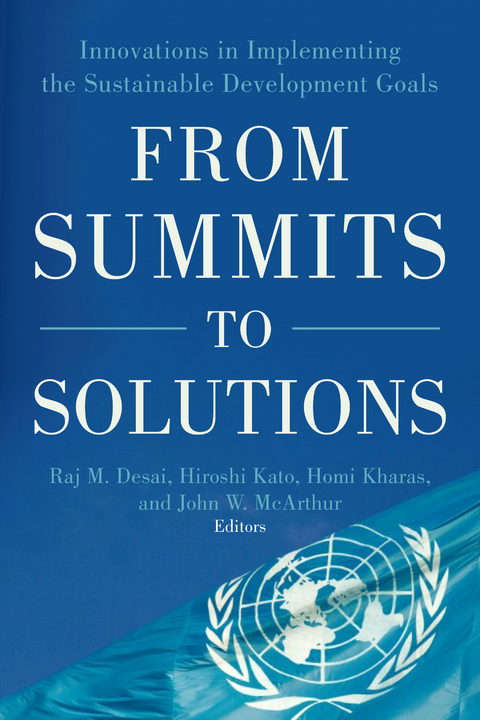
From Summits to Solutions (eBook)
402 Seiten
Brookings Institution Press (Verlag)
978-0-8157-3664-6 (ISBN)
lt;div>
Raj M. Desai is a visiting fellow in Global Economy and Development at Brookings Institution, and associate professor of international development in the Edmund A. Walsh School of Foreign Service at Georgetown University. Previously, he was a member of the core team for the World Bank's World Development Report unit.
Hiroshi Kato is senior vice president of the Japan International Cooperation Agency, overseeing several departments (Africa, Infrastructure and Peacebuilding, Rural Development, Domestic Strategy and Partnership) and JICA-University Alliance for Development Studies. Previously, he served as director of the JICA Research Institute.
Homi Kharas is the interim vice president and director of Global Economy and Development at Brookings Institution. He has served as the lead author and executive secretary of the secretariat supporting the High Level Panel advising the U.N. secretary general on the post-2015 development agenda (2012–13).
John W. McArthur is a senior fellow in the Global Economy and Development program at Brookings Institution. He is also a senior adviser to the UN Foundation and a board governor for the International Development Research Centre. Previously, he served as chief executive officer of Millennium Promise and manager of the UN Millennium Project.
Contents:
Acknowledgments
1. The Need for Innovations to Implement the Sustainable Development Goals, Raj M. Desai, Hiroshi Kato, Homi Kharas, and John W. McArthur
Part I. Capturing Value
2. Expanding Women’s Economic Opportunities, Jeni Klugman and Laura Tyson
3. From Green Bonds to Sustainable Development: The Case of Nigeria, Amina Mohammed with Simon Zadek
4. Collective Action on Business Standards, Goals, and Metrics to Achieve Scale and Impact for the SDGs, Jane Nelson
5. Professionalizing Cross-Sector Collaboration to Implement the SDGs, Ann Florini
6. Building Sustainable Financing Architecture to Achieve the SDGs: The Case of Brazil, Rogério Studart
Part II. Targeting Places
7. Making Rural Areas Places of Opportunity: Not Just a “Rural Agenda,” Bettina Prato
8. Using Remote Sensing and Geospatial Information for Sustainable Development, Linda See, Steffen Fritz, Inian Moorthy, Olha Danylo, Michiel van Dijk, and Barbara Ryan
9. Enhancing Statistical Capacity for Development, Ryuichi Tomizawa and Noriharu Masugi
10. Rescaling Government for an Urban Future, Reuben Abraham and Pritika Hingorani
11. Protecting Half the Ocean? Enric Sala and Kristin Rechberger
Part III. Updating Governance
12. A Canadian North Star: Crafting an Advanced Economy Approach to the Sustainable Development Goals, Margaret Biggs and John W. McArthur
13. A People’s Agenda: Citizen Participation and the SDGs, Dhananjayan Sriskandarajah
14. Safeguarding Our Global Commons, Naoko Ishii
15. Unity in Diversity: Reshaping the Global Health Architecture, Ikuo Takizawa
16. Crowding-In Private Finance: What Multilateral Banks Can Do Differently, Mahmoud Mohieldin and Jos Verbeek, with Nritya Subramaniam
Contributors
Index
| Verlagsort | Washington |
|---|---|
| Sprache | englisch |
| Maße | 150 x 150 mm |
| Themenwelt | Naturwissenschaften ► Biologie ► Ökologie / Naturschutz |
| Sozialwissenschaften ► Politik / Verwaltung ► Staat / Verwaltung | |
| Sozialwissenschaften ► Soziologie | |
| Wirtschaft ► Allgemeines / Lexika | |
| Wirtschaft ► Betriebswirtschaft / Management | |
| Wirtschaft ► Volkswirtschaftslehre | |
| Schlagworte | Economic Development • sustainable development • Sustainable Development Goals • United Nations |
| ISBN-10 | 0-8157-3664-9 / 0815736649 |
| ISBN-13 | 978-0-8157-3664-6 / 9780815736646 |
| Informationen gemäß Produktsicherheitsverordnung (GPSR) | |
| Haben Sie eine Frage zum Produkt? |
 EPUB (Adobe DRM)
Kopierschutz: Adobe-DRM
Adobe-DRM ist ein Kopierschutz, der das eBook vor Mißbrauch schützen soll. Dabei wird das eBook bereits beim Download auf Ihre persönliche Adobe-ID autorisiert. Lesen können Sie das eBook dann nur auf den Geräten, welche ebenfalls auf Ihre Adobe-ID registriert sind.
Details zum Adobe-DRM
Dateiformat: EPUB (Electronic Publication)
EPUB ist ein offener Standard für eBooks und eignet sich besonders zur Darstellung von Belletristik und Sachbüchern. Der Fließtext wird dynamisch an die Display- und Schriftgröße angepasst. Auch für mobile Lesegeräte ist EPUB daher gut geeignet.
Systemvoraussetzungen:
PC/Mac: Mit einem PC oder Mac können Sie dieses eBook lesen. Sie benötigen eine
eReader: Dieses eBook kann mit (fast) allen eBook-Readern gelesen werden. Mit dem amazon-Kindle ist es aber nicht kompatibel.
Smartphone/Tablet: Egal ob Apple oder Android, dieses eBook können Sie lesen. Sie benötigen eine
Geräteliste und zusätzliche Hinweise
Buying eBooks from abroad
For tax law reasons we can sell eBooks just within Germany and Switzerland. Regrettably we cannot fulfill eBook-orders from other countries.
aus dem Bereich