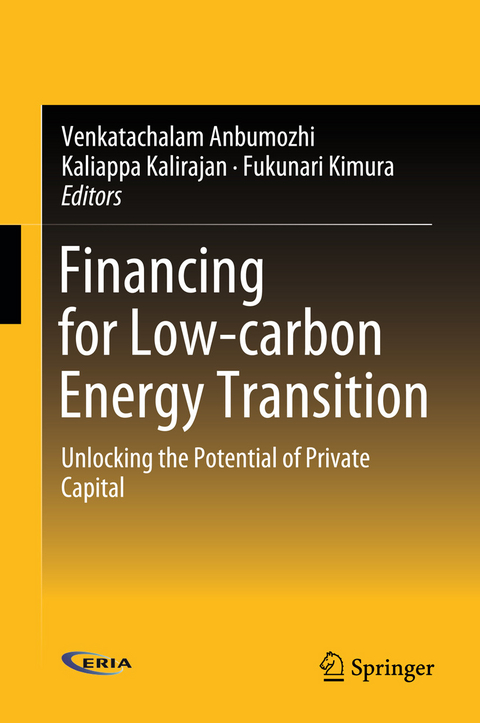
Financing for Low-carbon Energy Transition (eBook)
VIII, 438 Seiten
Springer Singapore (Verlag)
978-981-10-8582-6 (ISBN)
This book is the first comprehensive assessment of the state of low-carbon investments in Asia, analyzing the rationales, mandates and public-private financing activities. Based on the experiences of several regional initiatives wherein public financing is catalyzing private investments in low-carbon infrastructure, this book proposes a framework that can be used as a tool to identify factors that influence private investment decisions and policy instruments that can scale up the private capital.Placing the Asian economies onto a low-carbon development pathway requires an unprecedented shift in investments. This book addresses this situation by asking questions such as: * What is the central role of private finance in achieving the Paris Agreement targets? * What key policy levers and risk mitigation can governments use in an effort to unlock the potentials of private capital? * How can regionally coordinated actions hold significant promise for scaling up private investments?
Venkatachalam Anbumozhi is a Senior Economist at the Economic Research Institute for ASEAN and East Asia (ERIA), Indonesia. He has published widely on natural resource management, climate-friendly infrastructure design, and private sector participation in green growth. He was invited as a member of the APEC Expert Panel on Green Climate Finance and the ASEAN Panel for promoting climate-resilient growth. He has taught courses on resource management, international cooperation, and development finance.Kaliappa Kalirajan is a Professor at the Crawford School of Public Policy at the Australian National University, Australia. He is also a Visiting Professor at the Madras School of Economics, India and International University of Japan, Japan. His major areas of interest include macroeconomic and trade policies, sources of growth, regional cooperation in low-carbon energy systems, and technology issues in emerging Asian countries. He has released 150 publications in those areas in refereed academic and policy journals, and has authored and edited 15 books.Fukunari Kimura has been a Professor at the Faculty of Economics, Keio University, Tokyo, Japan since 2000 and Chief Economist at the Economic Research Institute for ASEAN and East Asia (ERIA) since 2008. His major research interest is in international trade and development economics. In particular, he has recently been active in writing on international production networks and economic integration in East Asia.
Introduction Unlocking the Potentials of Private Financing for Accelerated Low-Carbon Energy Transition: An Overview.- Part I - Estimating Private Finance in the Current Investment Needs and Potentials.- Estimation of the Current Flows and Future Needs in Investment for Low-Carbon Transition in Major Economies of Asia until 2030.- Private Financing Low-Carbon Energy Transition: Imbalances and Determinants.- Part II - Mapping the Multiple Risks of Private Finance in Low-Carbon Sectors.- Mapping the Necessary Policy Instruments to Unlock the Potentials of Private Finance for Modern Renewable Energy Sector.- Mapping the Necessary Policy Instruments to Unlock the Potentials of Private Finance for Carbon Capture and Storage Technologies.- Mapping Policy Instruments to Unlock the Private Finance Potentials to Improve Industrial Energy Efficiency.- Mapping the Necessary Policy Instruments to Unlock the Potentials of Private Sector Investments in Energy Efficiency for Transportation. - Leverage the Financing Role of Banks for Low-Carbon Energy Transition.- Role of Capital Market to Accelerate the Transition to Low-Carbon Energy System.- Costs and Benefits of Market-Based Instruments in Accelerating Low-Carbon Energy Transition.- Part III - Mapping Solutions to Unlock the Private Financing Potentials.- Effective Private Financing Approaches and Equity Financial Instruments for Low-Carbon Energy Investment: ADB Experiences.- Leveraging Private Finance through Public Finance: Role of International Financial Institutions.- Alternatives to Private Finance: Role of Fiscal Policy Reforms and Energy Taxation in Development of Renewable Energy Projects.- Prospects of Quality Infrastructure Program and Private Sector MRV for Accelerating the Transition Towards Low-Carbon Energy.- Prospects of Catalysing Regional Solutions and the Role of Low-Carbon Transition Fund.
| Erscheint lt. Verlag | 23.6.2018 |
|---|---|
| Zusatzinfo | VIII, 438 p. |
| Verlagsort | Singapore |
| Sprache | englisch |
| Themenwelt | Naturwissenschaften ► Biologie ► Ökologie / Naturschutz |
| Naturwissenschaften ► Geowissenschaften ► Meteorologie / Klimatologie | |
| Technik ► Elektrotechnik / Energietechnik | |
| Wirtschaft ► Betriebswirtschaft / Management ► Marketing / Vertrieb | |
| Wirtschaft ► Volkswirtschaftslehre | |
| Schlagworte | Asia-Pacific Economic Cooperation (Apec) • Association of South East Asian Nations (ASEAN) • Carbon capture • Clean Coal Technology • Clean Energy • Climate Change Management • CO2 emissions • energy efficiency • Fossil Fuels • green growth • Greenhouse Gas Emissions • Low-carbon economy • Low-carbon Energy Systems • Low-carbon Transition • Paris Agreement • Private capital • renewable energy • sustainable development |
| ISBN-10 | 981-10-8582-X / 981108582X |
| ISBN-13 | 978-981-10-8582-6 / 9789811085826 |
| Informationen gemäß Produktsicherheitsverordnung (GPSR) | |
| Haben Sie eine Frage zum Produkt? |
 PDF (Wasserzeichen)
DRM: Digitales Wasserzeichen
Dieses eBook enthält ein digitales Wasserzeichen und ist damit für Sie personalisiert. Bei einer missbräuchlichen Weitergabe des eBooks an Dritte ist eine Rückverfolgung an die Quelle möglich.
Dateiformat: PDF (Portable Document Format)
Mit einem festen Seitenlayout eignet sich die PDF besonders für Fachbücher mit Spalten, Tabellen und Abbildungen. Eine PDF kann auf fast allen Geräten angezeigt werden, ist aber für kleine Displays (Smartphone, eReader) nur eingeschränkt geeignet.
Systemvoraussetzungen:
PC/Mac: Mit einem PC oder Mac können Sie dieses eBook lesen. Sie benötigen dafür einen PDF-Viewer - z.B. den Adobe Reader oder Adobe Digital Editions.
eReader: Dieses eBook kann mit (fast) allen eBook-Readern gelesen werden. Mit dem amazon-Kindle ist es aber nicht kompatibel.
Smartphone/Tablet: Egal ob Apple oder Android, dieses eBook können Sie lesen. Sie benötigen dafür einen PDF-Viewer - z.B. die kostenlose Adobe Digital Editions-App.
Buying eBooks from abroad
For tax law reasons we can sell eBooks just within Germany and Switzerland. Regrettably we cannot fulfill eBook-orders from other countries.
aus dem Bereich