Power of Movement in Plants (eBook)
779 Seiten
Charles River Editors (Verlag)
978-1-5312-6871-8 (ISBN)
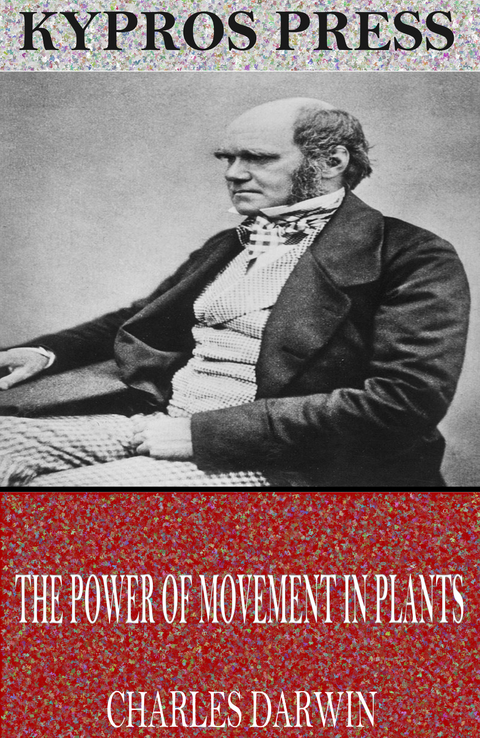
Charles Darwin was an English scientist best known for his contributions to the theory of evolution and his belief in natural selection. Darwin's writings remain popular and influential in science today. This edition of The Power of Movement in Plants includes a table of contents.
INTRODUCTION.
THE chief object of the present work is to describe and connect together several large classes of movement, common to almost all plants. The most widely prevalent movement is essentially of the same nature as that of the stem of a climbing plant, which bends successively to all points of the compass, so that the tip revolves. This movement has been called by Sachs “revolving nutation;” but we have found it much more convenient to use the terms circumnutation and circumnutate. As we shall have to say much about this movement, it will be useful here briefly to describe its nature. If we observe a circumnutating stem, which happens at the time to be bent, we will say towards the north, it will be found gradually to bend more and more easterly, until it faces the east; and so onwards to the south, then to the west, and back again to the north. If the movement had been quite regular, the apex would have described a circle, or rather, as the stem is always growing upwards, a circular spiral. But it generally describes irregular elliptical or oval figures; for the apex, after pointing in any one direction, commonly moves back to the opposite side, not, however, returning along the same line. Afterwards other irregular ellipses or ovals are successively described, with their longer axes directed to different points of the compass. Whilst describing such figures, the apex often travels in a zigzag line, or makes small subordinate loops or triangles. In the case of leaves the ellipses are generally narrow.
Until recently the cause of all such bending movements was believed to be due to the increased growth of the side which becomes for a time convex; that this side does temporarily grow more quickly than the concave side has been well established; but De Vries has lately shown that such increased growth follows a previously increased state of turgescence on the convex side.* In the case of parts provided with a so-called joint, cushion or pulvinus, which consists of an aggregate of small cells that have ceased to increase in size from a very early age, we meet with similar movements; and here, as Pfeffer has shown** and as we shall see in the course of this work, the increased turgescence of the cells on opposite sides is not followed by increased growth. Wiesner denies in certain cases the accuracy of De Vries’ conclusion about turgescence, and maintains*** that the increased extensibility of the cell-walls is the more important element. That such extensibility must accompany increased turgescence in order that the part may bend is manifest, and this has been insisted on by several botanists; but in the case of unicellular plants it can hardly fail to be the more important element. On the whole we may at present conclude that in-
* Sachs first showed (’Lehrbuch,’ etc., 4th edit. p. 452) the intimate connection between turgescence and growth. For De Vries’ interesting essay, ‘Wachsthumskrümmungen mehrzelliger Organe,’ see ‘Bot. Zeitung,’ Dec. 19, 1879, p. 830.
** ‘Die Periodischen Bewegungen der Blattorgane,’ 1875.
*** ‘Untersuchungen über den Heliotropismus,’ Sitzb. der K. Akad. der
Wissenschaft. (Vienna), Jan. 1880.
creased growth, first on one side and then on another, is a secondary effect, and that the increased turgescence of the cells, together with the extensibility of their walls, is the primary cause of the movement of circumnutation.*
In the course of the present volume it will be shown that apparently every growing part of every plant is continually circumnutating, though often on a small scale. Even the stems of seedlings before they have broken through the ground, as well as their buried radicles, circumnutate, as far as the pressure of the surrounding earth permits. In this universally present movement we have the basis or groundwork for the acquirement, according to the requirements of the plant, of the most diversified movements. Thus, the great sweeps made by the stems of twining plants, and by the tendrils of other climbers, result from a mere increase in the amplitude of the ordinary movement of circumnutation. The position which young leaves and other organs ultimately assume is acquired by the circumnutating movement being increased in some one direction. the leaves of various plants are said to sleep at night, and it will be seen that their blades then assume a vertical position through modified circumnutation, in order to protect their upper surfaces from being chilled through radiation. The movements of various organs to the light, which are so general throughout the vegetable kingdom, and occasionally from the light, or transversely with respect to it, are all modified
* See Mr. Vines’ excellent discussion (’Arbeiten des Bot. Instituts in
Würzburg,’ B. II. pp. 142, 143, 1878) on this intricate subject.
Hofmeister’s observations (’Jahreschrifte des Vereins für Vaterl.
Naturkunde in Würtemberg,’ 1874, p. 211) on the curious movements of
Spirogyra, a plant consisting of a single row of cells, are valuable in
relation to this subject.
forms of circumnutation; as again are the equally prevalent movements of stems, etc., towards the zenith, and of roots towards the centre of the earth. In accordance with these conclusions, a considerable difficulty in the way of evolution is in part removed, for it might have been asked, how did all these diversified movements for the most different purposes first arise? As the case stands, we know that there is always movement in progress, and its amplitude, or direction, or both, have only to be modified for the good of the plant in relation with internal or external stimuli.
Besides describing the several modified forms of circumnutation, some other subjects will be discussed. The two which have interested us most are, firstly, the fact that with some seedling plants the uppermost part alone is sensitive to light, and transmits an influence to the lower part, causing it to bend. If therefore the upper part be wholly protected from light, the lower part may be exposed for hours to it, and yet does not become in the least bent, although this would have occurred quickly if the upper part had been excited by light. Secondly, with the radicles of seedlings, the tip is sensitive to various stimuli, especially to very slight pressure, and when thus excited, transmits an influence to the upper part, causing it to bend from the pressed side. On the other hand, if the tip is subjected to the vapour of water proceeding from one side, the upper part of the radicle bends towards this side. Again it is the tip, as stated by Ciesielski, though denied by others, which is sensitive to the attraction of gravity, and by transmission causes the adjoining parts of the radicle to bend towards the centre of the earth. These several cases of the effects of contact, other irritants, vapour, light, and the attraction of gravity being transmitted from the excited part for some little distance along the organ in question, have an important bearing on the theory of all such movements.
[Terminology.—A brief explanation of some terms which will be used, must here be given. With seedlings, the stem which supports the cotyledons (i.e. the organs which represent the first leaves) has been called by many botanists the hypocotyledonous stem, but for brevity sake we will speak of it merely as the hypocotyl: the stem immediately above the cotyledons will be called the epicotyl or plumule. The radicle can be distinguished from the hypocotyl only by the presence of root-hairs and the nature of its covering. The meaning of the word circumnutation has already been explained. Authors speak of positive and negative heliotropism,*—that is, the bending of an organ to or from the light; but it is much more convenient to confine the word heliotropism to bending towards the light, and to designate as apheliotropism bending from the light. There is another reason for this change, for writers, as we have observed, occasionally drop the adjectives positive and negative, and thus introduce confusion into their discussions. Diaheliotropism may express a position more or less transverse to the light and induced by it. In like manner positive geotropism, or bending towards the centre of the earth, will be called by us geotropism; apogeotropism will mean bending in opposition to gravity or from the centre of the earth; and diageotropism, a position more or less transverse to the radius of the earth. The words heliotropism and geotropism properly mean the act of moving in relation to the light or the earth; but in the same manner as gravitation, though defined as “the act of tending to the centre,” is often used to express the cause of a body falling, so it will be found convenient occasionally to employ heliotropism and geotropism, etc., as the cause of the movements in question.
The term epinasty is now often used in Germany, and implies that the upper surface of an organ grows more quickly than the
* The highly useful terms of Heliotropism and Geotropism were first used by Dr. A. B. Frank: see his remarkable ‘Beiträge zur Pflanzenphysiologie,’ 1868. lower surface, and thus causes it to bend downwards. Hyponasty is the reverse, and implies increased growth along the lower surface, causing the part to bend upwards.*
Methods of Observation.—The movements, sometimes very small and sometimes considerable in extent, of the various organs observed by us, were traced in the manner which after many trials we...
| Erscheint lt. Verlag | 22.3.2018 |
|---|---|
| Sprache | englisch |
| Themenwelt | Naturwissenschaften ► Biologie ► Botanik |
| Schlagworte | animals • Biology • Classic • coral reefs • Darwinism • Evolution • Historical • Science |
| ISBN-10 | 1-5312-6871-4 / 1531268714 |
| ISBN-13 | 978-1-5312-6871-8 / 9781531268718 |
| Informationen gemäß Produktsicherheitsverordnung (GPSR) | |
| Haben Sie eine Frage zum Produkt? |
 EPUB (Adobe DRM)
Größe: 1,4 MB
Kopierschutz: Adobe-DRM
Adobe-DRM ist ein Kopierschutz, der das eBook vor Mißbrauch schützen soll. Dabei wird das eBook bereits beim Download auf Ihre persönliche Adobe-ID autorisiert. Lesen können Sie das eBook dann nur auf den Geräten, welche ebenfalls auf Ihre Adobe-ID registriert sind.
Details zum Adobe-DRM
Dateiformat: EPUB (Electronic Publication)
EPUB ist ein offener Standard für eBooks und eignet sich besonders zur Darstellung von Belletristik und Sachbüchern. Der Fließtext wird dynamisch an die Display- und Schriftgröße angepasst. Auch für mobile Lesegeräte ist EPUB daher gut geeignet.
Systemvoraussetzungen:
PC/Mac: Mit einem PC oder Mac können Sie dieses eBook lesen. Sie benötigen eine
eReader: Dieses eBook kann mit (fast) allen eBook-Readern gelesen werden. Mit dem amazon-Kindle ist es aber nicht kompatibel.
Smartphone/Tablet: Egal ob Apple oder Android, dieses eBook können Sie lesen. Sie benötigen eine
Geräteliste und zusätzliche Hinweise
Buying eBooks from abroad
For tax law reasons we can sell eBooks just within Germany and Switzerland. Regrettably we cannot fulfill eBook-orders from other countries.
EPUB (Ohne DRM)Digital Rights Management: ohne DRM
Dieses eBook enthält kein DRM oder Kopierschutz. Eine Weitergabe an Dritte ist jedoch rechtlich nicht zulässig, weil Sie beim Kauf nur die Rechte an der persönlichen Nutzung erwerben.
Dateiformat: EPUB (Electronic Publication)
EPUB ist ein offener Standard für eBooks und eignet sich besonders zur Darstellung von Belletristik und Sachbüchern. Der Fließtext wird dynamisch an die Display- und Schriftgröße angepasst. Auch für mobile Lesegeräte ist EPUB daher gut geeignet.
Systemvoraussetzungen:
PC/Mac: Mit einem PC oder Mac können Sie dieses eBook lesen. Sie benötigen dafür die kostenlose Software Adobe Digital Editions.
eReader: Dieses eBook kann mit (fast) allen eBook-Readern gelesen werden. Mit dem amazon-Kindle ist es aber nicht kompatibel.
Smartphone/Tablet: Egal ob Apple oder Android, dieses eBook können Sie lesen. Sie benötigen dafür eine kostenlose App.
Geräteliste und zusätzliche Hinweise
Buying eBooks from abroad
For tax law reasons we can sell eBooks just within Germany and Switzerland. Regrettably we cannot fulfill eBook-orders from other countries.
aus dem Bereich