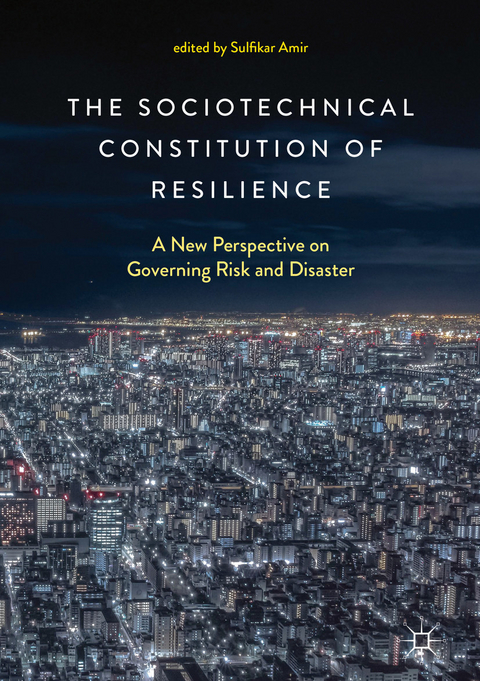
The Sociotechnical Constitution of Resilience (eBook)
XV, 289 Seiten
Springer Singapore (Verlag)
978-981-10-8509-3 (ISBN)
This book considers the concept of resilience in a global society where coping with the consequence and long term impact of crisis and disaster challenges the capacity of communities to bounce back in the event of severe disruption. Catastrophic events such as the 9.11 terrorist attack, the Fukushima nuclear disaster, and the volcano eruption in Central Java entailed massive devastation on physical infrastructures, and caused significant social and economic damage. This book considers how the modern sociotechnological system facilitating human activity defines how societies survive and whether a crisis will be short-lived or prolonged. Drawing on the concept of sociotechnical resilience, this book closely examines a range of events North America, Asia, Australia, and Europe. By presenting the successes and failures of sociotechnical resilience, it offers important insights and practical lessons to build better and comprehensive understandings of resilience in a real-world setting, significantly contributing to the study of disaster resilience.
Sulfikar Amir is an Associate Professor of science, technology, and society in the School of Social Sciences, Nanyang Technological University, Singapore. His research interests include science and technology studies, development, globalisation, disaster, risk, resilience, and infrastructure and city studies. He is the author of 'The Technological State in Indonesia: the Co-constitution of High Technology and Authoritarian Politics'. His ongoing project explores the production of hidden vulnerability in the Fukushima nuclear meltdown.
This book considers the concept of resilience in a global society where coping with the consequence and long term impact of crisis and disaster challenges the capacity of communities to bounce back in the event of severe disruption. Catastrophic events such as the 9.11 terrorist attack, the Fukushima nuclear disaster, and the volcano eruption in Central Java entailed massive devastation on physical infrastructures, and caused significant social and economic damage. This book considers how the modern sociotechnological system facilitating human activity defines how societies survive and whether a crisis will be short-lived or prolonged. Drawing on the concept of sociotechnical resilience, this book closely examines a range of events North America, Asia, Australia, and Europe. By presenting the successes and failures of sociotechnical resilience, it offers important insights and practical lessons to build better and comprehensive understandings of resilience in a real-world setting, significantly contributing to the study of disaster resilience.
Sulfikar Amir is an Associate Professor of science, technology, and society in the School of Social Sciences, Nanyang Technological University, Singapore. His research interests include science and technology studies, development, globalisation, disaster, risk, resilience, and infrastructure and city studies. He is the author of 'The Technological State in Indonesia: the Co-constitution of High Technology and Authoritarian Politics'. His ongoing project explores the production of hidden vulnerability in the Fukushima nuclear meltdown.
Introduction: Resilience as Sociotechnical Construct.- PART 1 DISSECTING RESILIENCE.- What (Sociotechnical) Resilience is Made of: Personal Trajectories and Erathquake Risk Mitigation in the San Francisco Bay Area.- Sociotechnical Resilience—From Recovery to Adaptation and Beyond: the Journey So Far….- Mapping Sociotechnical Resilience.- PART 2 DISRUPTED ENVIRONMENTS.- Weather Ready Nation or Ready Weather Agency?: Emphatic Accuracy and Sociotechnical Resilience in the National Weather Service.- Coping with Indonesia’s Mudflow Disaster.- PART 3 INFORMATIONAL RELATIONS.- Information Infrastructure and Resilience in American Disaster Plans.- An Audience Perspective on Disaster Response.- PART 4 ENGINEERED SYSTEMS.- Post-Fukushima Controversy on SPEEDI System: Contested Imaginary of Real-Time Simulation Technology for Emergency Radiation Protection.- Saving Onagawa: Sociotechnical Resilience in the 3.11 Disaster.- PART 5 URBAN LIFE.- An SME Driven Approach to Adopting Measures of Flood Resilience: A UK-Based Perspective.- How Resilience Discourses Shape Cities: the Case of Resilient Rotterdam.
| Erscheint lt. Verlag | 17.5.2018 |
|---|---|
| Zusatzinfo | XV, 289 p. 21 illus. |
| Verlagsort | Singapore |
| Sprache | englisch |
| Themenwelt | Naturwissenschaften ► Biologie ► Ökologie / Naturschutz |
| Sozialwissenschaften ► Politik / Verwaltung ► Staat / Verwaltung | |
| Sozialwissenschaften ► Soziologie ► Mikrosoziologie | |
| Sozialwissenschaften ► Soziologie ► Spezielle Soziologien | |
| Technik ► Architektur | |
| Schlagworte | Disaster Expertise • History of Disaster • Hybrid Environment • Institutional Vulnerability • Reflexive Resilience • Resilient Urbanism and Disaster Studies • Risk Epistemology • Sociotechnical Resilience • Sociotechnical System and Disasters • Vulnerable Infrastructures |
| ISBN-10 | 981-10-8509-9 / 9811085099 |
| ISBN-13 | 978-981-10-8509-3 / 9789811085093 |
| Informationen gemäß Produktsicherheitsverordnung (GPSR) | |
| Haben Sie eine Frage zum Produkt? |
 PDF (Wasserzeichen)
DRM: Digitales Wasserzeichen
Dieses eBook enthält ein digitales Wasserzeichen und ist damit für Sie personalisiert. Bei einer missbräuchlichen Weitergabe des eBooks an Dritte ist eine Rückverfolgung an die Quelle möglich.
Dateiformat: PDF (Portable Document Format)
Mit einem festen Seitenlayout eignet sich die PDF besonders für Fachbücher mit Spalten, Tabellen und Abbildungen. Eine PDF kann auf fast allen Geräten angezeigt werden, ist aber für kleine Displays (Smartphone, eReader) nur eingeschränkt geeignet.
Systemvoraussetzungen:
PC/Mac: Mit einem PC oder Mac können Sie dieses eBook lesen. Sie benötigen dafür einen PDF-Viewer - z.B. den Adobe Reader oder Adobe Digital Editions.
eReader: Dieses eBook kann mit (fast) allen eBook-Readern gelesen werden. Mit dem amazon-Kindle ist es aber nicht kompatibel.
Smartphone/Tablet: Egal ob Apple oder Android, dieses eBook können Sie lesen. Sie benötigen dafür einen PDF-Viewer - z.B. die kostenlose Adobe Digital Editions-App.
Buying eBooks from abroad
For tax law reasons we can sell eBooks just within Germany and Switzerland. Regrettably we cannot fulfill eBook-orders from other countries.
aus dem Bereich