


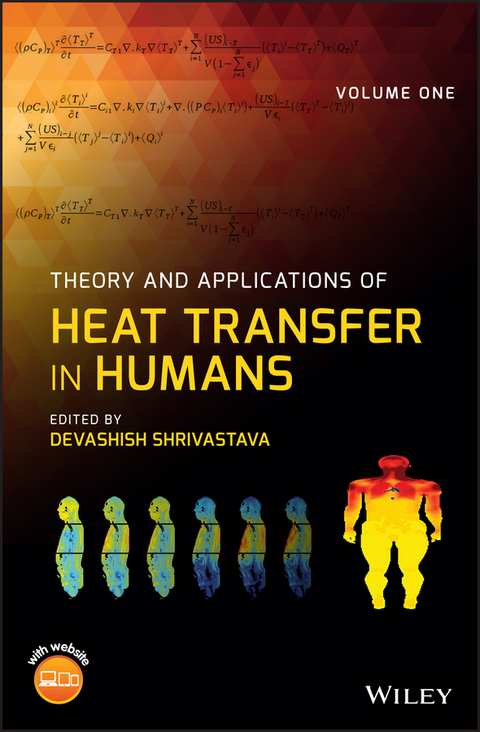
Theory and Applications of Heat Transfer in Humans, 2 Volume Set (eBook)
John Wiley & Sons (Verlag)
978-1-119-12732-1 (ISBN)
An authoritative guide to theory and applications of heat transfer in humans
Theory and Applications of Heat Transfer in Humans 2V Set offers a reference to the field of heating and cooling of tissue, and associated damage. The author-a noted expert in the field-presents, in this book, the fundamental physics and physiology related to the field, along with some of the recent applications, all in one place, in such a way as to enable and enrich both beginner and advanced readers. The book provides a basic framework that can be used to obtain 'decent' estimates of tissue temperatures for various applications involving tissue heating and/or cooling, and also presents ways to further develop more complex methods, if needed, to obtain more accurate results. The book is arranged in three sections: The first section, named 'Physics', presents fundamental mathematical frameworks that can be used as is or combined together forming more complex tools to determine tissue temperatures; the second section, named 'Physiology', presents ideas and data that provide the basis for the physiological assumptions needed to develop successful mathematical tools; and finally, the third section, named 'Applications', presents examples of how the marriage of the first two sections are used to solve problems of today and tomorrow.
This important text is the vital resource that:
- Offers a reference book in the field of heating and cooling of tissue, and associated damage.
- Provides a comprehensive theoretical and experimental basis with biomedical applications
- Shows how to develop and implement both, simple and complex mathematical models to predict tissue temperatures
- Includes simple examples and results so readers can use those results directly or adapt them for their applications
Designed for students, engineers, and other professionals, a comprehensive text to the field of heating and cooling of tissue that includes proven theories with applications. The author reveals how to develop simple and complex mathematical models, to predict tissue heating and/or cooling, and associated damage.
Devashish Shrivastava, PhD, works for US FDA, served as chair of the ISMRM MR safety study group committee and represented the US in standardization committees dealing with safety in MRI. His background and research interest are in developing validated bioheat transfer models to predict in vivo tissue heating in humans due to the use of medical devices and during occupational and recreational activities.
An authoritative guide to theory and applications of heat transfer in humans Theory and Applications of Heat Transfer in Humans 2V Set offers a reference to the field of heating and cooling of tissue, and associated damage. The author a noted expert in the field presents, in this book, the fundamental physics and physiology related to the field, along with some of the recent applications, all in one place, in such a way as to enable and enrich both beginner and advanced readers. The book provides a basic framework that can be used to obtain decent estimates of tissue temperatures for various applications involving tissue heating and/or cooling, and also presents ways to further develop more complex methods, if needed, to obtain more accurate results. The book is arranged in three sections: The first section, named Physics , presents fundamental mathematical frameworks that can be used as is or combined together forming more complex tools to determine tissue temperatures; the second section, named Physiology , presents ideas and data that provide the basis for the physiological assumptions needed to develop successful mathematical tools; and finally, the third section, named Applications , presents examples of how the marriage of the first two sections are used to solve problems of today and tomorrow. This important text is the vital resource that: Offers a reference book in the field of heating and cooling of tissue, and associated damage. Provides a comprehensive theoretical and experimental basis with biomedical applications Shows how to develop and implement both, simple and complex mathematical models to predict tissue temperatures Includes simple examples and results so readers can use those results directly or adapt them for their applications Designed for students, engineers, and other professionals, a comprehensive text to the field of heating and cooling of tissue that includes proven theories with applications. The author reveals how to develop simple and complex mathematical models, to predict tissue heating and/or cooling, and associated damage.
EDITED BY DEVASHISH SHRIVASTAVA, PHD, works for US FDA, served as chair of the ISMRM MR safety study group committee and represented the US in standardization committees dealing with safety in MRI. His background and research interest are in developing validated bioheat transfer models to predict in vivo tissue heating in humans due to the use of medical devices and during occupational and recreational activities.
Chapter 1
A Generic Thermal Model for Perfused Tissues
Devashish Shrivastava1,2
1US Food and Drug Administration, Silver Spring, MD, USA
2In Vivo Temperatures, LLC, Burnsville, MN, USA
* Corresponding author: devashish.shrivastava@gmail.com
1.1 Introduction
Many diagnostic and therapeutic procedures require a thermal model for perfused tissues for determining in vivo temperatures in order to better plan and implement those procedures (e.g., heating during MRI, burn management, etc.). However, it is extremely challenging to determine in vivo temperatures by solving the ‘exact’ thermal model, derived from first principles, and called the convective energy equation (CEE) [1]. This is so because it requires at least 20 linear computational nodes across the diameter of a blood vessel to obtain a numerically converged temperature solution of the CEE [2]. Blood vessel diameters range from ∼3 cm in large vessels (e.g., aorta, vena cava) to ∼3 µm in capillaries inside a human body. Thus, it requires a stupendous amount of computational power (∼3(1011) nodes for every 1 mm3 assuming a uniform mesh resolution of 0.15 µm) to solve for the temperatures in perfused tissues if the CEE is used alone. This is in addition to the daunting challenge of knowing the blood velocity field in all the vessels down to every single capillary as a function of space and time since the blood velocity is a necessary input to the CEE. Therefore, to manage computational costs, temperatures in tissues embedded with ‘small’ (<1 mm in diameter) more frequent blood vessels are determined using ‘approximate’ thermal models known as bioheat transfer models (BHTMs) [3, 4], and temperatures in ‘large’ (vessel diameter ≥ 1 mm), less frequent blood vessels are determined using the ‘exact’ thermal model, the CEE [1].
BHTMs can be derived using first principles or proposed intuitively. The objective of this chapter is to present a general methodology to derive BHTMs from first principles. Deriving BHTMs from first principles is important since it helps relate the variables and parameters of the bioheat models to the underlying physiology, which provides better insight into the most fundamental mechanisms at play. The methodology is used to, first, derive a general, ‘two-compartment’ BHTM with very few assumptions – herein called the two-compartment generic bioheat transfer model (GBHTM) [5]. Later, more general forms of the model (i.e., a three-compartment GBHTM and an ‘N + 1’ compartment GBHTM) are derived using the same methodology. Next, the newly derived two-compartment GBHTM is compared with Pennes' intuitively proposed (and thus, empirical) ‘gold standard’ BHTM to better understand the implicit and explicit assumptions, and thereby application regime of Pennes' BHTM. Pennes' BHTM is chosen since it is a simple, empirical, and widely used BHTM. Lack of a formal derivation makes it difficult to relate the parameters and variables of this simple BHTM to the underlying physiology (e.g., blood flow, blood vasculature geometry, thermal properties of tissue and blood vessels), which in turn has, historically, made the implementation and interpretation of Pennes' BHTM and its results controversial and unreliable. Finally, in vivo temperature predictions of the two-compartment GBHTM and Pennes' BHTM are compared to the measured temperatures for magnetic resonance imaging (MRI) applications to further illustrate the usefulness of the bioheat models.
1.2 Derivation of Generic Bioheat Thermal Models (GBHTMs)
Above, we discuss the complexity and the impracticality of solving the exact thermal model, the CEE, alone in perfused tissues to obtain point-wise true tissue temperature distribution in space and time. That scenario forces us, as a compromise, to develop an approximate thermal model to determine the temperature of a ‘volume’ of tissue (i.e., a ‘volume averaged’ tissue temperature), rather than determining the temperature of each point in tissue (i.e., point-wise true tissue temperature).
Let's derive an approximate thermal model, a two-compartment GBHTM, by volume averaging the CEE. The presented methodology is general and is used to derive a three-compartment GBHTM and an ‘N + 1’ compartment GBHTM later in this chapter. For those of you who are not interested in the derivation, you may refer directly to the final differential form of the two-compartment GBHTM presented in Equations 1.10 and 1.11 below. The three-compartment GBHTM is presented in Equations 1.14. The ‘N + 1’ compartment GBHTM is presented in Equations 1.16. Simplifications used to obtain the GBHTMs are presented in Equations 1.9.
1.2.1 A Two-Compartment Generic Bioheat Transfer Model
Let's consider a finite, vascularized, heated tissue. Let's assume that the blood stays inside the vasculature and everything surrounding the blood is a non-moving solid tissue. Conserving energy at a point in the solid tissue and blood results in the following point-wise true, exact thermal model, the CEE [1]. Note that the velocity of solid tissue uT is zero in Equation 1.1 by our assumption.
Also, note that solving Equation 1.1 for the point-wise temperatures in tissue perfused with smaller (<1 mm in diameter), more frequent blood vessels is impractical due to the tremendous cost of computation and the unavailability of the three-dimensional blood velocity field uBl. Next, let's imagine that our perfused tissue is made of several smaller volumes put together, herein called the averaging volume and each averaging volume V consists of two sub-volumes or compartments: a solid tissue sub-volume VT and blood sub-volume VBl. Integrating Equation 1.1 over the solid tissue and blood sub-volumes, separately, in an averaging volume results in Equation 1.2.
Applying divergence theorem to the first terms on the left-hand side (LHS) and right-hand side (RHS) of Equation 1.2 results in Equation 1.3. Interested readers are encouraged to derive Equation 1.3 using Equation 1.2 for themselves.
where, i and j = T, Bl and i ≠ j.
Assuming (a) constant density, (b) constant specific heat, and (c) incompressible blood and blood vessels in the averaging blood sub-volume, the second term on the LHS reduces to zero due to the principle of conservation of mass. (Note that this term is zero for solid tissue since uT = 0.) Thus, Equation 1.3 simplifies as follows.
where, i = j = T, Bl and i ≠ j.
In Equation 1.4, the first term on the RHS represents the energy gained by a solid tissue (or blood) sub-volume from adjacent solid tissue (or blood) sub-volumes. The second term on the RHS represents the energy exchange due to the interaction between the solid tissue and blood sub-volumes inside an averaging volume. The third term on the RHS represents the energy gained by the solid tissue (or blood) sub-volume in an averaging volume due to source terms.
Next, normalizing Equation 1.4 by sub-volume Vi the following general integral form of the generic BHTM (Equation 1.5) is obtained. This form satisfies the energy equation and is valid for any unheated and heated tissue with no phase change. Note that Equation 1.5 represents two equations; one for solid tissue and another for blood.
where, i = j = T, Bl and i ≠ j and
1.2.2 Simplifications
The following three simplifications are made to obtain a differential form of the two-compartment GBHTM.
where, i = j = T, Bl and i≠ j, and
The first simplification (Equation 1.7) relates the energy exchange among the tissue (or blood) sub-volume of an averaging volume and tissue (or blood) sub-volumes of surrounding averaging volumes to the average temperatures of tissue (or blood) sub-volumes. This simplification is similar to the simplifications used by many other BHTMs [e.g., [6–16]]. A new, to be determined, parameter Ci1 is introduced in Equation 1.7 to keep the simplification general.
The second simplification (Equation 1.8) defines the thermal interaction between a tissue and the embedded vasculature using the tissue and blood sub-volume averaged temperatures and a heat transfer coefficient (i.e., U). Note that this heat transfer coefficient is different from conventional heat transfer coefficients and must be evaluated to appropriately implement the GBHTM since the new heat transfer coefficient is defined based on the volume-averaged temperatures. Conventional heat transfer coefficients are defined using a tissue boundary temperature and a mixed mean blood temperature.
The third simplification (Equation 1.9) is similar to the simplification proposed by Equation...
| Erscheint lt. Verlag | 16.4.2018 |
|---|---|
| Sprache | englisch |
| Themenwelt | Naturwissenschaften ► Biologie |
| Naturwissenschaften ► Chemie | |
| Naturwissenschaften ► Physik / Astronomie ► Angewandte Physik | |
| Naturwissenschaften ► Physik / Astronomie ► Thermodynamik | |
| Schlagworte | A Biochemical, Structural and Theromodynamical • Bildgebende Verfahren i. d. Biomedizin • biomedical engineering • Biomedical Imaging • Biomedizintechnik • Building Whole-body Models for Bioheat Computations • Chemie • Chemistry • Devashish Shrivastava</p> • Generating Blood Vasculature • Gewebe (Physiol.) • handbook to Heat Transfer in Humans 2V Set • Heat Related Illness • Interventional Radiology • Invasive Radiologie • <p>Introduction to Heat Transfer in Humans 2V Set • Measuring Electromagnetic Properties of Tissue • Measuring Optical Properties of Tissue Measuring • Measuring Thermal Properties of Tissue • Measuring Thermal Properties of Tissue at Cryogenic Temperatures • Medical Science • Medizin • Modeling Thermally Important Blood Vessels • NMR Spectroscopy / MRI / Imaging • NMR-Spektroskopie / MRT / Bildgebende Verfahren • Physiological Response to Cold blood flow metabolism • resource to Heat Transfer in Humans 2V Set • Sound Properties of Tissue Physiological Response to Heat • Theory and Applications of Heat Transfer in Humans 2V Set • theory Developing Mathematical Models of • Wärme • Wärmehaushalt • Wärmemessung • Wärmeübertragung |
| ISBN-10 | 1-119-12732-7 / 1119127327 |
| ISBN-13 | 978-1-119-12732-1 / 9781119127321 |
| Informationen gemäß Produktsicherheitsverordnung (GPSR) | |
| Haben Sie eine Frage zum Produkt? |
 EPUB (Adobe DRM)
Kopierschutz: Adobe-DRM
Adobe-DRM ist ein Kopierschutz, der das eBook vor Mißbrauch schützen soll. Dabei wird das eBook bereits beim Download auf Ihre persönliche Adobe-ID autorisiert. Lesen können Sie das eBook dann nur auf den Geräten, welche ebenfalls auf Ihre Adobe-ID registriert sind.
Details zum Adobe-DRM
Dateiformat: EPUB (Electronic Publication)
EPUB ist ein offener Standard für eBooks und eignet sich besonders zur Darstellung von Belletristik und Sachbüchern. Der Fließtext wird dynamisch an die Display- und Schriftgröße angepasst. Auch für mobile Lesegeräte ist EPUB daher gut geeignet.
Systemvoraussetzungen:
PC/Mac: Mit einem PC oder Mac können Sie dieses eBook lesen. Sie benötigen eine
eReader: Dieses eBook kann mit (fast) allen eBook-Readern gelesen werden. Mit dem amazon-Kindle ist es aber nicht kompatibel.
Smartphone/Tablet: Egal ob Apple oder Android, dieses eBook können Sie lesen. Sie benötigen eine
Geräteliste und zusätzliche Hinweise
Buying eBooks from abroad
For tax law reasons we can sell eBooks just within Germany and Switzerland. Regrettably we cannot fulfill eBook-orders from other countries.


