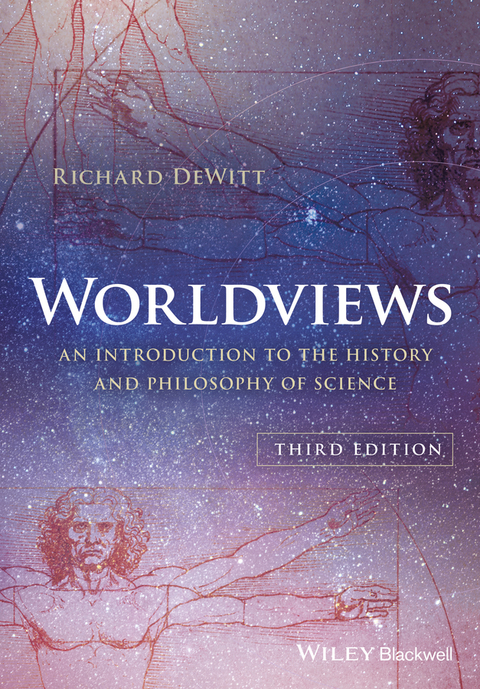
Worldviews (eBook)
384 Seiten
Wiley-Blackwell (Verlag)
978-1-119-11899-2 (ISBN)
Winner of the 2018 Choice Award for Outstanding Academic Title!
PRAISE FOR PREVIOUS EDITIONS
'This is a brilliantly clear introduction (and indeed reframing) of the history and philosophy of science in terms of worldviews and their elements.... In addition, the book is incredibly well-informed from both a scientific and philosophical angle. Highly recommended.'
Scientific and Medical Network
'Unlike many other introductions to philosophy of science, DeWitt's book is at once historically informative and philosophically thorough and rigorous. Chapter notes, suggested readings, and references enhance its value.'
Choice
'Written in clear and comprehensible prose and supplemented by effective diagrams and examples, Worldviews is an ideal text for anyone new to the history and philosophy of science. As the reader will come to find out, DeWitt is a gifted writer with the unique ability to break down complex and technical concepts into digestible parts, making Worldviews a welcoming and not overwhelming book for the introductory reader.'
History and Philosophy of the Life Sciences, vol. 28(2)
Now in its third edition, Worldviews: An Introduction to the History and Philosophy of Science strengthens its reputation as the most accessible and teachable introduction to the history and philosophy of science on the market. Geared toward engaging undergraduates and those approaching the history and philosophy of science for the first time, this intellectually-provocative volume takes advantage of its author's extensive teaching experience, parsing complex ideas using straightforward and sensible examples drawn from the physical sciences.
Building on the foundations which earned the book its critical acclaim, author Richard DeWitt considers fundamental issues in the philosophy of science through the historical worldviews that influenced them, charting the evolution of Western science through the rise and fall of dominant systems of thought. Chapters have been updated to include discussion of recent findings in quantum theory, general relativity, and evolutionary theory, and two new chapters exclusive to the third edition enrich its engagement with radical developments in contemporary science.
At a time in modern history when the nature of truth, fact, and reality seem increasingly controversial, the third edition of Worldviews presents complex concepts with clarity and verve, and prepares inquisitive minds to engage critically with some of the most exciting questions in the philosophy of science.
Richard DeWitt is Professor of Philosophy at Fairfield University. His research interests are in the areas of mathematical and philosophical logic and the philosophy of mind. Recent publications include work with infinite valued logics in the Journal of Philosophical Logic and medieval logic in the International Philosophical Quarterly.
Richard DeWitt is Professor of Philosophy at Fairfield University. His research interests are in the areas of mathematical and philosophical logic and the philosophy of mind. Recent publications include work with infinite valued logics in the Journal of Philosophical Logic and medieval logic in the International Philosophical Quarterly.
List of Figures
Acknowledgments
Introduction
Part I: Fundamental Issues 1
1 Worldviews
2 Truth
3 Empirical Facts and Philosophical/Conceptual Facts
4 Confirming and Disconfirming Evidence and Reasoning
5 The Quine-Duhem Thesis and Implications for Scientific Method
6 A Philosophical Interlude: Problems and Puzzles of Induction
7 Falsifiability
8 Instrumentalism and Realism
Part II: The Transition from the Aristotelian Worldview to the Newtonian Worldview
9 The Structure of the Universe on the Aristotelian Worldview
10 The Preface to Ptolemy's Almagest: The Earth as Spherical, Stationary, and at the Center of the Universe
11 Astronomical Data: The Empirical Facts
12 Astronomical Data: The Philosophical/Conceptual Facts
13 The Ptolemaic System
14 The Copernican System
15 The Tychonic System
16 Kepler's System
17 Galileo and the Evidence from the Telescope
18 A Summary of Problems Facing the Aristotelian Worldview
19 Philosophical and Conceptual Connections in the Development of the New Science
20 Overview of the New Science and the Newtonian Worldview
21 Philosophical Interlude: What Is a Scientific Law?
22 The Development of the Newtonian Worldview, 1700-1900
Part III: Recent Developments in Science and Worldviews
23 The Special Theory of Relativity
24 The General Theory of Relativity
25 Philosophical Interlude: Are (Some) Scientific Theories Incommensurable?
26 Introduction to Quantum Theory: Basic Empirical Facts and the Mathematics of Quantum Theory
27 The Reality Question: The Measurement Problem and Interpretations of Quantum Theory
28 Quantum Theory and Locality: EPR, Bell's Theorem, and the Aspect Experiments
29 Overview of the Theory of Evolution
30 Reflections on Evolution
31 Worldviews: Concluding Thoughts
Chapter Notes and Suggested Reading
References
Index
Introduction
This book is intended primarily for those coming to the history and philosophy of science for the first time. If this description fits you, welcome to a fascinating territory to explore. This field involves some of the deepest, most difficult, and most fundamental questions there are. But at the same time, the “lens of science,” so to speak, focuses these questions more sharply than they are often otherwise focused. I hope you enjoy this field as much as I do, and I especially hope your appetite is whetted to the point where you will want to return to explore these subjects in more depth.
This sort of introductory work provides special challenges. On the one hand, I want to be accurate with the history, the philosophy, and the interconnections between the two. On the other hand, I want to avoid the level of detail and minutiae that might swamp one approaching this subject for the first time. Those of us who do history and philosophy of science full-time – most of us are academics – tend to get caught up in the details of our disciplines, and I think we often lose sight of what such detail must look like to one new to the subject. When faced with these minutiae, newcomers often come away with the sense “Why would anyone care about that?”
The question is an understandable one. The details and minutiae are important, but their importance can only be understood in the context of a broader picture. So I hope, in this text, to paint one such broader picture. But although this text provides a rather broad-brushstroke picture, to the best of my knowledge what I say is accurate, though it admittedly leaves out a good deal of detail.
The connections between history, science, and philosophy are endlessly complex and fascinating. As mentioned, I hope to whet your appetite, to make you want to explore these issues in more detail, and perhaps even come to appreciate and enjoy the minutiae. Nothing would please me more than if, at the end of this book, you visit your bookstore, or fire up your web browser, and order works that will enable you to explore these topics further.
Notes on the Third Edition
Since this new edition contains a fair amount of new material, some brief notes on these additions are in order. Various scientific traditions (Aristotelian, Newtonian, current sciences) have always been a central theme in the book, and given this, questions surrounding the possible incommensurability of such scientific traditions (roughly, the question of whether one tradition can be properly understood from the point of view of a different tradition) have always been sort of lurking in the background of previous editions. For this edition, and following the suggestions of several reviewers of earlier editions, I've added a chapter explicitly discussing issues surrounding incommensurability. This chapter comes relatively late in the book (Chapter 25), which allows the discussion to use, as examples, scientific traditions discussed earlier in the book.
In addition, I've added a chapter on the measurement problem in quantum theory. The measurement problem is widely viewed as a major (perhaps the major) issue with the standard approach to quantum theory (at least, quantum theory taken realistically). Most, perhaps all, of the discussions of the measurement problem I am familiar with are not geared toward someone who might be encountering these topics for the first time. For this chapter, I took pains to try to describe the measurement problem, especially why it is a problem, in a way that will work for someone who has not encountered such issues before.
Regarding evolutionary theory: since the publication of the second edition, I've become less than happy with the way I presented the basics of evolutionary theory in that edition. It's not that what was said was mistaken; rather, I think it was overly simplistic. For this edition, I took the previous material, tossed it in the bin, and started from scratch. So while the title of the chapter is the same, the material on the basics of evolutionary theory is entirely new, and substantially more extensive than what was in the second edition. I think it works much better. (The historical material toward the end of that chapter, on Darwin's and Wallace's routes to discovering natural selection, has been cleaned up and condensed, but is basically the same.)
I might note that I do not anticipate there being another edition beyond this one. The main reasons are (i) practical considerations mean that books of this sort can only be so long, and with this edition we are at the point where it would be difficult to add new material without exceeding these practical limits, and (ii) I do not believe in putting out new and only slightly modified editions mainly aimed at killing off sales of previous editions. As such, for this edition I've taken a good amount of time to carefully review every chapter. For some chapters only minor changes were made, for example, rewriting sentences for greater clarity. For other chapters I made much more substantial changes.
Finally, for the chapters in the final section concerning recent developments, I have added references to some interesting experiments that have been conducted since the publication of the second edition. Mainly these involve relativity (for example, the recent detection of gravitational waves predicted by Einstein's general relativity), and recent experiments in quantum theory (for example, involving further tests of Bell's theorem).
Suggested Primary Sources to Accompany the Book
Much of the material in the book can be usefully accompanied by primary sources. A wide variety of additional primary sources could be used, and below is a list, I think of manageable length, of primary sources I would recommend. All of the sources below have the advantage of being available online, and from sources in the public domain such that copyright issues do not arise.
- Descartes' Meditations I and II
- Hume's Enquiry, Section IV, Part II
- Aristotle's On the Heavens, Book II, Chapter 14
- Osiander's forward to Copernicus' On the Revolutions of the Heavenly Spheres
- Letter from Schonberg to Copernicus (as included in Copernicus' On the Revolutions)
- Galileo's Letter to Castelli
- Bellarmine's Letter to Foscarini
- Galileo's Letter to the Grand Duchess Christina
- The Inquisition's Indictment of Galileo
- The Inquisition's Sentencing of Galileo
- Galileo's Abjuration
- Einstein's “On the Electrodynamics of Moving Bodies”
- Einstein, Podolsky, and Rosen's “Can Quantum-Mechanical Description of Physical Reality Be Considered Complete?”
- Bell's “On the Einstein Podolsky Rosen Paradox”
A Note on the Structure of the Book
In the barest of outlines, my approach in this book is (i) to introduce some fundamental issues in the history and philosophy of science; (ii) to explore the transition from the Aristotelian worldview to the Newtonian worldview; and (iii) to explore challenges to our own western worldview brought on by recent developments, most notably relativity theory, quantum theory, and evolutionary theory.
To accomplish these goals, the book is divided into three parts. Part I provides an introduction to some fundamental issues in the history and philosophy of science. Such issues include the notion of worldviews, scientific method and reasoning, truth, evidence, the contrast between empirical facts and philosophical/conceptual facts, falsifiability, and instrumentalism and realism. The relevance of and interconnections between these topics are illustrated throughout Parts II and III.
In Part II, we explore the change from the Aristotelian worldview to the Newtonian worldview, noting the role played by some of the philosophical/conceptual issues involved in this change. Of particular interest is the role played by certain philosophical/conceptual “facts” that are central to the Aristotelian worldview. Discussion of these beliefs serves to illustrate many of the issues from Part I, and also sets the stage for the discussion, in Part III, of some of our own philosophical/conceptual “facts” that we must abandon in light of recent discoveries.
Part III provides an introduction to recent discoveries and developments, most notably relativity theory, quantum theory, and evolutionary theory. As we explore these, we will see that these new discoveries and developments require substantial changes in some of the key beliefs that almost everyone in the western world was raised with. And having emphasized, in Part II, the role played by philosophical/conceptual beliefs in the Aristotelian worldview, we now see that some of the beliefs we have long taken as obvious empirical facts turn out, in light of recent developments, to be mistaken philosophical/conceptual “facts.”
At this point in time it is clear that changes in our overall view of the world will be required as recognition of these mistaken philosophical/conceptual beliefs becomes more widespread. It is difficult to say at this point just what shape these changes will take, but it is becoming increasingly likely that our grandchildren will inherit a view of the world substantially different from our own. I hope you enjoy exploring and thinking about not...
| Erscheint lt. Verlag | 16.4.2018 |
|---|---|
| Sprache | englisch |
| Themenwelt | Geisteswissenschaften ► Philosophie ► Allgemeines / Lexika |
| Geisteswissenschaften ► Philosophie ► Erkenntnistheorie / Wissenschaftstheorie | |
| Naturwissenschaften | |
| Schlagworte | An Introduction to the History and Philosophy of Science 3rd Edition • Astronomical Data The Empirical Facts • Astronomical Data The Philosophical and Conceptual Facts • Confirming and Disconfirming Evidence and Reasoning • Empirical Facts and Philosophical and Conceptual Facts • falsifiability • Galileo and the Evidence from the Telescope • Geschichte • Geschichte der Medizin u. Naturwissenschaften • History • History of Science & Medicine • Instrumentalism and Realism • Kepler’s System • Philosophie • Philosophie i. d. Technik • Philosophie in den Naturwissenschaften • Philosophy • philosophy of science • Philosophy of Technology • Richard DeWitt • The Copernican System • The Earth as Spherical Stationary and at the Center of the Universe • The Preface to Ptolemy's Almagest • The Ptolemaic System • The Quine-Duhem Thesis and Implications for Scientific Method • The Structure of the Universe on the Aristotelian Worldview • The Transition from the Aristotelian Worldview to the Newtonian Worldview • The Tychonic System • worldviews |
| ISBN-10 | 1-119-11899-9 / 1119118999 |
| ISBN-13 | 978-1-119-11899-2 / 9781119118992 |
| Informationen gemäß Produktsicherheitsverordnung (GPSR) | |
| Haben Sie eine Frage zum Produkt? |
 EPUB (Adobe DRM)
Kopierschutz: Adobe-DRM
Adobe-DRM ist ein Kopierschutz, der das eBook vor Mißbrauch schützen soll. Dabei wird das eBook bereits beim Download auf Ihre persönliche Adobe-ID autorisiert. Lesen können Sie das eBook dann nur auf den Geräten, welche ebenfalls auf Ihre Adobe-ID registriert sind.
Details zum Adobe-DRM
Dateiformat: EPUB (Electronic Publication)
EPUB ist ein offener Standard für eBooks und eignet sich besonders zur Darstellung von Belletristik und Sachbüchern. Der Fließtext wird dynamisch an die Display- und Schriftgröße angepasst. Auch für mobile Lesegeräte ist EPUB daher gut geeignet.
Systemvoraussetzungen:
PC/Mac: Mit einem PC oder Mac können Sie dieses eBook lesen. Sie benötigen eine
eReader: Dieses eBook kann mit (fast) allen eBook-Readern gelesen werden. Mit dem amazon-Kindle ist es aber nicht kompatibel.
Smartphone/Tablet: Egal ob Apple oder Android, dieses eBook können Sie lesen. Sie benötigen eine
Geräteliste und zusätzliche Hinweise
Buying eBooks from abroad
For tax law reasons we can sell eBooks just within Germany and Switzerland. Regrettably we cannot fulfill eBook-orders from other countries.
aus dem Bereich