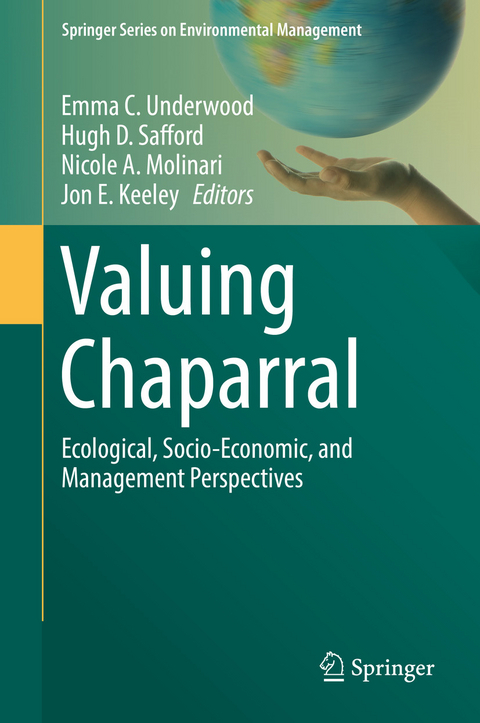
Valuing Chaparral (eBook)
XXV, 467 Seiten
Springer International Publishing (Verlag)
978-3-319-68303-4 (ISBN)
Chaparral shrubland ecosystems are an iconic feature of the California landscape, and a highly biodiverse yet highly flammable backdrop to some of the fastest growing urban areas in the United States. Chaparral-type ecosystems are a common element of all of the world's Mediterranean-type climate regions - of which California is one - yet there is little public appreciation of the intrinsic value and the ecosystem services that these landscapes provide. Valuing Chaparral is a compendium of contributions from experts in chaparral ecology and management, with a focus on the human relationship with chaparral ecosystems. Chapters cover a wide variety of subjects, ranging from biodiversity to ecosystem services like water provision, erosion control, carbon sequestration and recreation; from the history of human interactions with chaparral to current education and conservation efforts; and from chaparral restoration and management to scenarios of the future under changing climate, land use, and human population. Valuing Chaparral will be of interest to resource managers, the research community, policy makers, and the public who live and work in the chaparral dominated landscapes of California and other Mediterranean-type climate regions.
Dr. Emma Underwood is a research scientist with the Department of Environmental Science and Policy at the University of California, Davis and is a visiting fellow with Southampton University in the UK. A central theme of her research is the application of geospatial tools and remote sensing techniques to address biodiversity and conservation issues and inform environmental decision-making. Her research interests include conservation assessments of biodiversity, estimating conservation return on investment, evaluating ecosystem services, and mapping and predicting the distribution of invasive plant species. During the past 15 years Emma's research has spanned a variety of ecosystems including tropical forests and a global conservation assessment of Mediterranean-type climate regions. Prior to UC Davis, she worked for the World Wildlife Fund-US and has since undertaken collaborative research with The Nature Conservancy, the US Geological Survey, and the US Forest Service. Emma received her Ph.D. in Ecology from the University of California.
Dr. Hugh Safford is Regional Ecologist for the USDA Forest Service's Pacific Southwest Region (California, Hawaii, Pacific territories), and member of the research faculty in the Department of Environmental Science and Policy at the University of California, Davis. Hugh manages a staff of ecologists that provide expertise in vegetation, fire, and restoration ecology, climate change, inventory, and monitoring to the 18 national forests in the Pacific Southwest Region. He is manager of the Regional Research Natural Area program, Sierra Nevada region leader for the California Fire Science Delivery Consortium, and science advisory board member for a number of environmental collaboratives and NGOs. Hugh provides international technical assistance on fire, forest management, and climate change issues in partnership with the US Agency for International Development (USAID) and the International Program of the Forest Service. Hugh grew up in southwestern Montana and now splits his time between Davis and Lake Tahoe, California. He earned his Ph.D. in Ecology from the University of California in 1999.
Dr. Nicole Molinari is a community ecologist with a broad interest in the consequences of human induced global changes, including the effects of biological invasions, nutrient enrichment, climate change and altered disturbance regimes on vegetation patterns. Nicole currently serves as the US Forest Service province ecologist for southern California (Angeles, Cleveland, Los Padres and San Bernardino national forests) where she applies scientific and ecological principles to address management issues. Her focus with the US Forest Service centers on fire ecology, ecological restoration and the response of vegetation to a changing environment. She is particularly interested in questions that couple her curiosity for the natural world with applied outcomes that can inform management and land use decisions. Nicole received her MS in Biology from Cal Poly-San Luis Obispo, and her Ph.D. in Ecology and Evolution from the University of California Santa Barbara in 2014.
Dr. Jon Keeley is a senior scientist with the US Geological Survey, an adjunct professor at UCLA, and a research associate at the Rancho Santa Ana Botanic Garden. He has served in Washington, D.C. as director of the ecology program for the National Science Foundation and was professor of biology at Occidental College for 20 years. He has spent sabbaticals in all of the Mediterranean-type climate regions of the world. Jon has over 350 publications in national and internationalscientific journals. His research on wildfires includes work on ecological and climate impacts, as well as non-native invasive plants, fire-stimulated seed germination, taxonomy of manzanitas (Arctostaphylos) and biochemical pathways of photosynthesis in vernal pool plants. He has received a Guggenheim Fellowship, is an Honorary Lifetime Member of the California Botanical Society, and a Fellow of the Ecological Society of America. He is senior author of a 2012 Cambridge University Press book 'Fire in Mediterranean Climate Ecosystems: Ecology, Evolution and Management.'
Dr. Emma Underwood is a research scientist with the Department of Environmental Science and Policy at the University of California, Davis and is a visiting fellow with Southampton University in the UK. A central theme of her research is the application of geospatial tools and remote sensing techniques to address biodiversity and conservation issues and inform environmental decision-making. Her research interests include conservation assessments of biodiversity, estimating conservation return on investment, evaluating ecosystem services, and mapping and predicting the distribution of invasive plant species. During the past 15 years Emma’s research has spanned a variety of ecosystems including tropical forests and a global conservation assessment of Mediterranean-type climate regions. Prior to UC Davis, she worked for the World Wildlife Fund-US and has since undertaken collaborative research with The Nature Conservancy, the US Geological Survey, and the US Forest Service. Emma received her Ph.D. in Ecology from the University of California. Dr. Hugh Safford is Regional Ecologist for the USDA Forest Service’s Pacific Southwest Region (California, Hawaii, Pacific territories), and member of the research faculty in the Department of Environmental Science and Policy at the University of California, Davis. Hugh manages a staff of ecologists that provide expertise in vegetation, fire, and restoration ecology, climate change, inventory, and monitoring to the 18 national forests in the Pacific Southwest Region. He is manager of the Regional Research Natural Area program, Sierra Nevada region leader for the California Fire Science Delivery Consortium, and science advisory board member for a number of environmental collaboratives and NGOs. Hugh provides international technical assistance on fire, forest management, and climate change issues in partnership with the US Agency for International Development (USAID) and the International Program of the Forest Service. Hugh grew up in southwestern Montana and now splits his time between Davis and Lake Tahoe, California. He earned his Ph.D. in Ecology from the University of California in 1999.Dr. Nicole Molinari is a community ecologist with a broad interest in the consequences of human induced global changes, including the effects of biological invasions, nutrient enrichment, climate change and altered disturbance regimes on vegetation patterns. Nicole currently serves as the US Forest Service province ecologist for southern California (Angeles, Cleveland, Los Padres and San Bernardino national forests) where she applies scientific and ecological principles to address management issues. Her focus with the US Forest Service centers on fire ecology, ecological restoration and the response of vegetation to a changing environment. She is particularly interested in questions that couple her curiosity for the natural world with applied outcomes that can inform management and land use decisions. Nicole received her MS in Biology from Cal Poly-San Luis Obispo, and her Ph.D. in Ecology and Evolution from the University of California Santa Barbara in 2014.Dr. Jon Keeley is a senior scientist with the US Geological Survey, an adjunct professor at UCLA, and a research associate at the Rancho Santa Ana Botanic Garden. He has served in Washington, D.C. as director of the ecology program for the National Science Foundation and was professor of biology at Occidental College for 20 years. He has spent sabbaticals in all of the Mediterranean-type climate regions of the world. Jon has over 350 publications in national and internationalscientific journals. His research on wildfires includes work on ecological and climate impacts, as well as non-native invasive plants, fire-stimulated seed germination, taxonomy of manzanitas (Arctostaphylos) and biochemical pathways of photosynthesis in vernal pool plants. He has received a Guggenheim Fellowship, is an Honorary Lifetime Member of the California Botanical Society, and a Fellow of the Ecological Society of America. He is senior author of a 2012 Cambridge University Press book "Fire in Mediterranean Climate Ecosystems: Ecology, Evolution and Management."
Foreword Preface Acknowledgments Chapter 1 California Chaparral and its Global Significance Chapter 2 Drivers of Chaparral Plant Diversity Chapter 3 Faunal Diversity in Chaparral Ecosystems Chapter 4 Native Peoples’ Relationship to the California Chaparral Chapter 5. Essential Landscape: An Environmental History of Chaparral Ecosystems in California Chapter 6 Biogeochemical Cycling of Carbon and Nitrogen in Chaparral Dominated Ecosystems Chapter 7 Sediment Delivery, Flood Control, and Physical Ecosystem Services in Southern California Chaparral Landscapes Chapter 8 Water Provision in Chaparral Landscapes – Water Quality and Water Quantity Chapter 9 Mapping the Value of National Forest Landscapes for Ecosystem Service Provision Chapter 10 Recreation Ecosystem Services from Chaparral Dominated Landscapes: A Baseline Assessment from National Forests in Southern California Chapter 11 Connecting Californians with the Chaparral Chapter 12 Chaparral Landscape Conversion in Southern CaliforniaChapter 13 Chaparral RestorationChapter 14 Climate Change Trends for ChaparralChapter 15 Managing Chaparral Resources on Public LandsSummary Chapter: The Past, Present, and Future of California ChaparralContributors
| Erscheint lt. Verlag | 9.4.2018 |
|---|---|
| Reihe/Serie | Springer Series on Environmental Management | Springer Series on Environmental Management |
| Zusatzinfo | XXV, 467 p. 85 illus., 66 illus. in color. |
| Verlagsort | Cham |
| Sprache | englisch |
| Themenwelt | Sachbuch/Ratgeber ► Natur / Technik ► Natur / Ökologie |
| Naturwissenschaften ► Biologie | |
| Naturwissenschaften ► Geowissenschaften | |
| Schlagworte | biodiversity • carbon storage • Chapparral shrublands • conservation • Ecosystem services • fire return interval • Flood control • habitat conversion • Mediterranean-type climate regions • Native American use • natural resources and energy economics • Recreation • sediment erosion retention • water quality • water quantity |
| ISBN-10 | 3-319-68303-9 / 3319683039 |
| ISBN-13 | 978-3-319-68303-4 / 9783319683034 |
| Informationen gemäß Produktsicherheitsverordnung (GPSR) | |
| Haben Sie eine Frage zum Produkt? |
 PDF (Wasserzeichen)
DRM: Digitales Wasserzeichen
Dieses eBook enthält ein digitales Wasserzeichen und ist damit für Sie personalisiert. Bei einer missbräuchlichen Weitergabe des eBooks an Dritte ist eine Rückverfolgung an die Quelle möglich.
Dateiformat: PDF (Portable Document Format)
Mit einem festen Seitenlayout eignet sich die PDF besonders für Fachbücher mit Spalten, Tabellen und Abbildungen. Eine PDF kann auf fast allen Geräten angezeigt werden, ist aber für kleine Displays (Smartphone, eReader) nur eingeschränkt geeignet.
Systemvoraussetzungen:
PC/Mac: Mit einem PC oder Mac können Sie dieses eBook lesen. Sie benötigen dafür einen PDF-Viewer - z.B. den Adobe Reader oder Adobe Digital Editions.
eReader: Dieses eBook kann mit (fast) allen eBook-Readern gelesen werden. Mit dem amazon-Kindle ist es aber nicht kompatibel.
Smartphone/Tablet: Egal ob Apple oder Android, dieses eBook können Sie lesen. Sie benötigen dafür einen PDF-Viewer - z.B. die kostenlose Adobe Digital Editions-App.
Buying eBooks from abroad
For tax law reasons we can sell eBooks just within Germany and Switzerland. Regrettably we cannot fulfill eBook-orders from other countries.
aus dem Bereich