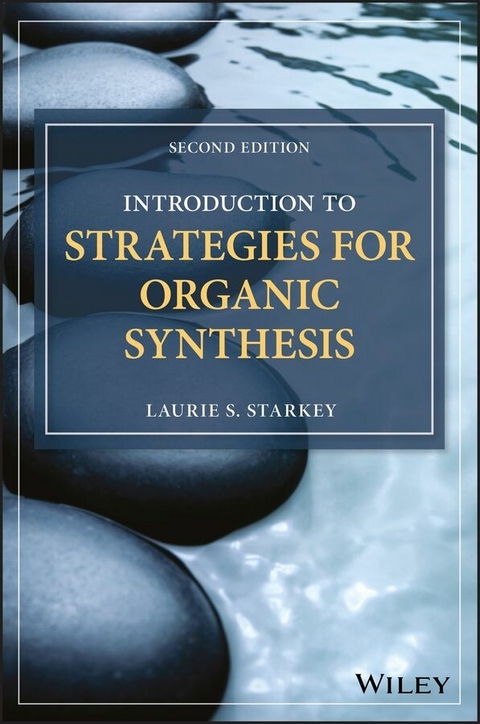
Introduction to Strategies for Organic Synthesis (eBook)
John Wiley & Sons (Verlag)
978-1-119-34721-7 (ISBN)
Bridging the Gap Between Organic Chemistry Fundamentals and Advanced Synthesis Problems
Introduction to Strategies of Organic Synthesis bridges the knowledge gap between sophomore-level organic chemistry and senior-level or graduate-level synthesis to help students more easily adjust to a synthetic chemistry mindset. Beginning with a thorough review of reagents, functional groups, and their reactions, this book prepares students to progress into advanced synthetic strategies. Major reactions are presented from a mechanistic perspective and then again from a synthetic chemist's point of view to help students shift their thought patterns and teach them how to imagine the series of reactions needed to reach a desired target molecule.
Success in organic synthesis requires not only familiarity with common reagents and functional group interconversions, but also a deep understanding of functional group behavior and reactivity. This book provides clear explanations of such reactivities and explicitly teaches students how to make logical disconnections of a target molecule.
This new Second Edition of Introduction to Strategies for Organic Synthesis:
- Reviews fundamental organic chemistry concepts including functional group transformations, reagents, stereochemistry, and mechanisms
- Explores advanced topics including protective groups, synthetic equivalents, and transition-metal mediated coupling reactions
- Helps students envision forward reactions and backwards disconnections as a matter of routine
- Gives students confidence in performing retrosynthetic analyses of target molecules Includes fully-worked examples, literature-based problems, and over 450 chapter problems with detailed solutions
- Provides clear explanations in easy-to-follow, student-friendly language
- Focuses on the strategies of organic synthesis rather than a catalogue of reactions and modern reagents
The prospect of organic synthesis can be daunting at the outset, but this book serves as a useful stepping stone to refresh existing knowledge of organic chemistry while introducing the general strategies of synthesis. Useful as both a textbook and a bench reference, this text provides value to graduate and advanced undergraduate students alike.
LAURIE S. STARKEY, PHD, is a Professor of Organic Chemistry at California State Polytechnic University, Pomona, where she has been teaching organic chemistry and organic synthesis since 1996. Her research focuses on chemical education, including the development and assessment of online learning tools and the creation of educational videos and animations. Dr. Starkey was awarded the Cal Poly Pomona College of Science's Distinguished Teaching Award in 2000, and the Provost's Award in Teaching Excellence in 2013.
LAURIE S. STARKEY, PHD, is a Professor of Organic Chemistry at California State Polytechnic University, Pomona, where she has been teaching organic chemistry and organic synthesis since 1996. Her research focuses on chemical education, including the development and assessment of online learning tools and the creation of educational videos and animations. Dr. Starkey was awarded the Cal Poly Pomona College of Science's Distinguished Teaching Award in 2000, and the Provost's Award in Teaching Excellence in 2013.
Preface xix
Acknowlegments xxi
CHAPTER 1 Synthetic Toolbox 1: Retrosynthesis and Protective Groups 1
1.1 Retrosynthetic Analysis 3
1.2 Protective Groups 11
CHAPTER 1 Problems Protective Groups 19
CHAPTER 2 Synthetic Toolbox 2: Overview of Organic Transformations 21
2.1 Nucleophiles and Electrophiles 23
2.2 Oxidation and Reduction Reactions 27
CHAPTER 2 Problems Nucleophiles, Electrophiles, and Redox 41
CHAPTER 3 Synthesis of Monofunctional Target Molecules (1-FG TMs) 45
3.1 Synthesis of Alcohols (ROH) and Phenols (ArOH) 47
3.2 Synthesis of Alkyl (RX) and Aryl Halides (ArX) 61
3.3 Synthesis of Ethers (ROR') 67
3.4 Synthesis of Thiols (RSH) and Thioethers (RSR´) 73
3.5 Synthesis of Amines (RNH2) and Anilines (ArNH2) 77
3.6 Synthesis of Alkenes (R2C?TCR2) 85
3.7 Synthesis of Alkynes (RC identical to CR') 93
3.8 Synthesis of Alkanes (RH) 97
3.9 Synthesis of Aldehydes and Ketones (RCHO, R2C?TO) 105
3.10 Synthesis of Carboxylic Acids (RCO2H) 117
3.11 Synthesis of Carboxylic Acid Derivatives 125
CHAPTER 3 Problems 1-FG TMs 139
CHAPTER 4 Synthesis of Target Molecules with Two Functional Groups (2-FG TMs) 143
4.1 Synthesis of beta?/Hydroxy Carbonyls and alpha,beta?/Unsaturated Carbonyls 145
4.2 More Enolate Reactions: Synthesis of 1,3?/Dicarbonyls, 1,5?/Dicarbonyls, and Cyclohexenones 157
4.3 "Illogical" 2?/Group Disconnections: Umpolung (Polarity Reversal) 171
CHAPTER 4 Problems 2-FG TMs 183
CHAPTER 5 Synthesis of Aromatic Target Molecules 187
5.1 Electrophilic Aromatic Substitution (ArH + E+ --> ArE) 189
5.2 Synthesis of Aromatic TMs via Diazonium Salts (ArN2 + + Nu: --> ArNu) 201
5.3 Nucleophilic Aromatic Substitution (ArX + Nu: --> ArNu) 205
CHAPTER 5 Problems Aromatic TMs 209
CHAPTER 6 Synthesis of Compounds Containing Rings 211
6.1 Synthesis of Cyclopropanes 213
6.2 Synthesis of Cyclobutanes 215
6.3 Synthesis of Five?/Membered Rings (Radical Cyclization Reactions) 217
6.4 Synthesis of Six?/Membered Rings (Diels-Alder Reaction) 221
CHAPTER 6 Problems Cyclic TMs 231
CHAPTER 7 Predicting and Controlling Stereochemistry 235
7.1 Reactions that Form Racemates 237
7.2 SN2 Mechanism: Backside Attack 243
7.3 Elimination Mechanisms 245
7.4 Additions to Alkenes and Alkynes 247
7.5 Additions to Carbonyls 251
7.6 Additions to Enolates: Aldol Stereochemistry 257
7.7 Enantioselectivity and Asymmetric Syntheses 261
CHAPTER 7 Problems Stereochemistry 269
CHAPTER 8 Transition Metal-Mediated Carbon-Carbon Bond Formation 273
8.1 Transition Metal Coordination Complexes 275
8.2 Organometallic Reaction Mechanisms 283
8.3 Carbonylation and Decarbonylation 291
8.4 (ArX + Alkene --> Ar?/Alkene) 295
8.5 Palladium?/Catalyzed Cross?/Coupling Reactions (RX + R'M --> R?/R') 297
8.6 Olefin Metathesis Reactions 303
8.7 Retrosynthesis: Disconnections Based on Metal-Mediated Reactions 307
CHAPTER 8 Problems Transition Metal-Mediated Synthesis 309
SOLUTIONS TO PROBLEMS 313
Index 389
CHAPTER 1.1
RETROSYNTHETIC ANALYSIS
Every organic synthesis problem actually begins at the end of the story, a target molecule (TM). The goal is to design a reasonable synthesis that affords the TM as the major product. In the interest of saving both time and money, an ideal synthesis will employ readily available starting materials and will be as efficient as possible. The planning of a synthesis involves imagining the possible reactions that could give the desired product; this process is called doing a retrosynthesis or performing a retrosynthetic analysis of a TM. A special arrow is used to denote a retrosynthetic step. The ⇒ arrow leading away from the TM represents the question “What starting materials could I use to make this product?” and points to an answer to that question. The analysis begins by identifying a functional group present on the target molecule and recalling the various reactions that are known to give products containing that functional group (or pattern of FGs). The process is continued by analyzing the functional groups in the proposed starting material and doing another retrosynthetic step, continuing to work backward toward simple, commercially available starting materials. Once the retrosynthetic analysis is complete, then the forward multistep synthesis can be developed, beginning with the proposed starting materials and treating them with the necessary reagents to eventually transform them into the desired TM.
Retrosynthesis and Synthesis of a Target Molecule (TM)
A retrosynthesis involves working backward from the given target molecule (work done in our minds and on paper), while the synthesis is the forward path leading to the target molecule (experimental work done in the lab). Performing a retrosynthetic analysis is challenging since it requires not only knowledge of an enormous set of known organic reactions but also the ability to imagine the experimental conditions necessary to produce a desired product. This challenge becomes more manageable by developing a systematic approach to synthesis problems.*
When evaluating a given target molecule, it is important to consider how the functional groups present in the TM can be formed. There are two possibilities for creating a given functional group: by conversion from a different functional group (called a functional group interconversion or FGI), or as a result of a carbon─carbon bond‐forming reaction (requiring a retrosynthetic “disconnection”). In order to synthesize a target molecule (or transform a given starting material into a desired product), a combination of FGIs and carbon─carbon bond‐forming reactions will typically be required. While the key to the “synthesis” of complex organic molecules is the formation of new carbon─carbon bonds, the synthetic chemist must also be fully capable of swapping one functional group for another.
1.1.1 RETROSYNTHESIS BY FUNCTIONAL GROUP INTERCONVERSION (FGI)
Each functional group has a characteristic reactivity; for example, it might be electron‐rich, electron‐deficient, acidic, or basic. In order to synthesize organic compounds, we must construct the desired carbon framework while locating the required functional groups in the appropriate positions. This necessitates that the chemist is familiar not only with the reactivities of each functional group but also with the possible interconversions between functional groups. Such functional group interconversions (FGIs) enable the chemist to move along a synthetic pathway toward a desired target.
Examples of Functional Group Interconversions (FGI)
Let us consider a carboxylic acid target molecule (RCO2H). There are many ways to generate a carboxylic acid functional group, so there are many possible syntheses to consider (often, there may be more than one good solution to a given synthesis problem!). One reaction that gives a carboxylic acid product is the hydrolysis of a carboxylic acid derivative, such as a nitrile. Therefore, a possible retrosynthesis of a carboxylic acid TM (What starting materials are needed?) is to consider an FGI and imagine a nitrile starting material. In other words, if we had a nitrile in our hands, we could convert it to a carboxylic acid, leading to a synthesis of the target molecule.
Retrosynthesis of a TM via FGI
Synthesis of the TM
Choice of Reagents
There is almost always more than one reagent that can be used to achieve any given transformation. In fact, a quick look at a book such as Comprehensive Organic Transformations by Richard Larock* reveals that there may be dozens of possibilities. Why have so many methods been developed over the years for organic reactions? Because not every molecule—or every chemist—has the same needs. The most obvious reason any “one size fits all” approach fails is that complex synthetic targets contain a wide variety of functional groups. The molecule as a whole must tolerate the reaction conditions used, and side reactions with other functional groups must be kept to a minimum. For example, chromic acid oxidation (Na2Cr2O7, H2SO4) of a 2° alcohol to give a ketone would not be useful if the starting material contains any functional groups that are sensitive to acidic conditions. In such a case, the Swern oxidation might be preferred (DMSO, ClCOCOCl, Et3N). New reagents, catalysts, and methods are continuously being developed, with goals of having better selectivity, better tolerance for certain functional groups, being “greener” with less waste or lower toxicity, requiring fewer steps, being more efficient and/or less expensive, and so on.
The focus of this book is on the strategies of organic synthesis; it is not intended to be comprehensive in the treatment of modern reagents.† Instead, reagents used are those that are typically found in undergraduate organic chemistry textbooks. Hopefully, these reagents will be familiar to the reader, although they would not necessarily be the ones selected when the synthesis moves from paper to the laboratory. Furthermore, experimental details‡ have largely been omitted from this book. For example, osmium tetroxide oxidation of an alkene is given simply as “OsO4.” In reality, this expensive and toxic reagent is used in catalytic amounts in conjunction with some other oxidizing agent (e.g., NMO), so the precise reagents and experimental reaction conditions are much more complex than what is presented herein.
1.1.2 RETROSYNTHESIS BY MAKING A DISCONNECTION
Rather than being created via an FGI, a functional group (or pattern of FGs) may be created as a result of a reaction that also forms a carbon─carbon sigma bond. In that case, the retrosynthesis involves the disconnection of that bond. In a typical carbon─carbon bond‐forming reaction, one of the starting material carbons must have been a nucleophile (Nu:, electron‐rich), and the other must have been an electrophile (E+, electron‐deficient). While this is certainly not the only way to make a carbon─carbon bond (e.g., the organometallic coupling reactions explored in Chapter 8 offer an alternate approach), the pairing of appropriate nucleophiles and electrophiles serves as an important foundation to the logic of organic synthesis, and such strategies will solve a wide variety of synthetic problems. Therefore, the disconnection of the carbon─carbon bond is made heterolytically to give an anion (nucleophile) and a cation (electrophile). These imaginary fragments, called “synthons,” are then converted into reasonable starting materials. By being familiar with common nucleophiles and electrophiles, we can make logical disconnections. The example below shows the logical disconnection of an ether TM, affording recognizable alkyl halide E+ and alkoxide Nu: starting materials.
A Logical Disconnection of a TM
Disconnecting that same carbon–oxygen bond in the other direction (with both electrons going to the carbon) would be an illogical disconnection, since it leads to an electrophilic oxygen synthon for which there is no reasonable equivalent reagent.
An Illogical Disconnection of a TM
Let us consider once again a carboxylic acid TM. We have seen that a carboxylic acid can be prepared by an FGI if the carbon chain is already in place, but it is also possible to create new carbon–carbon bonds in a carboxylic acid synthesis. For example, the reaction of a Grignard reagent with carbon dioxide generates a carboxylic acid functional group, so this presents a possible disconnection for the target molecule’s retrosynthesis. The logical disconnection is the one that moves the electrons away from the carbonyl, giving reasonable synthons and recognizable starting materials (RMgBr Nu: and CO2 E+).
Retrosynthesis via Disconnection of a TM
Synthesis of the TM
What Makes a Good Synthesis?
The fact that multiple retrosynthetic strategies usually exist means that there will often be more than one possible synthesis of a desired target molecule. How can we determine which synthesis is best? This depends on many factors, but there are some general rules that can help us devise a good plan to synthesize the simple target molecules found in this book.
- Start with reasonable starting materials and reagents. A good synthesis begins with commercially available starting materials....
| Erscheint lt. Verlag | 28.3.2018 |
|---|---|
| Sprache | englisch |
| Themenwelt | Naturwissenschaften ► Chemie ► Organische Chemie |
| Naturwissenschaften ► Chemie ► Physikalische Chemie | |
| Schlagworte | advanced organic • advanced undergraduate organic lab • basic organic syntheses • beginner organic synthesis • catalysis • Chemie • Chemistry • elementary organic synthesis • graduate organic lab manual • introductory synthesis • Katalyse • <p>organic synthesis • Organic Chemistry • organic chemistry synthesis • organic synthesis basics • organic synthesis chemistry • organic synthesis elements • organic synthesis essentials • organic synthesis fundamentals • organic synthesis guide • organic synthesis help • organic synthesis lab supplement • organic synthesis mechanisms • organic synthesis planning • organic synthesis principles • organic synthesis problems • organic synthesis processes • organic synthesis reactions • organic synthesis reagents • organic synthesis reference • organic synthesis review • organic synthesis sequencing • organic synthesis stereochemistry </p> • organic synthesis strategies • organic synthesis study aid • organic synthesis text • Organische Chemie • organometallic reactions • Organometallic Synthesis • Pharmaceutical & Medicinal Chemistry • Pharmazeutische u. Medizinische Chemie • Retrosynthetic analysis • undergraduate organic synthesis |
| ISBN-10 | 1-119-34721-1 / 1119347211 |
| ISBN-13 | 978-1-119-34721-7 / 9781119347217 |
| Informationen gemäß Produktsicherheitsverordnung (GPSR) | |
| Haben Sie eine Frage zum Produkt? |
 EPUB (Adobe DRM)
Kopierschutz: Adobe-DRM
Adobe-DRM ist ein Kopierschutz, der das eBook vor Mißbrauch schützen soll. Dabei wird das eBook bereits beim Download auf Ihre persönliche Adobe-ID autorisiert. Lesen können Sie das eBook dann nur auf den Geräten, welche ebenfalls auf Ihre Adobe-ID registriert sind.
Details zum Adobe-DRM
Dateiformat: EPUB (Electronic Publication)
EPUB ist ein offener Standard für eBooks und eignet sich besonders zur Darstellung von Belletristik und Sachbüchern. Der Fließtext wird dynamisch an die Display- und Schriftgröße angepasst. Auch für mobile Lesegeräte ist EPUB daher gut geeignet.
Systemvoraussetzungen:
PC/Mac: Mit einem PC oder Mac können Sie dieses eBook lesen. Sie benötigen eine
eReader: Dieses eBook kann mit (fast) allen eBook-Readern gelesen werden. Mit dem amazon-Kindle ist es aber nicht kompatibel.
Smartphone/Tablet: Egal ob Apple oder Android, dieses eBook können Sie lesen. Sie benötigen eine
Geräteliste und zusätzliche Hinweise
Buying eBooks from abroad
For tax law reasons we can sell eBooks just within Germany and Switzerland. Regrettably we cannot fulfill eBook-orders from other countries.
aus dem Bereich