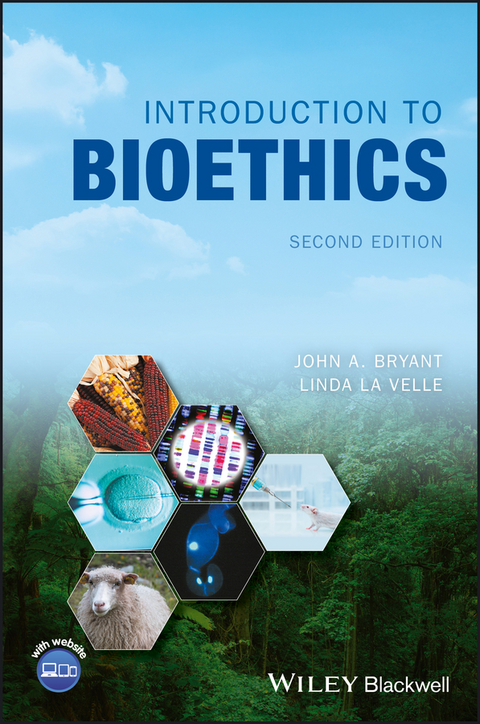
Introduction to Bioethics (eBook)
John Wiley & Sons (Verlag)
978-1-119-08015-2 (ISBN)
Provides comprehensive, yet concise coverage of the broad field of bioethics, dealing with the scientific, medical, social, religious, political and international concerns
This book offers complete information about all aspects of bioethics and its role in our world. It tackles the concerns of bioethicists, dealing with the ethical questions that arise in the relationships among life sciences, biotechnology, medicine, politics, law, and philosophy. The book introduces the various modes of ethical thinking and then helps the reader to apply that thinking to issues relating to the environment, to plants and animals, and to humans.
Written in an accessible manner, Introduction to Bioethics, Second Edition focuses on key issues directly relevant to those studying courses ranging from medicine through to biology and agriculture. Ethical analysis is threaded throughout each chapter and supplementary examples are included to stimulate further thought. In addition there are numerous mini-case studies to aid understanding, together with key references and further reading. Topics covered include genetic modification; GM crops, human genetics and genomics; cloning and stem cells; assisted reproduction; end of life issues; human enhancement; transhumanism and more.
- A concise introduction covering the whole field of bioethics
- Ethical analysis included throughout
- Mini case-studies in each chapter place ethics into specific contexts
- Includes exercises and commentary to further clarify ethical discussions
- Now fully revised, updated and re-ordered, with new chapters on Biofuels and on Synthetic Biology
Introduction to Bioethics, Second Edition is primarily aimed at undergraduate students taking courses in biomedical sciences, biological sciences, and medicine. It will also be useful to anyone with an interested in the ethics of biological and biomedical science, including science journalists and reporters, who want to inform themselves about current developments.
About the Authors
John A. Bryant is Professor Emeritus of Biosciences, College of Life and Environmental Sciences, University of Exeter, Exeter, UK.
Linda la Velle is Professor of Biology in Education, Institute of Education, University of Plymouth, Plymouth, UK, and Visiting Professor of Education, Bath Spa University, UK.
Provides comprehensive, yet concise coverage of the broad field of bioethics, dealing with the scientific, medical, social, religious, political and international concerns This book offers complete information about all aspects of bioethics and its role in our world. It tackles the concerns of bioethicists, dealing with the ethical questions that arise in the relationships among life sciences, biotechnology, medicine, politics, law, and philosophy. The book introduces the various modes of ethical thinking and then helps the reader to apply that thinking to issues relating to the environment, to plants and animals, and to humans. Written in an accessible manner, Introduction to Bioethics, Second Edition focuses on key issues directly relevant to those studying courses ranging from medicine through to biology and agriculture. Ethical analysis is threaded throughout each chapter and supplementary examples are included to stimulate further thought. In addition there are numerous mini-case studies to aid understanding, together with key references and further reading. Topics covered include genetic modification; GM crops, human genetics and genomics; cloning and stem cells; assisted reproduction; end of life issues; human enhancement; transhumanism and more. A concise introduction covering the whole field of bioethics Ethical analysis included throughout Mini case-studies in each chapter place ethics into specific contexts Includes exercises and commentary to further clarify ethical discussions Now fully revised, updated and re-ordered, with new chapters on Biofuels and on Synthetic Biology Introduction to Bioethics, Second Edition is primarily aimed at undergraduate students taking courses in biomedical sciences, biological sciences, and medicine. It will also be useful to anyone with an interested in the ethics of biological and biomedical science, including science journalists and reporters, who want to inform themselves about current developments.
About the Authors John A. Bryant is Professor Emeritus of Biosciences, College of Life and Environmental Sciences, University of Exeter, Exeter, UK. Linda la Velle is Professor of Biology in Education, Institute of Education, University of Plymouth, Plymouth, UK, and Visiting Professor of Education, Bath Spa University, UK.
Preface
Setting the scene
Chapter One Science and Society
Chapter Two Ethics and Bioethics
Biomedical science and medical technology
Chapter Three Life Before Birth I The New Reproductive Technologies
Chapter Four Life Before Birth II Embryos, Foetuses and Associated Issues
Chapter Five Cloning and Stem Cells
Chapter Six Human Genes and Genomes
Chapter Seven Transhumanism
Chapter Eight Decisions at the End of Life -When May I Die and When am I Dead?
Biotechnology
Chapter Nine GM and Synthetic Biology
Chapter Ten Genetic Modification of Plants
Chapter Eleven Genes: Some Wider Issues
Chapter Twelve Biofuels
Humans and the Biosphere
Chapter Thirteen Humans and Non-human animals
Chapter Fourteen The Environmental Crisis
Chapter Fifteen Planet and Population
Glossary
1
Science and Society
There is not a discovery in science, however revolutionary, however sparkling with insight, that does not arise out of what went before.
From Adding a Dimension: Seventeen Essays on the History of Science, Isaac Asimov (1964)
I feel the story should be told, partly because many of my scientific friends have expressed curiosity about how the double helix was found, and for them an incomplete version is better than none. But even more important, I believe, there remains a general ignorance about how science is ‘done’. That is not to say that all science is done in the manner described here. This is far from the case, for styles of scientific research vary almost as much as human personalities. On the other hand, I do not believe that the way DNA came out constitutes an odd exception to a scientific world complicated by the contradictory pulls of ambition and a sense of fair play.
From The Double Helix, James D Watson (1968)
The saddest aspect of life right now is that science gathers knowledge faster than society gathers wisdom.
From Isaac Asimov’s Book of Science and Nature Quotations, Isaac Asimov and Jason A. Shulman (1988)
1.1 What’s It All About?
This is a book about bioethics but we are starting with a consideration of the practice of science and its relationship with wider society. Why? Consider the four following case studies:
Case Study 1
- Donated gametes – sperm and ova – are used in fertility treatments for patients who are unable to produce their own.
- It is much easier, for obvious reasons, to donate sperm than ova.
- Donated ova are very scarce.
- During foetal development, females lay down more than a lifetime’s supply of oocytes (egg cells).
- It has therefore been suggested that aborted female foetuses may be used to supply oocytes/ova for fertility treatments.
- Note: Of the approximately 200,000 abortions that occur in the United Kingdom each year, up to 10,000 of those that involve a female foetus are late enough for egg cells to be present.
Do you approve or disapprove of this idea? What are your reasons?
Case Study 21
- A small less‐developed country in South America is deep in debt.
- Its main resource is its rainforest.
- In order to raise revenue, the government has granted a licence to a Japanese logging company to clear 25% of the forest.
- The land that has so far been cleared is used for cattle ranching, mainly to raise beef for the US market.
- The government has also granted a licence to a transnational biotechnology company to exploit the forest’s gene pool.
- In addition to the income from the licence, the company has agreed to pay royalties on income generated from discoveries based on the rainforest gene pool.
What are the issues involved in dealing with this situation?
Case Study 3
- On several occasions over the past 15 years, normally fertile couples have sought permission to undergo in vitro fertilisation in order to produce a baby that can be a stem cell donor for an older sibling.
- In most of the cases, the older sibling suffers from a genetic disorder, and the embryos created in vitro would be tested for the absence of the mutation and for a positive tissue match to the older sibling.
- In another case, the condition suffered by the older sibling is not ‘genetic’ but the child still needs donated stem cells. In this case the in vitro embryo would be selected solely as a tissue match.
In which of these cases, if any, would you grant permission? Give your reasons.
Case Study 4
- A small biotechnology company in Mexico has discovered a gene that encodes a protein in the network of resistance to oxidative stress in plants.
- Laboratory experiments have shown that when the gene is transferred by genetic modification techniques to crop species, the crop plants show an enhanced capacity to grow and produce yield under conditions where water supply is limiting.
- The company has not published its data because it is filing a patent on the gene.
- If the patent is granted, the company plans to licence it out to a major transnational agrichemical company.
Should the patent be granted? Give your reasons.
These case studies are on the surface very different from each other. However, they all describe situations in which ethical dilemmas have been raised by advances in science and by the way that the science, through its application, may have impacts on the lives of individuals and/or on wider society. The issues presented in these case studies are discussed in detail in later chapters. In the mean time it is important to consider briefly the factors that influence our decision‐making in these and similar situations:
- Firstly, there may be an immediate personal reaction – a ‘gut response’ – along the lines of ‘Yuk, that’s awful’ or ‘Wow, that’s brilliant’ or along more sociopolitical lines: ‘That’s just not fair/not right’.
- Secondly, there will (it is hoped) be a more thought‐out ethical analysis that may complement the gut reaction but which may also cause the gut reaction to be questioned.
- Thirdly, it is important to realise that both gut response and the more thought‐out ethical analysis are very likely to be affected by one’s world view or personal philosophy (which for some will include religious commitment).
- Fourthly, because advances in science are embedded in all these studies, one’s view of the science itself is important. Do we know all that we need to know in order to go ahead or is more work needed? Are the conclusions presented in support of a particular proposal soundly drawn? Do these scientists know what they are doing? Should the basic research that led to the current situation have been permitted in the first place?
Thus, science is one of the factors that informs bioethical decision‐making; we cannot avoid thinking about science, why and how it is done and how it relates to wider society. And that is what we explore in the rest of this chapter.
1.2 What Is Science?
1.2.1 Introduction: Some History (But Not Very Much)
We get the word science from a Latin word, scio, which means ‘I know’ and in the original usage science simply meant knowledge. The application of the word specifically to knowledge about the material nature of the universe, gained by a particular set of methods, dates back less than 200 years (see a more detailed discussion towards the end of this section). Some of those whom we regard as the great scientists of the past, such as Isaac Newton or Robert Boyle, would not have called themselves scientists. Indeed, Newton’s position at Cambridge was Lucasian Professor of Mathematics and his major work was called (translating from the Latin original) The Mathematical Principles of Natural Philosophy. The latter term natural philosophy was what we now call ‘science’ but because of the emphasis in the science of the time, in practice it came to mean physics. Indeed, it was used in this way in the older Scottish universities well into the second half of the 20th century. However, we now have a very clear idea of what we mean by the more general term science: the word implies a whole approach to the material world, to methods of acquiring knowledge about that world and to the body of knowledge thus acquired. So, how did we arrive at this situation?
To an early human being, the world around must have seemed a strange and often hostile place. It was certainly a place of contrasts, embodying both provision and threat. So while plants could be harvested, some were poisonous; while animals could be hunted, some animals, including some quarry animals, were very dangerous. Further, there were (and indeed still are) unpredictable and often devastating events such as storms, earthquakes and volcanic eruptions. Nature was not to be taken lightly and it was important that knowledge of the positive and negative aspects of the natural world was passed on verbally from generation to generation. Doubtless humankind’s investigation and knowledge of nature remained at this level for tens of thousands of years. However, dating from over 75,000 years ago, there is evidence of art; as that art, over successive millennia, became more sophisticated, it relied on quite detailed observations of nature. One just has to look at rock art and cave paintings in places as diverse as Australia, France, Siberia, South Africa2 and Spain dating from between 25,000 and 10,000 years ago to become aware of this. Furthermore, as cultures evolved, so did descriptive knowledge of the times and seasons, so that there was confidence that the sun would rise daily and that the seasonal rains would fall, that certain animals migrated and that plants grew at particular times. Some of that knowledge may have been very sophisticated; in Britain, for example, the alignment of particular stones in the stone circle at Stonehenge with the sunrise on the summer solstice and the sunset on the winter solstice indicates quite a detailed knowledge of astronomical events through the year. Stonehenge dates at about 2800 BC, around the same time as the period of building pyramids in Giza, Egypt, was under way. The alignment of the pyramids shows that the Egyptians...
| Erscheint lt. Verlag | 15.3.2018 |
|---|---|
| Sprache | englisch |
| Themenwelt | Medizin / Pharmazie ► Allgemeines / Lexika |
| Naturwissenschaften ► Biologie | |
| Schlagworte | Bioethics & Medical Ethics • bioethics and philosophy • Bioethics and Politics • Bioethics and the Law • Bioethik • Bioethik, Medizinethik • Biotech • Biotechnology • Biowissenschaften • clinical research ethics • ethic in transhumanism • ethics and human research • ethics and medicine • ethics for end of life issues • ethics in cloning • Ethics of biotechnology • ethics of genetic modification • guide to bioethics • human enhancement and ethics • Human Research • Life Sciences • <i> Introduction to Bioethics</i></p> • <p>bioethics • medical law • Medical Law & Ethics • Medical Science • Medizin • Medizinrecht u. Ethik • Philosophie • Philosophy • Stem Cell Ethics • the human genome project |
| ISBN-10 | 1-119-08015-0 / 1119080150 |
| ISBN-13 | 978-1-119-08015-2 / 9781119080152 |
| Informationen gemäß Produktsicherheitsverordnung (GPSR) | |
| Haben Sie eine Frage zum Produkt? |
 EPUB (Adobe DRM)
Kopierschutz: Adobe-DRM
Adobe-DRM ist ein Kopierschutz, der das eBook vor Mißbrauch schützen soll. Dabei wird das eBook bereits beim Download auf Ihre persönliche Adobe-ID autorisiert. Lesen können Sie das eBook dann nur auf den Geräten, welche ebenfalls auf Ihre Adobe-ID registriert sind.
Details zum Adobe-DRM
Dateiformat: EPUB (Electronic Publication)
EPUB ist ein offener Standard für eBooks und eignet sich besonders zur Darstellung von Belletristik und Sachbüchern. Der Fließtext wird dynamisch an die Display- und Schriftgröße angepasst. Auch für mobile Lesegeräte ist EPUB daher gut geeignet.
Systemvoraussetzungen:
PC/Mac: Mit einem PC oder Mac können Sie dieses eBook lesen. Sie benötigen eine
eReader: Dieses eBook kann mit (fast) allen eBook-Readern gelesen werden. Mit dem amazon-Kindle ist es aber nicht kompatibel.
Smartphone/Tablet: Egal ob Apple oder Android, dieses eBook können Sie lesen. Sie benötigen eine
Geräteliste und zusätzliche Hinweise
Buying eBooks from abroad
For tax law reasons we can sell eBooks just within Germany and Switzerland. Regrettably we cannot fulfill eBook-orders from other countries.
aus dem Bereich