


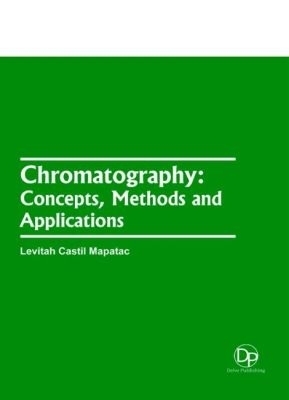
Chromatography
Concepts, Methods and Applications
Seiten
2016
Delve Publishing (Verlag)
978-1-68095-722-8 (ISBN)
Delve Publishing (Verlag)
978-1-68095-722-8 (ISBN)
- Titel nicht im Sortiment
- Artikel merken
Provies an introduction to chromatography. Chromatography has become a cornerstone of separation science, that branch of chemistry devoted to separating compounds from mixtures. There are two main categories of chromatography: preparative and analytical. Analytical work uses small sample sizes; preparative work uses large quantities of samples and collects the output in bulk.
Chromatography has become a cornerstone of separation science, that branch of chemistry devoted to separating compounds from mixtures. Chromatography is one of several separation techniques defined as differential migration from a narrow initial zone. Electrophoresis is another member of this group. In this case, the driving force is an electric field, which exerts different forces on solutes of different ionic charge. The resistive force is the viscosity of the nonflowing solvent. The combination of these forces yields ion mobilities peculiar to each solute. There are two main categories of chromatography: preparative and analytical. Analytical work uses small sample sizes; the objective is to separate compounds in order to identify them. Preparative work uses large quantities of samples and collects the output in bulk; the point of the chromatography here is to remove impurities from a commercial product. The two are not mutually exclusive. Chromatography has numerous applications in biological and chemical fields. It is widely used in biochemical research for the separation and identification of chemical compounds of biological origin. In the petroleum industry the technique is employed to analyze complex mixtures of hydrocarbons. Pharmaceutical industries use this method both to prepare huge quantities of extremely pure materials, and also to analyze the purified compounds for trace contaminants. These separation techniques like chromatography gain importance in different kinds of companies, different departments like Fuel Industry, biotechnology, biochemical processes, and forensic science. Chromatography is used for quality analyses and checker in the food industry, by identifying and separating, analyzing additives, vitamins, preservatives, proteins, and amino acids. Chromatography like HPLC is used in DNA fingerprinting and bioinformatics.
Chromatography has become a cornerstone of separation science, that branch of chemistry devoted to separating compounds from mixtures. Chromatography is one of several separation techniques defined as differential migration from a narrow initial zone. Electrophoresis is another member of this group. In this case, the driving force is an electric field, which exerts different forces on solutes of different ionic charge. The resistive force is the viscosity of the nonflowing solvent. The combination of these forces yields ion mobilities peculiar to each solute. There are two main categories of chromatography: preparative and analytical. Analytical work uses small sample sizes; the objective is to separate compounds in order to identify them. Preparative work uses large quantities of samples and collects the output in bulk; the point of the chromatography here is to remove impurities from a commercial product. The two are not mutually exclusive. Chromatography has numerous applications in biological and chemical fields. It is widely used in biochemical research for the separation and identification of chemical compounds of biological origin. In the petroleum industry the technique is employed to analyze complex mixtures of hydrocarbons. Pharmaceutical industries use this method both to prepare huge quantities of extremely pure materials, and also to analyze the purified compounds for trace contaminants. These separation techniques like chromatography gain importance in different kinds of companies, different departments like Fuel Industry, biotechnology, biochemical processes, and forensic science. Chromatography is used for quality analyses and checker in the food industry, by identifying and separating, analyzing additives, vitamins, preservatives, proteins, and amino acids. Chromatography like HPLC is used in DNA fingerprinting and bioinformatics.
Levitah C. Mapatac is an Associate Professor, researcher, writer and a PhD holder from the University in Science and Technology of Southern Philippines. Her interest varies from different chemistry concepts and applications and currently doing research in traditional medicines, water waste pollution and environmental chemistry in the aspect of contamination pathways, profilling and rehabilatation of mining waste.
| Erscheinungsdatum | 16.03.2018 |
|---|---|
| Sprache | englisch |
| Maße | 152 x 229 mm |
| Gewicht | 780 g |
| Themenwelt | Naturwissenschaften ► Chemie ► Analytische Chemie |
| ISBN-10 | 1-68095-722-8 / 1680957228 |
| ISBN-13 | 978-1-68095-722-8 / 9781680957228 |
| Zustand | Neuware |
| Informationen gemäß Produktsicherheitsverordnung (GPSR) | |
| Haben Sie eine Frage zum Produkt? |
Mehr entdecken
aus dem Bereich

aus dem Bereich
Stoffsammlung für chemische Laborpraktika mit Vorlagen für …
Buch | Hardcover (2023)
Shaker (Verlag)
CHF 76,70


