


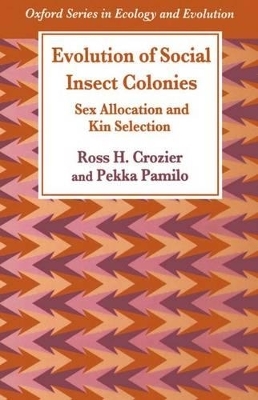
Evolution of Social Insect Colonies
Sex Allocation and Kin Selection
Seiten
1996
Oxford University Press (Verlag)
978-0-19-854942-0 (ISBN)
Oxford University Press (Verlag)
978-0-19-854942-0 (ISBN)
Crozier and Pamilo's contribution is to analyse the genetic basis of the patterns of reproduction and resource allocation found in social insect colonies - bees, wasps, ants, and termites. This is done much more comprehensively and with greater depth and insight than in any previous study, and is a significant step forward in the fields of social evolution and population genetics.
This book is about the genetics and behaviour of individuals within colonies of social insects - bees, wasps, ants, and termites. Colonial living is characterized by division of labour and finely coordinated organization, by reproductive function being limited to certain individuals, by cooperative brood care, and by the presence of non-reproductive workers. Within a colony, however, many events are the result of conflicts between individuals seeking to maximize their own interests. Ever since Darwin, this interplay of cooperation and conflict has raised many important questions in evolutionary biology, especially about how cooperative behaviour is maintained in the absence of direct reproduction by workers. How is the heritable component of this behaviour passed on? Crozier and Pamilo's contribution is to analyse the genetic basis of the patterns of reproduction and resource allocation found in social insect colonies. This is done more comprehensively and with greater depth and insight than in any previous study, and is a significant step forward in the fields of population genetics and social evolution.
This book is about the genetics and behaviour of individuals within colonies of social insects - bees, wasps, ants, and termites. Colonial living is characterized by division of labour and finely coordinated organization, by reproductive function being limited to certain individuals, by cooperative brood care, and by the presence of non-reproductive workers. Within a colony, however, many events are the result of conflicts between individuals seeking to maximize their own interests. Ever since Darwin, this interplay of cooperation and conflict has raised many important questions in evolutionary biology, especially about how cooperative behaviour is maintained in the absence of direct reproduction by workers. How is the heritable component of this behaviour passed on? Crozier and Pamilo's contribution is to analyse the genetic basis of the patterns of reproduction and resource allocation found in social insect colonies. This is done more comprehensively and with greater depth and insight than in any previous study, and is a significant step forward in the fields of population genetics and social evolution.
Introduction ; Inclusive fitness and sex allocation ; The evolution in insects ; Evolution of colony characteristics ; Intra-colony conflicts over sex allocation ; Colony-level variation of sex ratios ; Literature cited ; Author index ; Subject index
| Erscheint lt. Verlag | 7.3.1996 |
|---|---|
| Reihe/Serie | Oxford Series in Ecology and Evolution |
| Zusatzinfo | line figures, tables |
| Verlagsort | Oxford |
| Sprache | englisch |
| Maße | 154 x 232 mm |
| Gewicht | 500 g |
| Themenwelt | Naturwissenschaften ► Biologie ► Evolution |
| Naturwissenschaften ► Biologie ► Genetik / Molekularbiologie | |
| Naturwissenschaften ► Biologie ► Zoologie | |
| ISBN-10 | 0-19-854942-3 / 0198549423 |
| ISBN-13 | 978-0-19-854942-0 / 9780198549420 |
| Zustand | Neuware |
| Informationen gemäß Produktsicherheitsverordnung (GPSR) | |
| Haben Sie eine Frage zum Produkt? |
Mehr entdecken
aus dem Bereich

aus dem Bereich


