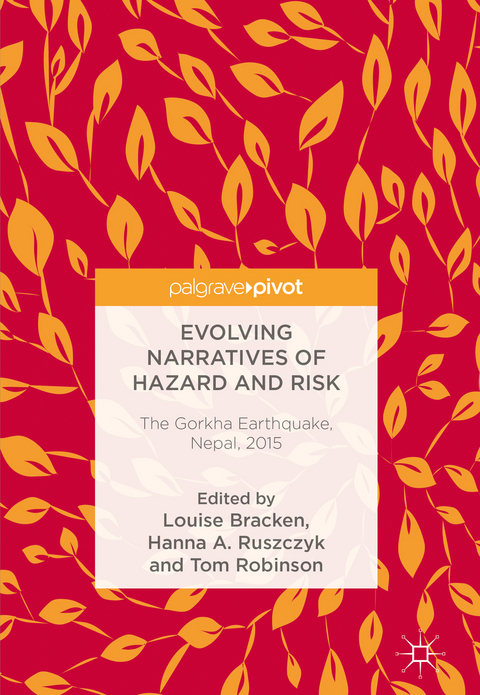
Evolving Narratives of Hazard and Risk (eBook)
XXI, 192 Seiten
Springer International Publishing (Verlag)
978-3-319-65211-5 (ISBN)
This book presents a range of academic research and personal reflections on the Gorkha earthquake that struck Nepal in 2015. For the first time, perspectives from geography, disaster risk reduction, cultural heritage protection, archaeology, anthropology, social work, health and emergency response are discussed in a single volume. Contributions are included from practitioners and researchers from Nepal and Durham University in the UK, many of whom were in Nepal at the time of the earthquake.
Evolving Narratives of Hazard and Risk explores the event of the earthquake, its consequences and its impacts, to provide a holistic and multi-perspective understanding of this special hazard and its significant ramifications for social, political, economic and cultural aspects of life in Nepal. The book highlights how these multiple perspectives are needed to inform each other in order to develop and shape new ways of thinking and interacting with environmental hazards.
This collection of works will be of interest to students and academics of Environment Studies, Human Geography and Environmental Policy, and will be of particular relevance to those involved in risk research and managing risk and hazard events.
Louise Bracken is Executive Director of the Institute of Hazard, Risk and Resilience and the Wilson Chair in Hazard and Risk Research at Durham University, UK.
Hanna Ruszczyk is a Post Doctoral Research Associate in the Institute of Hazard, Risk and Resilience at Durham University, UK.
Tom Robinson is an Addison Wheeler Fellow in the Department of Geography at Durham University, UK.
Louise Bracken is Executive Director of the Institute of Hazard, Risk and Resilience and the Wilson Chair in Hazard and Risk Research at Durham University, UK.Hanna Ruszczyk is a Post Doctoral Research Associate in the Institute of Hazard, Risk and Resilience at Durham University, UK.Tom Robinson is an Addison Wheeler Fellow in the Department of Geography at Durham University, UK.
Part I: Earthquake Preparedness and Response 1. Introduction to the Gorkha earthquake; Hanna Ruszczyk and Tom Robinson2. Earthquake Risk Reduction Efforts in Nepal: NSET's Experience; Amod M. Dixit et al3. The First 100 Hours: Emergency Response to the Gorkha Earthquake; Gopi Basyal 4. Health and the Nepal Earthquake: Ways Forward; Ramjee Bhandari, Chandika Shrestha and Shiva Raj Mishra5. The Science of Earthquake Forecasting: What's Next for Nepal and the Himalayan Region?; Sanchita Neupane6. Disaster Games and the Role of Science for Informing High-Level Emergency Response Planning for Nepal; Tom Robinson Part II: Disciplinary Perspectives7. Communities in the Aftermath of Nepal's Earthquake; Ben Campbell 8. The Earthquake and Ideas Lying Around; Hanna Ruszczyk 9. Green Social Work and the Uptake by the Nepal School of Social Work: Building Resilience in Disaster Stricken Communities; Lena Dominelli 10. Looking Down Not Up: Protecting the Post-Disaster Subsurface Heritage of the Kathmandu Valley's UNESCO World Heritage Site; Robin Coningham et al11.Looking and Moving Forward; Tom Robinson, Hanna Ruszczyk, and Louise Bracken
| Erscheint lt. Verlag | 21.2.2018 |
|---|---|
| Zusatzinfo | XXI, 192 p. |
| Verlagsort | Cham |
| Sprache | englisch |
| Themenwelt | Naturwissenschaften ► Geowissenschaften ► Geografie / Kartografie |
| Sozialwissenschaften ► Politik / Verwaltung | |
| Sozialwissenschaften ► Soziologie | |
| Schlagworte | disaster risk reduction • Earthquake Preparedness and Response • Earthquake Risk Reduction Efforts in Nepal • Environmental Geography • Gorkha Earthquake • Narratives of Hazard and Risk • Nepal, 2015 • Nepal School of Social Work |
| ISBN-10 | 3-319-65211-7 / 3319652117 |
| ISBN-13 | 978-3-319-65211-5 / 9783319652115 |
| Informationen gemäß Produktsicherheitsverordnung (GPSR) | |
| Haben Sie eine Frage zum Produkt? |
 PDF (Wasserzeichen)
DRM: Digitales Wasserzeichen
Dieses eBook enthält ein digitales Wasserzeichen und ist damit für Sie personalisiert. Bei einer missbräuchlichen Weitergabe des eBooks an Dritte ist eine Rückverfolgung an die Quelle möglich.
Dateiformat: PDF (Portable Document Format)
Mit einem festen Seitenlayout eignet sich die PDF besonders für Fachbücher mit Spalten, Tabellen und Abbildungen. Eine PDF kann auf fast allen Geräten angezeigt werden, ist aber für kleine Displays (Smartphone, eReader) nur eingeschränkt geeignet.
Systemvoraussetzungen:
PC/Mac: Mit einem PC oder Mac können Sie dieses eBook lesen. Sie benötigen dafür einen PDF-Viewer - z.B. den Adobe Reader oder Adobe Digital Editions.
eReader: Dieses eBook kann mit (fast) allen eBook-Readern gelesen werden. Mit dem amazon-Kindle ist es aber nicht kompatibel.
Smartphone/Tablet: Egal ob Apple oder Android, dieses eBook können Sie lesen. Sie benötigen dafür einen PDF-Viewer - z.B. die kostenlose Adobe Digital Editions-App.
Buying eBooks from abroad
For tax law reasons we can sell eBooks just within Germany and Switzerland. Regrettably we cannot fulfill eBook-orders from other countries.
aus dem Bereich