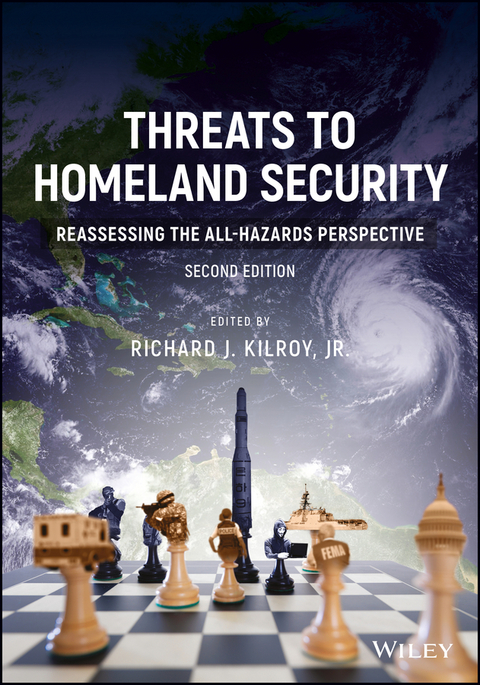
Threats to Homeland Security (eBook)
John Wiley & Sons (Verlag)
978-1-119-25198-9 (ISBN)
Addresses threats to homeland security from terrorism and emergency management from natural disasters
Threats to Homeland Security, Second Edition examines the foundations of today's security environment, from broader national security perspectives to specific homeland security interests and concerns. It covers what we protect, how we protect it, and what we protect it from. In addition, the book examines threats from both an international perspective (state vs non-state actors as well as kinds of threat capabilities-from cyber-terrorism to weapons of mass destruction) and from a national perspective (sources of domestic terrorism and future technological challenges, due to globalization and an increasingly interconnected world).
This new edition of Threats to Homeland Security updates previous chapters and provides new chapters focusing on new threats to homeland security today, such as the growing nexus between crime and terrorism, domestic and international intelligence collection, critical infrastructure and technology, and homeland security planning and resources-as well as the need to reassess the all-hazards dimension of homeland security from a resource and management perspective.
- Features new chapters on homeland security intelligence, crime and domestic terrorism, critical infrastructure protection, and resource management
- Provides a broader context for assessing threats to homeland security from the all-hazards perspective, to include terrorism and natural disasters
- Examines potential targets at home and abroad
- Includes a comprehensive overview of U.S. policy, strategy, and technologies for preventing and countering terrorism
- Includes self-assessment areas, key terms, summary questions, and application exercises. On-line content includes PPT lessons for each chapter and a solutions key for academic adopters
Threats to Homeland Security, Second Edition is an excellent introductory text on homeland security for educators, as well as a good source of training for professionals in a number of homeland security-related disciplines.
Richard J. Kilroy, Jr., is an Assistant Professor of Politics at Coastal Carolina University in Conway, SC where he teaches courses in Intelligence Operations, Intelligence Analysis, Terrorism and Political Violence, Security Management and Risk Assessment, Homeland Security, and U.S.-Latin American Relations in support of Information Systems Technology, Political Science, and Intelligence and National Security Studies degree programs. He spent 23 years in active duty as an Army Intelligence and Latin America Foreign Area Officer.
Richard J. Kilroy, Jr., is an Assistant Professor of Politics at Coastal Carolina University in Conway, SC where he teaches courses in Intelligence Operations, Intelligence Analysis, Terrorism and Political Violence, Security Management and Risk Assessment, Homeland Security, and U.S.-Latin American Relations in support of Information Systems Technology, Political Science, and Intelligence and National Security Studies degree programs. He spent 23 years in active duty as an Army Intelligence and Latin America Foreign Area Officer.
PREFACE
When the first edition of Threats to Homeland Security was published in 2007, there was a dearth of academic literature available on the topic to support the demand on college campuses for classes related to homeland security and terrorism after 9/11. First attempts at meeting this void were texts in traditional fields of study, such as political science or criminal justice. Terrorism studies was still a little known field in security studies programs at some colleges, such as Georgetown University, which primarily looked at the subject from a theoretical or conceptual framework. Other approaches looked at the topic in terms of policy studies, such as national security policy or foreign policy courses, which expanded to include the subject of homeland security. The consensus though was for most writers to take an exclusive view of homeland security, focusing on terrorism as the primary threat.
After Hurricanes Katrina and Rita struck the Gulf Coast in August and September 2005, causing catastrophic damage and loss of life, similar to a terrorist attack, there was shift in homeland security toward a more inclusive view, which looked at threats from an all‐hazards perspective. As a result there was a new emphasis placed on producing academic literature that emphasized natural disaster response and planning, primarily in the field of emergency management. New college curricula also developed in areas of “applied sciences” that now placed greater emphasis on studying the role of first responders, as well as state and federal government agencies in responding to natural disasters, as opposed to terrorist attacks. Community colleges, four‐year undergraduate institutions, and even graduate schools began to develop degree programs related to emergency management and planning in order to build on the next inclusive view of homeland security.
It was in this context that the first edition of the text was named Threats to Homeland Security: An All‐Hazards Perspective. In other words, the goal in writing such a text was to provide students in a variety of academic disciplines and fields of study an integrated approach toward security studies and the continuing nature of security challenges to the nation through both a theoretical and practical lens. In the text, students and practitioners gained a comprehensive understanding of threats to the United States from an interdisciplinary perspective. By emphasizing the “all‐hazards perspective,” readers of the first edition gained a better understanding of a more inclusive view of the threats the nation faced at the time, with an expectation that these would be also be the types of “all‐hazard” threats homeland security studies would need to address in the future.
Since that time, homeland security, as both an area of academic study and professional practice, has evolved considerably. Today, according to the University and Agency Partnership Initiative of the Center for Homeland Defense and Security, there are more than 400 programs of study related to homeland security, from associate to doctoral degrees. There has been increased engagement between law enforcement agencies at the local, state, and federal levels to approach threats to public safety in new ways, to include the development of fusion centers and joint task forces. The federal government has increased the role of the Department of Homeland Security (DHS) in confronting threats, both domestically and internationally. The Department of Defense, with the development of US Northern Command, has increased its homeland defense role to coordinate military support to other federal and state agencies to confront threats that are both naturogenic and anthropogenic. And, most recently, revelations about US intelligence agencies collecting data on US citizens have expanded the dialogue on the nature of terrorist threats, breaking down traditional barriers between domestic and foreign intelligence activities.
Furthermore, in the 10 years since publication of the first edition, there has been a sea change in domestic politics and international relations, which has shaken the foundations of states and societies globally. From the international economic crisis of 2008 and the Arab Spring of 2010 to the global emergence of the Islamic State (IS) in 2014, the world has become more, rather than less, dangerous. The former director of National Intelligence, James Clapper (2014), noted, “Looking back over my more than half a century in intelligence, I’ve not experienced a time when we’ve been beset by more crises and threats around the globe.”
So, what’s changed in the text? With 10 years having elapsed since the publication of the first edition, all the original chapters have been revised and in some cases completely rewritten. New chapters have been added to address threats to critical infrastructure, the role of intelligence in homeland security, and homeland security planning and resources. Each chapter also addresses the overall theme of the text in reassessing whether the all‐hazards perspective should continue to guide homeland security studies from an academic viewpoint, as well as homeland security policy from a practitioner’s viewpoint.
In Chapter 1, Richard J. Kilroy Jr. provides an historical overview of the development of national security policies and strategies based on the threats the United States has faced since its beginning. From its early foundations focused on isolationism and nonintervention to the evolution of geopolitics that moved the United States to becoming a global superpower during the Cold War, the nature of the threats to the country has influenced the high politics of security. In the previous edition, this chapter ended with a discussion of the new Global War on Terrorism, focused primarily on al‐Qaeda. Since that time, the United States has withdrawn from Iraq, is drawing down in Afghanistan, and yet continues to face an expanding terrorist threat from new groups, such as the Islamic State in Iraq and Syria (IS). This chapter has been updated to reflect the changes in national security and homeland security policies and strategy that occurred since the Obama administration came into office and changed the focus of national security away from fighting a Global War on Terrorism to focus on specific threats under the title of Overseas Contingency Operations, specifically using drone warfare to target terrorist leaders. It also touches on the early direction of the new Trump administration on national security in 2017.
In Chapter 2, Richard J. Kilroy Jr. explains the evolution from an “exclusive” view of homeland security, focused only on terrorist threats, to the “inclusive” view, which assessed all potential hazards as threats to the homeland. More recently there has been a some discussion about moving away from looking at homeland security from an all‐hazards perspective, since it has tended to “water down” the threat of terrorism, as federal, state, and local agencies put every possible threat under the homeland security umbrella. From an emergency management perspective, local communities had to prepare for every possible contingency, which taxed resources and budgets. Federal homeland security funding began to dry up due to the budget crisis in 2008–2009. As a result, there was less of an all‐hazards perspective to one of prioritizing the types of threats communities faced and to place their resources there. As a result, this chapter addresses these changes and the impact that moving away from an all‐hazards perspective may have on the types of threats the United States faces today and in the future.
In Chapter 3, Chad S. Foster explores meanings and perspectives associated with homeland security. Questions addressed include: What are the historical traditions and prevailing theories associated with homeland security? What context is important for gaining an understanding of homeland security problems and approaches? What constitutes the homeland security enterprise, including the roles of federal, state, and local agencies? The revision to this chapter from the previous edition looks at the emergence of homeland security institutions and interests at all levels of government.
In Chapter 4, Alexander Siedschlag explores the all‐hazards perspective to threat assessment, focused on management within the National Preparedness System. The chapter’s focus was traditionally on prevention, protection, mitigation, response, and recovery and the “disaster impact process,” as well as risk and vulnerability assessments. In the revision to the chapter, Siedschlag focuses on threat assessments and how the United States assesses threats to national security, as well as homeland security. Understanding the threat assessment process is critical to influencing intelligence collection and also how federal, state, and local agencies can better allocate resources when focused on specific threats. Siedschlag explains how threat assessment aids the decision‐making process and how it can be helpful in reducing costs to local communities by allowing first responders and emergency managers to focus on the mitigation, risk reduction, and preparedness programs their communities need most.
In Chapter 5, Steven Kuhr offers a new chapter focusing specifically on critical infrastructure protection. New technologies and the increased use of “systems of systems” approaches create new efficiencies and availability of basic services such as power generation,...
| Erscheint lt. Verlag | 28.2.2018 |
|---|---|
| Sprache | englisch |
| Themenwelt | Studium ► Querschnittsbereiche ► Prävention / Gesundheitsförderung |
| Naturwissenschaften ► Chemie | |
| Sozialwissenschaften ► Politik / Verwaltung | |
| Technik | |
| Wirtschaft ► Betriebswirtschaft / Management | |
| Schlagworte | all-hazards • Arbeitsschutz u. Arbeitssicherheit • Arbeitssicherheit u. Umweltschutz i. d. Chemie • Chemical and Environmental Health and Safety • Chemie • Chemistry • Critical Infrastructure Protection • Cyber defense • cyber threats from terrorists, criminals, and nation-states • emergency management • Emergency preparedness • Gesundheits- u. Sozialwesen • Health & Social Care • Homeland Security • homeland security intelligence • homeland security management • Innere Sicherheit • Intelligence Analysis • intelligence collection operations • Law enforcement • <p>homeland security • national defense • national security • Occupational Health & Safety • operational continuity • protecting information systems • protecting the homeland • protection from terrorism • public safety • risk assessment and analysis • security management • security studies • Sicherheitsmanagement • State and non-state actors • terrorism • terrorism studies • threats • Threats to Homeland Security, Second Edition</p> • weapons of mass destruction |
| ISBN-10 | 1-119-25198-2 / 1119251982 |
| ISBN-13 | 978-1-119-25198-9 / 9781119251989 |
| Informationen gemäß Produktsicherheitsverordnung (GPSR) | |
| Haben Sie eine Frage zum Produkt? |
 EPUB (Adobe DRM)
Kopierschutz: Adobe-DRM
Adobe-DRM ist ein Kopierschutz, der das eBook vor Mißbrauch schützen soll. Dabei wird das eBook bereits beim Download auf Ihre persönliche Adobe-ID autorisiert. Lesen können Sie das eBook dann nur auf den Geräten, welche ebenfalls auf Ihre Adobe-ID registriert sind.
Details zum Adobe-DRM
Dateiformat: EPUB (Electronic Publication)
EPUB ist ein offener Standard für eBooks und eignet sich besonders zur Darstellung von Belletristik und Sachbüchern. Der Fließtext wird dynamisch an die Display- und Schriftgröße angepasst. Auch für mobile Lesegeräte ist EPUB daher gut geeignet.
Systemvoraussetzungen:
PC/Mac: Mit einem PC oder Mac können Sie dieses eBook lesen. Sie benötigen eine
eReader: Dieses eBook kann mit (fast) allen eBook-Readern gelesen werden. Mit dem amazon-Kindle ist es aber nicht kompatibel.
Smartphone/Tablet: Egal ob Apple oder Android, dieses eBook können Sie lesen. Sie benötigen eine
Geräteliste und zusätzliche Hinweise
Buying eBooks from abroad
For tax law reasons we can sell eBooks just within Germany and Switzerland. Regrettably we cannot fulfill eBook-orders from other countries.
aus dem Bereich