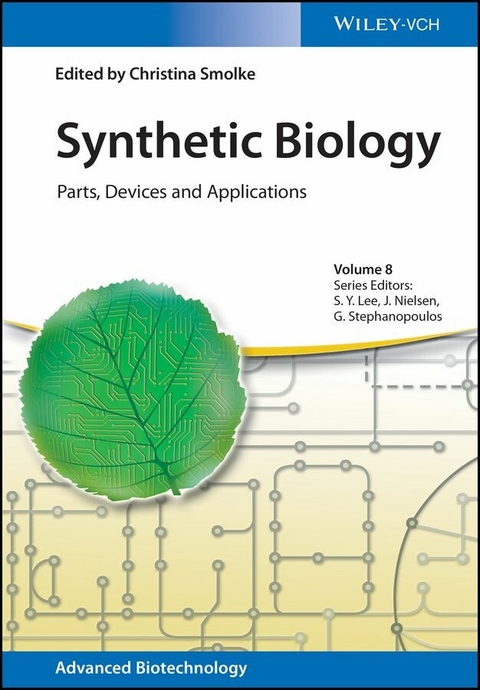
Synthetic Biology (eBook)
Wiley-VCH Verlag GmbH & Co. KGaA
978-3-527-68808-1 (ISBN)
A review of the interdisciplinary field of synthetic biology, from genome design to spatial engineering.
Written by an international panel of experts, Synthetic Biology draws from various areas of research in biology and engineering and explores the current applications to provide an authoritative overview of this burgeoning field. The text reviews the synthesis of DNA and genome engineering and offers a discussion of the parts and devices that control protein expression and activity. The authors include information on the devices that support spatial engineering, RNA switches and explore the early applications of synthetic biology in protein synthesis, generation of pathway libraries, and immunotherapy.
Filled with the most recent research, compelling discussions, and unique perspectives, Synthetic Biology offers an important resource for understanding how this new branch of science can improve on applications for industry or biological research.
Sang Yup Lee is Distinguished Professor at the Department of Chemical and Biomolecular Engineering at the Korea Advanced Institute of Science and Technology (KAIST).
Jens Nielsen is Professor and Director to Chalmers University of Technology, Sweden. He has received numerous Danish and international awards including the Nature Mentor Award.
Professor Gregory Stephanopoulos is the W. H. Dow Professor of Chemical Engineering at the Massachusetts Institute of Technology and Director of the MIT Metabolic Engineering Laboratory.
Series editors: Sang Yup Lee is Distinguished Professor at the Department of Chemical and Biomolecular Engineering at the Korea Advanced Institute of Science and Technology (KAIST). He is currently the Director of the Center for Systems and Synthetic Biotechnology, Director of the BioProcess Engineering Research Center, and Director of the Bioinformatics Research Center. He received numerous awards, including the National Order of Merit, the Merck Metabolic Engineering Award and the Elmer Gaden Award. Lee is the Editor-in-Chief of the Biotechnology Journal and Associate Editor and board member of numerous other journals. Lee is currently serving as a member of Presidential Advisory Committee on Science and Technology (Korea). Jens Nielsen has a PhD degree (1989) in Biochemical Engineering from the Danish Technical University (DTU), and after that established his independent research group and was appointed full Professor there in 1998. He was Fulbright visiting professor at MIT in 1995-1996. At DTU he founded and directed the Center for Microbial Biotechnology. In 2008 he was recruited as Professor and Director to Chalmers University of Technology, Sweden. Jens Nielsen has received numerous Danish and international awards including the Nature Mentor Award, and is member of several academies, including the National Academy of Engineering in USA and the Royal Swedish Academy of Science. He is a founding president of the International Metabolic Engineering Society. Professor Gregory Stephanopoulos is the W. H. Dow Professor of Chemical Engineering at the Massachusetts Institute of Technology (MIT, USA) and Director of the MIT Metabolic Engineering Laboratory. He is also Instructor of Bioengineering at Harvard Medical School (since 1997). He has been recognized by numerous awards from the American Institute of Chemical Engineers (AIChE) (Wilhelm, Walker and Founders awards), American Chemical Society (ACS), Society of industrial Microbiology (SIM), BIO (Washington Carver Award), the John Fritz Medal of the American Association of Engineering Societies, and others. In 2003 he was elected member of the National Academy of Engineering (USA) and in 2014 President of AIChE. Volume editors of the Synthetic Biology Volume: Christina Smolke is Professor at Stanford University in the Department of Bioengineering. Before being recruited to Stanford, she was an Assistant Professor in the Department of Chemical Engineering at Caltech. Christina`s research program focuses on developing modular genetic platforms for programming information processing and control functions in living systems. She has pioneered the design and application of RNA molecules that process and transmit user-specified input signals to targeted protein outputs, thereby linking molecular computation to gene expression. These technologies are leading to transformative advances in how we interact with and program biology, providing access to otherwise inaccessible information on cellular state, and allowing sophisticated exogenous and embedded control over cellular functions. Her laboratory is applying these technologies to addressing key challenges in cellular therapeutics, targeted molecular therapies, and green biosynthesis strategies. Christina?s innovative research program has been recognized with the receipt of several awards, including the NSF CAREER Award, Beckman Young Investigator Award, Alfred P. Sloan Research Fellowship, World Technology Network Award in Biotechnology, and Technology Review`s TR35 Award.
Cover 1
Title Page 5
Copyright 6
Contents 7
About the Series Editors 17
Part I DNA Synthesis and Genome Engineering 19
Chapter 1 Competition and the Future of Reading and Writing DNA 21
1.1 Productivity Improvements in Biological Technologies 21
1.2 The Origin of Moore’s Law and Its Implications for Biological Technologies 23
1.3 Lessons from Other Technologies 24
1.4 Pricing Improvements in Biological Technologies 25
1.5 Prospects for New Assembly Technologies 26
1.6 Beyond Programming Genetic Instruction Sets 28
1.7 Future Prospects 28
References 29
Chapter 2 Trackable Multiplex Recombineering (TRMR) and Next-Generation Genome Design Technologies: Modifying Gene Expression in E. coli by Inserting Synthetic DNA Cassettes and Molecular Barcodes 33
2.1 Introduction 33
2.2 Current Recombineering Techniques 34
2.2.1 Recombineering Systems 35
2.2.2 Current Model of Recombination 35
2.3 Trackable Multiplex Recombineering 37
2.3.1 TRMR and T2RMR Library Design and Construction 37
2.3.2 Experimental Procedure 41
2.3.3 Analysis of Results 42
2.4 Current Challenges 43
2.4.1 TRMR and T2RMR are Currently Not Recursive 44
2.4.2 Need for More Predictable Models 44
2.5 Complementing Technologies 45
2.5.1 MAGE 45
2.5.2 CREATE 45
2.6 Conclusions 46
Definitions 46
References 47
Chapter 3 Site-Directed Genome Modification with Engineered Zinc Finger Proteins 51
3.1 Introduction to Zinc Finger DNA-Binding Domains and Cellular Repair Mechanisms 51
3.1.2 Homologous Recombination 52
3.1.3 Non-homologous End Joining 53
3.2 Approaches for Engineering or Acquiring Zinc Finger Proteins 54
3.2.1 Modular Assembly 55
3.2.2 OPEN and CoDA Selection Systems 55
3.2.3 Purchase via Commercial Avenues 56
3.3 Genome Modification with Zinc Finger Nucleases 56
3.4 Validating Zinc Finger Nuclease-Induced Genome Alteration and Specificity 58
3.5 Methods for Delivering Engineered Zinc Finger Nucleases into Cells 59
3.6 Zinc Finger Fusions to Transposases and Recombinases 59
3.7 Conclusions 60
References 61
Chapter 4 Rational Efforts to Streamline the Escherichia coli Genome 67
4.1 Introduction 67
4.2 The Concept of a Streamlined Chassis 68
4.3 The E. coli Genome 69
4.4 Random versus Targeted Streamlining 72
4.5 Selecting Deletion Targets 73
4.5.1 General Considerations 73
4.5.1.1 Naturally Evolved Minimal Genomes 73
4.5.1.2 Gene Essentiality Studies 73
4.5.1.3 Comparative Genomics 74
4.5.1.4 In silico Models 74
4.5.1.5 Architectural Studies 74
4.5.2 Primary Deletion Targets 75
4.5.2.1 Prophages 75
4.5.2.2 Insertion Sequences (ISs) 75
4.5.2.3 Defense Systems 75
4.5.2.4 Genes of Unknown and Exotic Functions 76
4.5.2.5 Repeat Sequences 76
4.5.2.6 Virulence Factors and Surface Structures 76
4.5.2.7 Genetic Diversity-Generating Factors 77
4.5.2.8 Redundant and Overlapping Functions 77
4.6 Targeted Deletion Techniques 77
4.6.1 General Considerations 77
4.6.2 Basic Methods and Strategies 78
4.6.2.1 Circular DNA-Based Method 78
4.6.2.2 Linear DNA-Based Method 80
4.6.2.3 Strategy for Piling Deletions 80
4.6.2.4 New Variations on Deletion Construction 81
4.7 Genome-Reducing Efforts and the Impact of Streamlining 82
4.7.1 Comparative Genomics-Based Genome Stabilizationand Improvement 82
4.7.2 Genome Reduction Based on Gene Essentiality 84
4.7.3 Complex Streamlining Efforts Based on Growth Properties 85
4.7.4 Additional Genome Reduction Studies 86
4.8 Selected Research Applications of Streamlined-Genome E. coli 86
4.8.1 Testing Genome Streamlining Hypotheses 86
4.8.2 Mobile Genetic Elements, Mutations, and Evolution 86
4.8.3 Gene Function and Network Regulation 87
4.8.4 Codon Reassignment 88
4.8.5 Genome Architecture 88
4.9 Concluding Remarks, Challenges, and Future Directions 89
References 91
Chapter 5 Functional Requirements in the Program and the Cell Chassis for Next-Generation Synthetic Biology 99
5.1 A Prerequisite to Synthetic Biology: An Engineering Definition of What Life Is 99
5.2 Functional Analysis: Master Function and Helper Functions 101
5.3 A Life-Specific Master Function: Building Up a Progeny 103
5.4 Helper Functions 104
5.4.1 Matter: Building Blocks and Structures (with Emphasis on DNA) 105
5.4.2 Energy 109
5.4.3 Managing Space 110
5.4.4 Time 113
5.4.5 Information 114
5.5 Conclusion 115
Acknowledgments 116
References 116
Part II Parts and Devices Supporting Control of Protein Expression and Activity 125
Chapter 6 Constitutive and Regulated Promoters in Yeast: How to Design and Make Use of Promoters in S. cerevisiae 127
6.1 Introduction 127
6.2 Yeast Promoters 128
6.3 Natural Yeast Promoters 131
6.3.1 Regulated Promoters 131
6.3.2 Constitutive Promoters 133
6.4 Synthetic Yeast Promoters 134
6.4.1 Modified Natural Promoters 134
6.4.2 Synthetic Hybrid Promoters 135
6.5 Conclusions 139
Definitions 140
References 140
Chapter 7 Splicing and Alternative Splicing Impact on Gene Design 149
7.1 The Discovery of “Split Genes” 149
7.2 Nuclear Pre-mRNA Splicing in Mammals 150
7.2.1 Introns and Exons: A Definition 150
7.2.2 The Catalytic Mechanism of Splicing 150
7.2.3 A Complex Machinery to Remove Nuclear Introns:The Spliceosome 150
7.2.4 Exon Definition 152
7.3 Splicing in Yeast 153
7.3.1 Organization and Distribution of Yeast Introns 153
7.4 Splicing without the Spliceosome 154
7.4.1 Group I and Group II Self-Splicing Introns 154
7.4.2 tRNA Splicing 155
7.5 Alternative Splicing in Mammals 155
7.5.1 Different Mechanisms of Alternative Splicing 155
7.5.2 Auxiliary Regulatory Elements 157
7.5.3 Mechanisms of Splicing Regulation 158
7.5.4 Transcription-Coupled Alternative Splicing 160
7.5.5 Alternative Splicing and Nonsense-Mediated Decay 161
7.5.6 Alternative Splicing and Disease 162
7.6 Controlled Splicing in S. cerevisiae 163
7.6.1 Alternative Splicing 163
7.6.2 Regulated Splicing 164
7.6.3 Function of Splicing in S. cerevisiae 165
7.7 Splicing Regulation by Riboswitches 165
7.7.1 Regulation of Group I Intron Splicing in Bacteria 166
7.7.2 Regulation of Alternative Splicing by Riboswitches in Eukaryotes 166
7.8 Splicing and Synthetic Biology 168
7.8.1 Impact of Introns on Gene Expression 169
7.8.2 Control of Splicing by Engineered RNA-Based Devices 169
7.9 Conclusion 171
Acknowledgments 171
Definitions 171
References 171
Chapter 8 Design of Ligand?Controlled Genetic Switches Based on RNA Interference 187
8.1 Utility of the RNAi Pathway for Application in Mammalian Cells 187
8.2 Development of RNAi Switches that Respond to Trigger Molecules 188
8.2.1 Small Molecule?Triggered RNAi Switches 189
8.2.2 Oligonucleotide?Triggered RNAi Switches 191
8.2.3 Protein?Triggered RNAi Switches 192
8.3 Rational Design of Functional RNAi Switches 192
8.4 Application of the RNAi Switches 193
8.5 Future Perspectives 195
Definitions 196
References 196
Chapter 9 Small Molecule-Responsive RNA Switches (Bacteria): Important Element of Programming Gene Expression in Response to Environmental Signals in Bacteria 199
9.1 Introduction 199
9.2 Design Strategies 199
9.2.1 Aptamers 200
9.2.2 Screening and Genetic Selection 200
9.2.3 Rational Design 201
9.3 Mechanisms 201
9.3.1 Translational Regulation 201
9.3.2 Transcriptional Regulation 202
9.4 Complex Riboswitches 203
9.5 Conclusions 203
Keywords with Definitions 203
References 204
Chapter 10 Programming Gene Expression by Engineering Transcript Stability Control and Processing in Bacteria 207
10.1 An Introduction to Transcript Control 207
10.1.1 Why Consider Transcript Control? 208
10.1.2 The RNA Degradation Process in E. coli 208
10.1.3 The Effects of Translation on Transcript Stability 210
10.1.4 Structural and Noncoding RNA-Mediated Transcript Control 211
10.1.5 Polyadenylation and Transcript Stability 213
10.2 Synthetic Control of Transcript Stability 213
10.2.1 Transcript Stability Control as a “Tuning Knob” 213
10.2.2 Secondary Structure at the 5? and 3? Ends 214
10.2.3 Noncoding RNA-Mediated 215
10.2.4 Model-Driven Transcript Stability Control for MetabolicPathway Engineering 216
10.3 Managing Transcript Stability 219
10.3.1 Transcript Stability as a Confounding Factor 219
10.3.2 Anticipating Transcript Stability Issues 219
10.3.3 Uniformity of 5? and 3? Ends 220
10.3.4 RBS Sequestration by Riboregulators and Riboswitches 221
10.3.5 Experimentally Probing Transcript Stability 222
10.4 Potential Mechanisms for Transcript Control 223
10.4.1 Leveraging New Tools 223
10.4.2 Unused Mechanisms Found in Nature 224
10.5 Conclusions and Discussion 225
Acknowledgments 226
Definitions 226
References 227
Chapter 11 Small Functional Peptides and Their Application in Superfunctionalizing Proteins 235
11.1 Introduction 235
11.2 Permissive Sites and Their Identification in a Protein 236
11.3 Functional Peptides 238
11.3.1 Functional Peptides that Act as Binders 238
11.3.2 Peptide Motifs that are Recognized by Labeling Enzymes 239
11.3.3 Peptides as Protease Cleavage Sites 240
11.3.4 Reactive Peptides 241
11.3.5 Pharmaceutically Relevant Peptides: Peptide Epitopes,Sugar Epitope Mimics, and Antimicrobial Peptides 241
11.3.5.1 Peptide Epitopes 242
11.3.5.2 Peptide Mimotopes 242
11.3.5.3 Antimicrobial Peptides 243
11.4 Conclusions 245
Definitions 246
Abbreviations 246
Acknowledgment 247
References 247
Part III Parts and Devices Supporting Spatial Engineering 255
Chapter 12 Metabolic Channeling Using DNA as a Scaffold 257
12.1 Introduction 257
12.2 Biosynthetic Applications of DNA Scaffold 260
12.2.1 l?Threonine 260
12.2.2 trans?Resveratrol 263
12.2.3 1,2?Propanediol 264
12.2.4 Mevalonate 264
12.3 Design of DNA?Binding Proteins and Target Sites 265
12.3.1 Zinc Finger Domains 266
12.3.2 TAL?DNA Binding Domains 267
12.3.3 Other DNA?Binding Proteins 268
12.4 DNA Program 268
12.4.1 Spacers between DNA?Target Sites 268
12.4.2 Number of DNA Scaffold Repeats 270
12.4.3 DNA?Target Site Arrangement 271
12.5 Applications of DNA?Guided Programming 272
Definitions 273
References 274
Chapter 13 Synthetic RNA Scaffolds for Spatial Engineering in Cells 279
13.1 Introduction 279
13.2 Structural Roles of Natural RNA 279
13.2.1 RNA as a Natural Catalyst 280
13.2.2 RNA Scaffolds in Nature 281
13.3 Design Principles for RNA Are Well Understood 281
13.3.1 RNA Secondary Structure is Predictable 282
13.3.2 RNA can Self?Assemble into Structures 283
13.3.3 Dynamic RNAs can be Rationally Designed 283
13.3.4 RNA can be Selected in vitro to Enhance Its Function 284
13.4 Applications of Designed RNA Scaffolds 284
13.4.1 Tools for RNA Research 284
13.4.2 Localizing Metabolic Enzymes on RNA 285
13.4.3 Packaging Therapeutics on RNA Scaffolds 287
13.4.4 Recombinant RNA Technology 287
13.5 Conclusion 288
13.5.1 New Applications 288
13.5.2 Technological Advances 288
Definitions 289
References 289
Chapter 14 Sequestered: Design and Construction of Synthetic Organelles 297
14.1 Introduction 297
14.2 On Organelles 299
14.3 Protein?Based Organelles 301
14.3.1 Bacterial Microcompartments 301
14.3.1.1 Targeting 303
14.3.1.2 Permeability 305
14.3.1.3 Chemical Environment 306
14.3.1.4 Biogenesis 307
14.3.2 Alternative Protein Organelles: A Minimal System 308
14.4 Lipid?Based Organelles 310
14.4.1 Repurposing Existing Organelles 311
14.4.1.1 The Mitochondrion 311
14.4.1.2 The Vacuole 312
14.5 De novo Organelle Construction and Future Directions 313
Acknowledgments 315
References 315
Part IV Early Applications of Synthetic Biology: Pathways, Therapies, and Cell-Free Synthesis 325
Chapter 15 Cell-Free Protein Synthesis: An Emerging Technology for Understanding, Harnessing, and Expanding the Capabilities of Biological Systems 327
15.1 Introduction 327
15.2 Background/Current Status 329
15.2.1 Platforms 329
15.2.1.1 Prokaryotic Platforms 329
15.2.1.2 Eukaryotic Platforms 330
15.2.2 Trends 332
15.3 Products 334
15.3.1 Noncanonical Amino Acids 334
15.3.2 Glycosylation 334
15.3.3 Antibodies 336
15.3.4 Membrane Proteins 336
15.4 High-Throughput Applications 338
15.4.1 Protein Production and Screening 338
15.4.2 Genetic Circuit Optimization 339
15.5 Future of the Field 339
Definitions 340
Acknowledgments 340
References 341
Chapter 16 Applying Advanced DNA Assembly Methods to Generate Pathway Libraries 349
16.1 Introduction 349
16.2 Advanced DNA Assembly Methods 351
16.3 Generation of Pathway Libraries 352
16.3.1 In vitro Assembly Methods 353
16.3.2 In vivo Assembly Methods 357
16.3.2.1 In vivo Chromosomal Integration 357
16.3.2.2 In vivo Plasmid Assembly and One-Step Optimization Libraries 358
16.3.2.3 In vivo Plasmid Assembly and Iterative Multi-step OptimizationLibraries 359
16.4 Conclusions and Prospects 361
Definitions 361
References 362
Chapter 17 Synthetic Biology in Immunotherapy and Stem Cell Therapy Engineering 367
17.1 The Need for a New Therapeutic Paradigm 367
17.2 Rationale for Cellular Therapies 368
17.3 Synthetic Biology Approaches to Cellular Immunotherapy Engineering 369
17.3.1 CAR Engineering for Adoptive T-Cell Therapy 370
17.3.2 Genetic Engineering to Enhance T-Cell Therapeutic Function 375
17.3.3 Generating Safer T-Cell Therapeutics with Synthetic Biology 377
17.4 Challenges and Future Outlook 380
Acknowledgment 382
Definitions 382
References 383
Part V Societal Ramifications of Synthetic Biology 391
Chapter 18 Synthetic Biology: From Genetic Engineering 2.0 to Responsible Research and Innovation 393
18.1 Introduction 393
18.2 Public Perception of the Nascent Field of Synthetic Biology 394
18.2.1 Perception of Synthetic Biology in the United States 395
18.2.2 Perception of Synthetic Biology in Europe 397
18.2.2.1 European Union 397
18.2.2.2 Austria 397
18.2.2.3 Germany 399
18.2.2.4 Netherlands 400
18.2.2.5 United Kingdom 401
18.2.3 Opinions from Concerned Civil Society Groups 402
18.3 Frames and Comparators 402
18.3.1 Genetic Engineering: Technology as Conflict 404
18.3.2 Nanotechnology: Technology as Progress 405
18.3.3 Information Technology: Technology as Gadget 405
18.3.4 SB: Which Debate to Come? 406
18.4 Toward Responsible Research and Innovation (RRI) in Synthetic Biology 407
18.4.1 Engagement of All Societal Actors – Researchers, Industry,Policy Makers, and Civil Society – and Their Joint Participationin the Research and Innovation 408
18.4.2 Gender Equality 409
18.4.3 Science Education 410
18.4.4 Open Access 410
18.4.5 Ethics 412
18.4.6 Governance 413
18.5 Conclusion 414
Acknowledgments 415
References 415
Index 421
EULA 428
| Erscheint lt. Verlag | 20.2.2018 |
|---|---|
| Reihe/Serie | Advanced Biotechnology |
| Advanced Biotechnology | Advanced Biotechnology |
| Mitarbeit |
Herausgeber (Serie): Sang Yup Lee, Jens Nielsen, Gregory Stephanopoulos |
| Sprache | englisch |
| Themenwelt | Naturwissenschaften ► Chemie |
| Schlagworte | applications of synthetic biology, synthesis of DNA • biomedical engineering • Biomedical Engineering Special Topics • Biomedizintechnik • Biomolecules (DNA, RNA, Peptides, etc.) • Biomoleküle (DNA, RNA, Peptide) • Biotechnologie • Biotechnologie i. d. Biowissenschaften • Biotechnologie i. d. Chemie • Biotechnology • Biowissenschaften • Cell & Molecular Biology • Chemie • Chemistry • fundamental and applied research and synthetic biology • Genome engineering • Life Sciences • <p>Guide to synthetic biology • measuring engineering and synthetic biology • methods in enzymology • Molecular Bioengineering • molecular biology and synthetic biology • Molekulares Bioengineering • protein activity and synthetic biology • protein expression and synthetic biology • Protein synthesis • research into synthetic biology • resource for synthetic biology • social ramifications of synthetic biology • spatial engineering and synthetic biology • Spezialthemen Biomedizintechnik • synthetic biology in immunotherapy • synthetic gene networks • Synthetic RNA scaffolds for spatial engineering in cells</p> • Synthetische Biologie • the rapid expansion of synthetic biology • understanding applications of synthetic biology • understanding devices of synthetic biology • understanding parts of synthetic biology • understanding synthetic biology • Zell- u. Molekularbiologie |
| ISBN-10 | 3-527-68808-0 / 3527688080 |
| ISBN-13 | 978-3-527-68808-1 / 9783527688081 |
| Informationen gemäß Produktsicherheitsverordnung (GPSR) | |
| Haben Sie eine Frage zum Produkt? |
 PDF (Adobe DRM)
Kopierschutz: Adobe-DRM
Adobe-DRM ist ein Kopierschutz, der das eBook vor Mißbrauch schützen soll. Dabei wird das eBook bereits beim Download auf Ihre persönliche Adobe-ID autorisiert. Lesen können Sie das eBook dann nur auf den Geräten, welche ebenfalls auf Ihre Adobe-ID registriert sind.
Details zum Adobe-DRM
Dateiformat: PDF (Portable Document Format)
Mit einem festen Seitenlayout eignet sich die PDF besonders für Fachbücher mit Spalten, Tabellen und Abbildungen. Eine PDF kann auf fast allen Geräten angezeigt werden, ist aber für kleine Displays (Smartphone, eReader) nur eingeschränkt geeignet.
Systemvoraussetzungen:
PC/Mac: Mit einem PC oder Mac können Sie dieses eBook lesen. Sie benötigen eine
eReader: Dieses eBook kann mit (fast) allen eBook-Readern gelesen werden. Mit dem amazon-Kindle ist es aber nicht kompatibel.
Smartphone/Tablet: Egal ob Apple oder Android, dieses eBook können Sie lesen. Sie benötigen eine
Geräteliste und zusätzliche Hinweise
Buying eBooks from abroad
For tax law reasons we can sell eBooks just within Germany and Switzerland. Regrettably we cannot fulfill eBook-orders from other countries.
aus dem Bereich