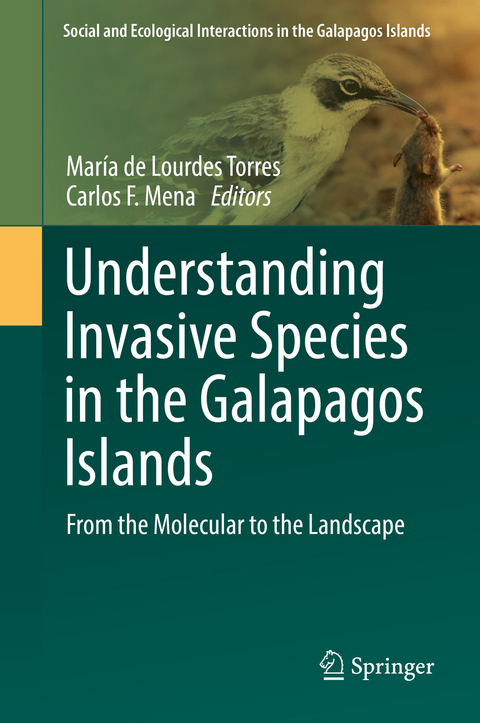
Understanding Invasive Species in the Galapagos Islands (eBook)
XXVII, 237 Seiten
Springer International Publishing (Verlag)
9783319671772 (ISBN)
María de Lourdes Torres, Ph.D.Vicedecana, Coordinadora BiotecnologíaColegio de Ciencias Biológicas y Ambientales, COCIBAUniversidad San Francisco de QuitoT: (+593) 2 297-1700 ext. 1746E-mail: ltorres@usfq.edu.ecDiego de Robles y Vía Interoceánica, Quito, Ecuador Carlos F. MenaColegio de Ciencias Biológicas y Ambientales, COCIBAUniversidad San Francisco de QuitoT: (+593 2) 297-1700, ext. 1866E-mail: cmena@usfq.edu.ec
Preface Introduction: Introduced Species and the Threats to the Galapagos Chapter 1. A Preliminary Assessment of the Genetic Diversity and Population Structure of Guava, Psidium Guajava, In San Cristobal. Chapter 2. Genetic consequences of invasive species in the Galapagos Islands. Chapter 3. Interactions Among Exotics: Guava and its Associated Fauna in the Highlands of San Cristobal. Chapter 4. A Study Contrasting Two Congener Plant Species: Psidium guajava (introduced guava) and P. galapageium (Galapagos guava) in the Galapagos Islands Chapter 5. Quinine tree invasion and control in Galapagos: a case study. Heinke Jäger Chapter 6. Allelopathic Impacts of the Invasive Tree Cedrela odorata L. (Meliaceae, Sapindales=Magnoliidae) in the Galapagos Flora. Chapter 7. The Hitchhiker Wave: Non-native small terrestrial vertebrates in the Galápagos. Chapter 8. Multi-Scale Remote Sensing of Introduced and Invasive Species: An Overview of Approaches and Perspectives. Chapter 9. Remote Sensing of Invasive Species in the Galapagos Islands: Comparison of Pixel-Based, Principal Components and Object-Oriented Image Classification Approaches. Chapter 10. Stakeholder Perceptions of Invasive Species and Participatory Remote Sensing in the Galapagos Islands. Chapter 11: A Conceptual Framework for the Management of a Highly Valued Invasive Tree in the Galapagos Islands. Conclusion: Conclusion and Management Implications.
| Erscheint lt. Verlag | 15.2.2018 |
|---|---|
| Reihe/Serie | Social and Ecological Interactions in the Galapagos Islands | Social and Ecological Interactions in the Galapagos Islands |
| Zusatzinfo | XXVII, 237 p. 43 illus., 37 illus. in color. |
| Verlagsort | Cham |
| Sprache | englisch |
| Themenwelt | Naturwissenschaften ► Biologie ► Ökologie / Naturschutz |
| Naturwissenschaften ► Geowissenschaften ► Geografie / Kartografie | |
| Schlagworte | Endemic species • Environmental Geography • Fragile ecosystems • Galapagos Islands • genetic diversity • Invasive species • Landscape patterns • Management strategies • Nature and society • Protected areas |
| ISBN-13 | 9783319671772 / 9783319671772 |
| Informationen gemäß Produktsicherheitsverordnung (GPSR) | |
| Haben Sie eine Frage zum Produkt? |
 PDF (Wasserzeichen)
DRM: Digitales Wasserzeichen
Dieses eBook enthält ein digitales Wasserzeichen und ist damit für Sie personalisiert. Bei einer missbräuchlichen Weitergabe des eBooks an Dritte ist eine Rückverfolgung an die Quelle möglich.
Dateiformat: PDF (Portable Document Format)
Mit einem festen Seitenlayout eignet sich die PDF besonders für Fachbücher mit Spalten, Tabellen und Abbildungen. Eine PDF kann auf fast allen Geräten angezeigt werden, ist aber für kleine Displays (Smartphone, eReader) nur eingeschränkt geeignet.
Systemvoraussetzungen:
PC/Mac: Mit einem PC oder Mac können Sie dieses eBook lesen. Sie benötigen dafür einen PDF-Viewer - z.B. den Adobe Reader oder Adobe Digital Editions.
eReader: Dieses eBook kann mit (fast) allen eBook-Readern gelesen werden. Mit dem amazon-Kindle ist es aber nicht kompatibel.
Smartphone/Tablet: Egal ob Apple oder Android, dieses eBook können Sie lesen. Sie benötigen dafür einen PDF-Viewer - z.B. die kostenlose Adobe Digital Editions-App.
Buying eBooks from abroad
For tax law reasons we can sell eBooks just within Germany and Switzerland. Regrettably we cannot fulfill eBook-orders from other countries.
aus dem Bereich