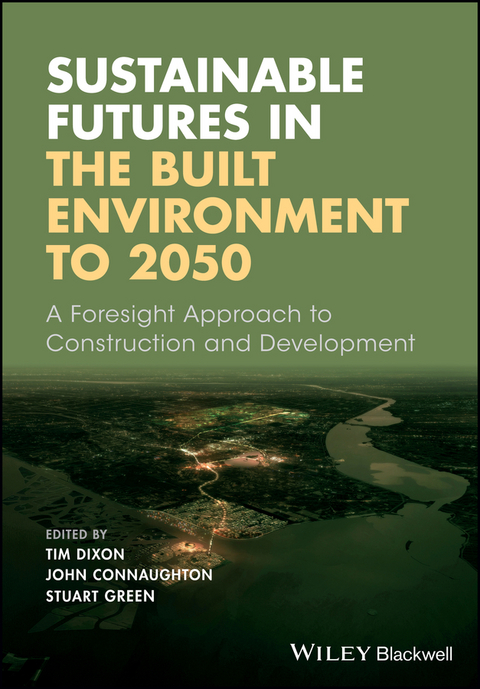
Sustainable Futures in the Built Environment to 2050 (eBook)
John Wiley & Sons (Verlag)
978-1-119-06382-7 (ISBN)
Brings together leading thinking on issues of new professional practice and on the future of a sustainable built environment
This book focuses on both construction and development issues, and examines how we can transition to a sustainable future by the year 2050-bringing together leading research and practice at building, neighbourhood, and city levels. It deftly analyses how emerging socio-economic, technological, and environmental trends will influence the built environment of the future. The book covers a broad spectrum of interests across the scales of buildings, communities and cities, including how professional practice will need to adapt to these trends. The broader context is provided by an analysis of emergent business models and the changing requirements for expert advice from clients.
Sustainable Futures in the Built Environment to 2050: A Foresight Approach to Construction and Development features chapters covering: data and trends, including historical data and UK and international case studies; policies and practice related to the field; current state of scientific understanding; key challenges; key technological advances (including disruptive and systemic technological innovations); change issues and critical uncertainties; and future visions. It provides:
- A strong conceptual framework based on a 'Foresight' approach
- Discussion of the key data and trends that underpin each chapter
- Coverage of both construction and property development
- Specially commissioned chapters by academics and practitioners
- A synthesis of the main findings in the book and key insights for the future to 2050
Sustainable Futures in the Built Environment to 2050: A Foresight Approach to Construction and Development is an important book for postgraduate students and researchers, construction, real estate and property development specialists, engineers, planners, architects, foresight and futures studies specialists, and anyone involved in sustainable buildings.
Tim Dixon is Professor of Sustainable Futures in the Built Environment, School of the Built Environment at the University of Reading, UK.
John Connaughton is Professor of Sustainable Construction and Head of Construction Management and Engineering, School of the Built Environment at the University of Reading, UK.
Stuart Green is Professor of Construction Management, School of the Built Environment at the University of Reading, UK.
Brings together leading thinking on issues of new professional practice and on the future of a sustainable built environment This book focuses on both construction and development issues, and examines how we can transition to a sustainable future by the year 2050 bringing together leading research and practice at building, neighbourhood, and city levels. It deftly analyses how emerging socio-economic, technological, and environmental trends will influence the built environment of the future. The book covers a broad spectrum of interests across the scales of buildings, communities and cities, including how professional practice will need to adapt to these trends. The broader context is provided by an analysis of emergent business models and the changing requirements for expert advice from clients. Sustainable Futures in the Built Environment to 2050: A Foresight Approach to Construction and Development features chapters covering: data and trends, including historical data and UK and international case studies; policies and practice related to the field; current state of scientific understanding; key challenges; key technological advances (including disruptive and systemic technological innovations); change issues and critical uncertainties; and future visions. It provides: A strong conceptual framework based on a Foresight' approach Discussion of the key data and trends that underpin each chapter Coverage of both construction and property development Specially commissioned chapters by academics and practitioners A synthesis of the main findings in the book and key insights for the future to 2050 Sustainable Futures in the Built Environment to 2050: A Foresight Approach to Construction and Development is an important book for postgraduate students and researchers, construction, real estate and property development specialists, engineers, planners, architects, foresight and futures studies specialists, and anyone involved in sustainable buildings.
Tim Dixon is Professor of Sustainable Futures in the Built Environment, School of the Built Environment at the University of Reading, UK. John Connaughton is Professor of Sustainable Construction and Head of Construction Management and Engineering, School of the Built Environment at the University of Reading, UK. Stuart Green is Professor of Construction Management, School of the Built Environment at the University of Reading, UK.
List of Contributors ix
Notes on Contributors x
Foreword xiv
Preface xvii
Acknowledgements xix
Book Endorsements xx
1 Introduction: Foresight and Futures Studies in Construction and Development 1
Tim Dixon, John Connaughton and Stuart Green
Part 1 Sustainability and the Built Environment 25
2 Climate Change, Resilience and the Built Environment 27
Janet F. Barlow, Li Shao and Stefan T. Smith
3 Sustainability in Real Estate Markets 50
Jorn van de Wetering
4 From the 'Sustainable Community' to Prosperous People and Places: Inclusive Change in the Built Environment 72
Saffron Woodcraft and Constance Smith
5 Smart and Sustainable?: The Future of 'Future Cities' 94
Tim Dixon
6 Sustainable Infrastructure 117
Martino Tran, Jim Hall, Robert Nicholls, Adrian J. Hickford, Modassar Chaudry and Geoff Watson
7 Sustainable Design of the Built Environment 137
Lorraine Farrelly
Part 2 Changing Professional Practice 155
8 Planning for Sustainability: Reflections on a Necessary Activity 157
Joe Doak and Gavin Parker
9 Sustainable Construction: Contested Knowledge and the Decline of Professionalism 172
Stuart Green
10 Sustainable Procurement 194
John Connaughton and Will Hughes
11 Social Media in the Built Environment 223
Bob Thompson
Part 3 Provocations about the Future: Practitioners' Viewpoints 249
12 Sustainability through Collaboration and Skills Development 251
Andy Ford and Aaron Gillich
13 Built Environment Professionals as Sustainability Advocates 270
Gerard Healey
Part 4 Transformative Technologies and Innovation 285
14 Energy Interactions: The Growing Interplay between Buildings and Energy Networks 287
Phil Coker and Jacopo Torriti
15 Sustained Innovation Uptake in Construction 310
Graeme D. Larsen
16 Humanising the Digital: A Cautionary View of the Future 325
Ian J. Ewart
Part 5 Conclusions and Common Themes 337
17 Understanding and Shaping Sustainable Futures in the Built Environment to 2050 339
Tim Dixon, John Connaughton and Stuart Green
Index 339
Note on Contributors
Professor Janet F. Barlow is in the Department of Meteorology at the University of Reading and does research in urban meteorology, natural ventilation and renewable energy. She was a Board member of the International Association for Urban Climate, and is currently on the Steering Committee for the UK Wind Engineering Society. She is also on the Met Office Scientific Advisory Committee.
Dr Modassar Chaudry is a Senior Research Fellow in the School of Engineering at Cardiff University. His expertise covers a range of energy topics, in particular modelling (optimisation) and analysis of gas, electricity and heating supply systems. He has co‐authored a number book chapters and journal papers on integrated energy network modelling and analysis.
Dr Phil Coker is a Lecturer in Renewable Energy in the School of the Built Environment, University of Reading. Following 15 years as an engineer in the UK gas industry, he has spent the last decade researching the impacts of variability in low‐carbon energy systems. Current projects range from helping the system operator respond to increased intermittent renewables, through assessing the system value of hydrogen to supporting development of a commercial vehicle‐to‐grid solution.
Joe Doak is Associate Professor of Urban Planning and Development at the University of Reading. He has undertaken major research into the formulation and implementation of regional, strategic and local planning policies, and was a senior planning officer at county and district levels of UK local government.
Dr Ian J. Ewart is an anthropologist and engineer, and currently Lecturer in Digital Technologies in the School of the Built Environment, University of Reading. His research focus is on the perception and application of technologies, the practices these influence, and how these inform the real, social experience of the world.
Professor Lorraine Farrelly is an architect and head of the new Architecture School at the University of Reading. The ambition for the new School is to relate the education experience to current professional practices in architecture, and to develop a collaborative education model that positions architecture within the built environment professions. She has written several books considering relationships between architecture and urban design.
Professor Andy Ford is the Director of Research at London South Bank University. He has worked extensively on innovative building throughout his career and contributed to many award‐winning designs. Andy is the founder of Fulcrum Consulting. Andy’s long‐term interest in knowledge transfer led to academia in 2013 following the sale of Fulcrum Consulting to Mott MacDonald.
Dr Aaron Gillich has a BEng in Aerospace Engineering from Carleton University, an MSc in Astronomy and Physics from St Mary’s University, and a PhD in Architecture from the University of Cambridge. He is currently a Senior Lecturer at London South Bank University. His research focuses on the energy trilemma of delivering a low‐cost, low‐carbon, secure energy system.
Professor Jim Hall is Director of the Environmental Change Institute and Professor of Climate and Environmental Risks at the University of Oxford. His research focuses on management of climate‐related risks in infrastructure systems, in particular relating to various dimensions of water security, including flooding and water scarcity. He leads the UK Infrastructure Transitions Research Consortium (ITRC), which has developed the world’s first national infrastructure simulation models for appraisal of national infrastructure investment and risks. His book The Future of National Infrastructure: A System of Systems Approach was published by Cambridge University Press in 2016.
Dr Gerard Healey is a sustainable built environment practitioner with over 10 years’ experience. He has worked for design firm Arup and currently is Manager – Sustainable Campus Design for the University of Melbourne. Gerard’s PhD investigated socio‐technical transitions for sustainability and he brings this multi‐disciplinary perspective to his practice.
Adrian J. Hickford is Senior Research Assistant in the Transportation Research Group at the University of Southampton. As well as his recent work on implementing strategic change to infrastructure provision, he has been involved in a number of projects aiming to increase the use of sustainable travel, and enhanced practices of traffic accident data gathering and use.
Professor Will Hughes is Professor of Construction Management and Economics at the School of the Built Environment, University of Reading. His research is positioned in the construction sector, focusing on the business of construction in relation to contracting, management, organisation and procurement. His current research is on modelling construction procurement decisions and contributing to national and international standards drafting.
Dr Graeme D. Larsen is an Associate Professor in Construction Management and Innovation at the University of Reading. He held the position of School Director of PhD Research Studies at the School of the Built Environment for 8 years. Dr Larsen is a Fellow of the Chartered Institute of Building (CIOB). His research interests include innovation diffusion, networks of firms, sustainability, communication networks, innovative methods in niche markets and sports venues. Dr Larsen has secured funding for research projects with such names as Silverstone Circuits Limited, published over 30 research articles and successfully supervised a number of PhD candidates.
Professor Robert Nicholls is Professor of Coastal Engineering at the University of Southampton. His research is focused on coastal impacts and adaptation to climate change from local to global scales. More broadly, he is also interested in integrated assessment problems analysing complex systems subject to multiple drivers such as infrastructure.
Professor Gavin Parker is Professor of Planning Studies at the University of Reading, UK and for a period he was a director of the Royal Town Planning Institute (RTPI). He is a chartered town planner and researcher who has written extensively on planning, land and citizenship. His books include Key Concepts in Planning (Sage, 2012), written with Joe Doak.
Professor Li Shao is based at the School of Construction Management and Engineering at the University of Reading, UK. He is a Director of the EPSRC Engineering Doctorate Centre Technologies for Sustainable Built Environments. He specialises in building energy management and climate change adaptation, including the integration of green space in the built environment.
Dr Constance Smith is a Hallsworth Research Fellow in Social Anthropology at the University of Manchester. She works on the anthropology of urban planning and architecture. She has conducted extensive fieldwork in African cities and, more recently, on urban change and placemaking in London.
Dr Stefan Thor Smith is a Lecturer in Energy Systems and the Built Environment within the School of the Built Environment, University of Reading. His research is focused on energy use and climate within an urban context, anthropogenic influence on urban environments and resilience of city infrastructure to climate change.
Bob Thompson is a Director of Remit Consulting specialising in research and strategy, with a special interest in the impact of technological change on all aspects of real estate. Recent publications include The Building Machine (Parkside, 2014), The Role of Cloud Computing in Commercial Property (with Andrew Waller, RICS, 2011) and The Role of Social Media in Property (RICS, 2009). In total, he has produced over 250 publications across all channels since 1985.
Dr Jacopo Torriti is an Associate Professor in Energy Economics and Policy in the School of the Built Environment at the University of Reading, with previous roles at the London School of Economics, University of Surrey, European University Institute and the Massachusetts Institute of Technology. He is author of more than 50 publications in the area of energy demand, economics and policy, including the book Peak Energy Demand and Demand Side Response, and sits on DEFRA’S Economics Advisory Panel.
Dr Martino Tran is Assistant Professor in Urban Systems at the University of British Columbia and Research Associate at the University of Oxford. He has broad interests in complexity, resilience and risk, and has published widely on modelling the performance of future technology and infrastructure. He has advised governments and industry on major infrastructure investments in energy and transport.
Dr Jorn van de Wetering is a Lecturer in Real Estate Appraisal at Real Estate & Planning in the Henley Business School at the University of Reading. He holds a PhD in Real Estate Economics. His research interests include property market adoption patterns of eco‐certification and the financial performance of environmentally and energy‐efficient office space.
Geoff Watson is a Senior Research Assistant in the Infrastructure Research Group in the Faculty of Engineering and the Environment at the University of Southampton. He is working on the modelling of future infrastructure requirements for the UK solid waste sector. He also contributed to the infrastructure chapter on the second UK Climate Change Risk Assessment. He has also been involved in research in...
| Erscheint lt. Verlag | 9.1.2018 |
|---|---|
| Sprache | englisch |
| Themenwelt | Naturwissenschaften ► Biologie ► Ökologie / Naturschutz |
| Technik ► Architektur | |
| Technik ► Bauwesen | |
| Wirtschaft ► Volkswirtschaftslehre | |
| Schlagworte | architectural theory • Architecture • Architektur • Architekturtheorie • Architektur / Theorie • Baubetrieb • Bauingenieur- u. Bauwesen • Civil Engineering & Construction • Construction • construction futures • Construction Management • Construction: Sustainability • Foresight • Future Architecture • future built environments • Futures Studies • future trends in buildings • green buildings • legislation for sustainable building • making the transition to a sustainable future • Nachhaltiges Bauen • Social Sustainability • sustainability • Sustainable Architecture • sustainable brownfield regeneration • Sustainable buildings • Sustainable Built Environment • sustainable communities • Sustainable construction • sustainable development • Sustainable futures • Sustainable Planning • sustainable property development • sustainable real estate • the future of built environments • the year 2050 • Urban Regeneration |
| ISBN-10 | 1-119-06382-5 / 1119063825 |
| ISBN-13 | 978-1-119-06382-7 / 9781119063827 |
| Informationen gemäß Produktsicherheitsverordnung (GPSR) | |
| Haben Sie eine Frage zum Produkt? |
 EPUB (Adobe DRM)
Kopierschutz: Adobe-DRM
Adobe-DRM ist ein Kopierschutz, der das eBook vor Mißbrauch schützen soll. Dabei wird das eBook bereits beim Download auf Ihre persönliche Adobe-ID autorisiert. Lesen können Sie das eBook dann nur auf den Geräten, welche ebenfalls auf Ihre Adobe-ID registriert sind.
Details zum Adobe-DRM
Dateiformat: EPUB (Electronic Publication)
EPUB ist ein offener Standard für eBooks und eignet sich besonders zur Darstellung von Belletristik und Sachbüchern. Der Fließtext wird dynamisch an die Display- und Schriftgröße angepasst. Auch für mobile Lesegeräte ist EPUB daher gut geeignet.
Systemvoraussetzungen:
PC/Mac: Mit einem PC oder Mac können Sie dieses eBook lesen. Sie benötigen eine
eReader: Dieses eBook kann mit (fast) allen eBook-Readern gelesen werden. Mit dem amazon-Kindle ist es aber nicht kompatibel.
Smartphone/Tablet: Egal ob Apple oder Android, dieses eBook können Sie lesen. Sie benötigen eine
Geräteliste und zusätzliche Hinweise
Buying eBooks from abroad
For tax law reasons we can sell eBooks just within Germany and Switzerland. Regrettably we cannot fulfill eBook-orders from other countries.
aus dem Bereich