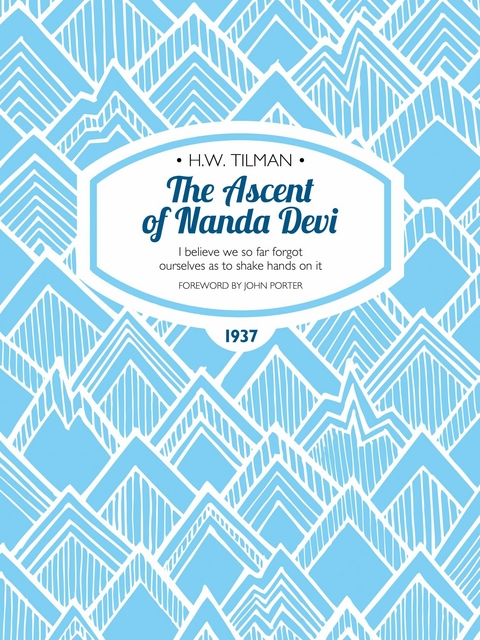
Ascent of Nanda Devi (eBook)
Vertebrate Publishing (Verlag)
978-1-909461-19-2 (ISBN)

Harold William Bill Tilman (1898 1977) was among the greatest adventurers of his time, a pioneering mountaineer and sailor who held exploration above all else. Tilman joined the army at seventeen and was twice awarded the Military Cross for bravery during WWI. After the war Tilman left for Africa, establishing himself as a coffee grower. He met Eric Shipton and began their famed mountaineering partnership, traversing Mount Kenya and climbing Kilimanjaro. Turning to the Himalaya, Tilman went on two Mount Everest expeditions, reaching 27,000 feet without oxygen in 1938. In 1936 he made the first ascent of Nanda Devi the highest mountain climbed until 1950. He was the first European to climb in the remote Assam Himalaya, he delved into Afghanistan's Wakhan Corridor and he explored extensively in Nepal, all the while developing a mountaineering style characterised by its simplicity and emphasis on exploration. It was perhaps logical then that Tilman would eventually buy the pilot cutter Mischief, not with the intention of retiring from travelling, but to access remote mountains. For twenty-two years Tilman sailed Mischief and her successors to Patagonia, where he crossed the vast ice cap, and to Baffin Island to make the first ascent of Mount Raleigh. He made trips to Greenland, Spitsbergen and the South Shetlands, before disappearing in the South Atlantic Ocean in 1977.
In 1934, after fifty years of trying, mountaineers finally gained access to the Nanda Devi Sanctuary in the Garhwal Himalaya. Two years later an expedition led by H.W. Tilman reached the summit of Nanda Devi. At over 25,000 feet, it was the highest mountain to be climbed until 1950. The Ascent of Nanda Devi, Tilman's account of the climb, has been widely hailed as a classic. Keenly observed, well informed and at times hilariously funny, it is as close to a 'conventional' mountaineering account as Tilman could manage. Beginning with the history of the mountain ('there was none') and the expedition's arrival in India, Tilman recounts the build-up and approach to the climb. Writing in his characteristic dry style, he tells how Sherpas are hired, provisions are gathered (including 'a mouth-blistering sauce containing 100 per cent chillies') and the climbers head into the hills, towards Nanda Devi. Superbly parodied in The Ascent of Rum Doodle by W.E. Bowman, The Ascent of Nanda Devi was among the earliest accounts of a climbing expedition to be published. Much imitated but rarely matched, it remains one of the best.
– Chapter 2 –
Historical
The reader who blenches at the chapter heading will be pleased to hear that it is not necessary to recall the history of previous attempts on the mountain because there have not been any. For fifty years the problem which engaged the attention of many experienced mountaineers was not how to climb the mountain but how to reach it. But as the approach to the mountain was not the least serious of the problems which we had to face, perhaps it will not be out of place to outline briefly the story of these attempts, although they have already been recounted very thoroughly in Mr Shipton’s Nanda Devi.
The truism that we climb on the shoulders of our predecessors is sometimes forgotten, and it is difficult to exaggerate the importance of the part which earlier failures play in the final success. The Himalayan peaks over, say, 23,000 ft. which have been climbed at the first attempt can be numbered on the fingers of one hand, and even if the present climb be cited to the contrary, the answer is that we had the inestimable advantage of knowing where to make our effort and how to get there—knowledge gained for us by our forerunners. And apart from previous experience on the actual mountain there is the vast fund of accumulated knowledge of high climbing in general to draw upon; for though experiences may be ‘the name men give to their mistakes’ it does not lessen their value to those who are willing to learn.
The earliest expedition was that of W.W. Graham in 1883, who was accompanied by two Swiss guides and who hoped to reach the mountain by way of the Rishi gorge. This river, as has already been said, drains the whole of the Nanda Devi Basin. It has two sources at the snouts of the two glaciers encircling the north-east and south-west sides of the mountain, and the streams from these glaciers unite at the foot of the west ridge. From this point the river, by now a formidable torrent, flows west through a gorge or series of gorges until after a distance of about eight miles it joins the Dhauli river near the village of Rini. Graham’s party started to follow the river up from near its junction with the Dhauli, but were stopped almost at once by the difficulty of the terrain; nor to this day has anyone succeeded in passing the lower portals of the gorge.
Repulsed here Graham and his two guides, Boss and Kaufmann, moved round to the north and, after an unsuccessful attempt on Dunagiri, learnt from shepherds that there was a way into the Rishi nala over the northern containing wall which avoided the insuperable difficulties of the lower four miles. ‘On the evening of the second day’, Graham wrote, ‘we reached a lovely little table-land called Dunassau (Durashi). The last day’s route had been extremely wild running along the southern face of the ridge, sometimes with a sheer drop to the river below—some 7000 to 8000 feet. Such wild rocks and broken gullies I had never met before.’ Here most of their coolies deserted, but they pushed on: ‘Occasionally we had to hang on to a tuft of grass or a bunch of Alpine roses, and I do not exaggerate when I say that for half the day’s work hand-hold was as necessary as foot-hold.’ Several days of this sort of work brought them to a place where they were finally stopped by the smooth cliffs of the north side and inability to cross the river to the more accommodating south bank. The desertion of their remaining coolies put an end to their hopes and they abandoned their loads and struggled back as best they could.
In 1905 Dr Longstaff, a name for ever associated with mountain exploration in Garhwal, attacked the problem from the opposite side. In that year he and two Italian guides, the Brocherel brothers, were in the Gori valley to the east of the Nanda Devi massif with designs on East Nanda Devi (24,300 ft.). This mountain is the highest of the encircling peaks and from it extends that short ridge, the middle stroke of the reversed letter ‘Ǝ’, which links it with Nanda Devi itself. Starting from Milam in the Gori valley Longstaff’s party got on to the rim of the Basin at the foot of the south-east shoulder of the lesser Nanda Devi, at a height of 19,100 ft. They were thus the first ever to look down into the mysterious sanctuary; but the descent looked formidable, nor was it their objective. It had been a close thing, but the Sanctuary remained inviolate.
In 1907 Dr Longstaff returned to the attack with a strong party which included General Bruce, Mr Mumm, and three Alpine guides. Their first attempt was by what Dr Longstaff called the ‘back door’, the route which Graham had learnt of from the shepherds. Half-way up the gorge from Rini on the north side of the river, and a couple of thousand feet above it, there are two hanging valleys. Here is valuable grazing to which, in the summer, are brought the sheep and goats from many neighbouring villages, some enterprising but unknown shepherd of a bygone age having found a remarkable route to these alps, or Kharaks, as they are called locally. The route involves the crossing of a 14,000 ft. pass which in late spring is still snow-covered, and a rather hair-raising, or since sheep form the bulk of the travellers, wool-raising, traverse across a mile of cliffs. The pass, however, was found to be still blocked by snow, so the party moved round to the north and east of Dunagiri and proceeded up the Bagini glacier in an attempt to cross the northern wall of the Basin, the top stroke of our reversed ‘Ǝ’. There was a pass at the head of this glacier which according to the map then in use should have led into the Basin, but this region of ice and snow had of course not been included in the survey, and though the map did credit to the maker’s imagination it was apt to mislead. The map of Garhwal in use up to 1936 was made from a survey in 1868 which was, rightly, only carried up to the snow-line, and above this, not so rightly, it was largely filled in by guess-work. There is nothing but praise and thankfulness for the accuracy of the surveyed portion, but for the unsurveyed part we should all prefer to have a map which, like the crew of the Snark, we can all understand, ‘a perfect and absolute blank’. In 1934 we had the same experience as Dr Longstaff’s party in other parts of Garhwal. From an explorer’s point of view it may seem inconsistent and ungracious to gird at inadequate maps, for it is the explorer’s job to fill them in. But this is only a plea for blanks instead of fancy; blanks, of which there are, alas, but few remaining, thanks to the energy of the Indian Survey. At the present moment a new survey of Garhwal is in hand, and this year (1936) we had the advantage of a provisional new issue of the old map incorporating the results of much private and official work done in Garhwal in recent years. Is it not time to start a Society for the Suppression and Abolition of Maps and Guide Books, not necessarily confined to the Himalaya? With the accumulation of exact knowledge comes the desire to put it to use, and we shall presently have a Five-Year Plan for the Himalaya and learn that the Sanctuary is one of those eligible sites ‘ripe for development’. To show that this is not completely idle fancy I might mention that ‘Pilgrimage by Air’ is, if not an actual fact, at least an advertised one. The following appeared in The Times dated from Delhi this year: ‘An aerodrome among the Himalayas, 10,500 ft. above sea-level, is being constructed by the Air Transport Company here to cope with the pilgrim traffic to the Badrinath shrine, sacred to the Hindus. The present terminus (long may it remain so) of the air route to the shrine is situated at Gauchar, about 70 miles from Hardwar. The return journey between Hardwar (sic) and Gauchar takes about eight weeks by road, and could be done in twelve hours by rail.’ The words in parenthesis are the author’s. For Hardwar, in the last sentence, I suggest read Badrinath; we have been told the distance is seventy miles, and four weeks for the single journey is a little slow even for a pilgrim travelling on his hands and knees or measuring his length on the ground at every step, as some of them do.
To return to our exploring party on top of the Bagini pass; they found, after crossing the pass and descending another glacier, that they had got into the Rishi gorge at the point reached by Graham and were still separated by three miles of cliff from the inner Sanctuary. Shortage of food compelled them to hurry with all speed down the Rishi instead of attempting to force this upper passage, and they finally emerged by the ‘back door’, which was now clear of snow. After a rest they came up the Rishi once more and Dr Longstaff with two of the guides (the Brocherel brothers) climbed Trisul, going from a camp at 17,500 ft. to the top in one day—an amazing tour de force which is not likely to be repeated.
Trisul was climbed on June 12th, and the 14th saw Dr Longstaff and two Gurkhas trying to force a way up the south bank of the Rishi. Foiled here, they crossed to the north side by a natural rock bridge and camped near the entrance of the Rhamani torrent down which they had come on the previous journey recounted above. The height was 11,700 ft., and the next day they climbed to 13,500 ft. up the cliffs of the north bank, but found this side even less encouraging than the other. In view of the difficulties and at the instance of other plans still to be carried out, no further attempt was made to penetrate the grim defile and Dr Longstaff rejoined his party in the lower Rishi.
In 1932 Mr Ruttledge, who as Deputy Commissioner of the Almora district had had opportunities for studying the problem of Nanda Devi and the Basin both from distant Almora and from journeys to the east and north, thought that he had...
| Erscheint lt. Verlag | 16.12.2015 |
|---|---|
| Reihe/Serie | H.W. Tilman: The Collected Edition |
| H.W. Tilman: The Collected Edition | H.W. Tilman: The Collected Edition |
| Vorwort | John Porter |
| Verlagsort | London |
| Sprache | englisch |
| Themenwelt | Literatur ► Biografien / Erfahrungsberichte |
| Literatur ► Romane / Erzählungen | |
| Sachbuch/Ratgeber ► Sport | |
| Reisen ► Reiseberichte | |
| Reisen ► Reiseführer | |
| Naturwissenschaften ► Geowissenschaften ► Geografie / Kartografie | |
| Schlagworte | adventure books • adventurers • baroque • Bill Tilman • boating books • Changabang • climb book • climbing book • Eric Shipton • Expedition • explorers • first ascents • Garwhal Himalaya • Himalaya • H.W. 'Bill' Tilman • H W Tilman • H.W. Tilman • John Porter • Kuari pass • mischief • Mountaineering • mountaineering book • Mountains • NANDA • Nanda Devi • Nanda Devi Sanctuary • Nanda Kot • pilot cutter • Rhamani • Rishi Gorge • Rishi Valley • Sailing • sailing books • sea breeze • Shipton • T.G. Longstaff • Tilman • Travel writing • Trekking • unclimbed peaks |
| ISBN-10 | 1-909461-19-9 / 1909461199 |
| ISBN-13 | 978-1-909461-19-2 / 9781909461192 |
| Informationen gemäß Produktsicherheitsverordnung (GPSR) | |
| Haben Sie eine Frage zum Produkt? |
 EPUB (Adobe DRM)
Kopierschutz: Adobe-DRM
Adobe-DRM ist ein Kopierschutz, der das eBook vor Mißbrauch schützen soll. Dabei wird das eBook bereits beim Download auf Ihre persönliche Adobe-ID autorisiert. Lesen können Sie das eBook dann nur auf den Geräten, welche ebenfalls auf Ihre Adobe-ID registriert sind.
Details zum Adobe-DRM
Dateiformat: EPUB (Electronic Publication)
EPUB ist ein offener Standard für eBooks und eignet sich besonders zur Darstellung von Belletristik und Sachbüchern. Der Fließtext wird dynamisch an die Display- und Schriftgröße angepasst. Auch für mobile Lesegeräte ist EPUB daher gut geeignet.
Systemvoraussetzungen:
PC/Mac: Mit einem PC oder Mac können Sie dieses eBook lesen. Sie benötigen eine
eReader: Dieses eBook kann mit (fast) allen eBook-Readern gelesen werden. Mit dem amazon-Kindle ist es aber nicht kompatibel.
Smartphone/Tablet: Egal ob Apple oder Android, dieses eBook können Sie lesen. Sie benötigen eine
Geräteliste und zusätzliche Hinweise
Buying eBooks from abroad
For tax law reasons we can sell eBooks just within Germany and Switzerland. Regrettably we cannot fulfill eBook-orders from other countries.
aus dem Bereich