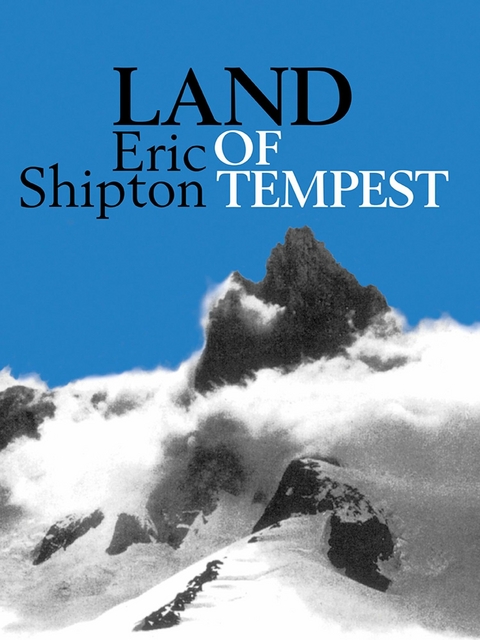
Land of Tempest (eBook)
Vertebrate Publishing (Verlag)
978-1-910240-31-1 (ISBN)
Eric Shipton (1907-1977) was one of the great mountain explorers of the 20th century, often known for his infamous climbing partnership with H.W. 'Bill' Tilman. He climbed extensively in the Alps in the 1920s, put up new routes on Mount Kenya in 1921, and in 1931, made the first ascent of Kamet with Frank Smythe - the highest peak climbed at that time. Shipton was involved with most of the Everest expeditions in the 1930s, reaching a high point of 28,000 feet in 1933. He went on to lead the 1951 expedition, which was the first to approach Everest from the north (Nepali) side through the Khumbu ice fall, and on which Edmund Hillary first set foot on the mountain.
Land of Tempest reveals Eric Shipton at his best - writing with enthusiasm and humour about his explorations in Patagonia in the 1950s and 1960s. He is an astute observer of nature and the human spirit, and this account of his travels is infused with with his own zest for discovery and the joy of camaraderie. Undaunted by hardship or by injury, Shipton and his team attempt to cross one of the great ice caps in Patagonia. It's impossible not to marvel at his determination, resilience and appetite for travel and adventure, be it climbing snow-clad mountains, or walking in forested foothills. Shipton takes a reader with him on his travels, and the often-inhospitable places he visits are a stark contrast to the warmth of the people he encounters. Land of Tempest is essential reading for anyone who loves nature, mountains, climbing, adventure or simply the joy of discovering unknown places.
– Chapter 1 –
A Strange Land
Having a taste for strange country, I had long nursed a strong desire to visit Southern Patagonia; but the habit of travelling among the mountain ranges of Central Asia, like all agreeable habits, had been hard to break. Those ranges had provided an unlimited field, fresh opportunities kept occurring and each new venture suggested another batch of enticing projects; so Patagonia had receded ever further and more dimly into the future.
I once thought of applying for the job of British Consul in Punta Arenas, on the Straits of Magellan. I was Consul-General in Kunming at the time, and after a year of non-recognition by the Chinese Communist Government, it had become clear that I would have to move elsewhere. Having previously spent four years as a similar official in Kashgar, which had enabled me to travel in the Pamir, Kuen Lun and Tien Shan, it seemed an excellent way to achieve my purpose. However, I discovered that the post of Consul in Punta Arenas was an honorary one held by a local British resident. In any case, when I returned to England in the summer of 1951, I immediately became embroiled in the revival of the attempts to climb Everest, and soon found myself back in the Himalaya.
I celebrated my fiftieth birthday in the Karakoram. It was doubtless this melancholy event that impressed me with the urgency of making definite plans for an expedition to Patagonia before I became too senile for such an undertaking. Even so I might have done nothing about it, had it not been for Geoff Bratt.
Geoff was a young Australian student, working (in his spare time between more attractive activities) for his Ph.D at the Imperial College of Science. In 1957 the College had launched an expedition to the Karakoram and had invited me to lead it. Geoff was a member of the party and he had done much of the preliminary organisation. We often shared a tent, and a great deal of varied discussion. Occasionally, of course, we talked of travel and exploration; and I found that he, too, was less interested in mountaineering for its own sake than as a means of getting to strange and little known parts of the world. On the subject of Patagonia it was not difficult to arouse his enthusiasm; his warmth brought mine to the boil and we agreed to go there together the following year.
Patagonia is not a country. The name refers to the whole of the mainland of South America south of the Rio Negro in Latitude 40° S. The bulk of this vast territory, lying in Argentina to the east of the Andes, consists of prairie, some of it flat, much of it hilly, nearly all of it dry, treeless and covered with coarse grass and open scrub. It is a stark, inhospitable land which, until late in the nineteenth century, was inhabited only by a few scattered Indian tribes. It was only then, towards the end of the century, that white men came, mostly direct from Europe or from the Falkland Islands, to settle there as sheep farmers, first along the Atlantic coast, then gradually further inland. Indeed the settlement of Patagonia is so recent that even today many of the estancieros are the sons and daughters of those original pioneers.
The Chilean part of Patagonia, except for a small area in the extreme south, is utterly different. Most of it is wild, rugged and uninhabited, a region of tempest and torrential rain, of fantastic geographical form and strange natural phenomena. The Pacific coast immediately west of the Andes, is split by a complex network of fjords which bite deep into the mainland and form an archipelago, a giant jigsaw of islands, 1,000 miles long. The climate is sub-antarctic, and the glaciation so extensive that, although the mountains are not particularly high, they are as spectacular as any in the entire range. There are two great ice caps, which are the only examples of their kind outside Polar regions. Many of the innumerable glaciers which radiate from these, flow down through dense ‘tropical forest’ (as Darwin described it) and thrust their massive fronts into the intricate system of waterways surrounding them. Parrots and humming-birds inhabit these forests.
There was no lack of interesting objectives. Apart from scores of unclimbed peaks, much of the region had never been visited. For example, the whole of the northern half of the main ice cap was untrodden ground, and with two exceptions none of the glaciers on the western side of the range had been explored. Although most of the channels had been charted since the voyage of the Beagle in 1831, for hundreds of miles along this tortuous, uninhabited coast, no one had penetrated inland, while the interior of many of the islands was unknown. The eastern side of the range was comparatively well explored, but even there, there was much interesting work to be done.
That so much of the region still remains unexplored is due almost entirely to the physical difficulties of travel there, for during the last fifty years many attempts have been made to penetrate it. The chief problem is presented by the weather, which is said to be some of the worst in the world. Heavy rain falls for prolonged periods; fine spells are rare and usually brief, and above all there is the notorious Patagonian wind, the savage storms which often continue for weeks at a stretch, with gusts up to 130 m.p.h. The terrain too, is unusually difficult. Most parts of the main range, even many on the eastern side, can only be approached by water and, because of the weather, the use of small craft on the lakes and fjords is liable to be a hazardous business. The glaciers in their lower reaches are often so broken and crevassed that it is virtually impossible to travel on them, and lateral moraines rarely provide an easy line of approach, as they usually do in the Himalaya. In the foothills the forest often presents an impassable barrier, particularly on the western side of the range, where the wind has twisted the stunted trees into a low-lying mass of tangled trunks and branches. It is these obstacles which have prevented most expeditions to the area from achieving more than a limited objective or covering more than a very small proportion of the region.
The lakes of Southern Patagonia were explored towards the end of the last century by several expeditions, notably by that of Francisco Moreno, a distinguished Argentine geographer, who discovered Lago Argentino and Lago San Martin. The first expedition into the main range was made in 1914 by Dr Frederick Reichert, who succeeded in reaching the head of the Moreno Glacier from Lago Argentino. Later, in 1916 and in 1933, he made two attempts to cross the main ice cap, the first from the head of Lago Viedma and the second from Lago San Martin. Though on both occasions he was frustrated by appalling weather conditions, he was able to bring back the first detailed accounts of the remarkable Plateau. Several more explorers have since tried to cross it. Another dominant figure in the exploration of the region was the redoubtable Salesian priest, Father Alberto de Agostini, who made no fewer than twelve expeditions to various parts of it, including the mountains of Tierra del Fuego, which have contributed the major part of our knowledge of the main range. The only complete crossing of the range had been made south of the ice cap by H.W. Tilman in 1956. During the course of his long voyage in Mischief he landed with two companions at the head of the Calvo Fjord on the Pacific side, and crossed the range to the front of the Moreno Glacier and back, a journey as the crow flies of twenty-five miles each way, which took them six weeks of arduous travel.
Geoff and I had first to decide upon the kind of expedition we were to take, and to begin with we were confronted by something of a vicious circle. Until we had formulated some clear objective we could hardly expect to receive financial support, and until we could discover the kind of work most likely to evoke support it was hard to choose an objective; particularly in view of our ignorance of local conditions. Neither of us cared very much what we did, so long as it gave us the chance to make the acquaintance of this fascinating region, and acquaintance that I hoped might ripen into terms of intimacy. In fact, I regarded this first trip as a reconnaissance, to learn something of problems and possibilities of exploratory travel with the view, later, to tackling a more ambitious venture. Eventually, after a good deal of research, we found the Trustees of the British Museum willing to send a botanist with us and to furnish a grant to cover his share of the cost. The man chosen for the job was Peter James and his assignment was to make a comprehensive collection of plants, lichens and mosses. This was a most valuable advance, for it gave us a nucleus upon which to build our plans.
Before the war, Tilman and I used to boast that we could work out our plans for an expedition to the Himalaya in half an hour on the back of an envelope. Basic simplicity was the keynote of all our ventures together; we knew exactly the weight of the food and equipment we would need, what we would have to take from England and what we could obtain locally and, above all, its cost. We were never more than a few pounds out in estimating our expenses. Planning an expedition to a new continent where inflation was rife was quite another matter, and Geoff and I soon found ourselves floundering in such a morass of uncertainties and conflicting advice that I began to wonder if we would ever get it organised. Moreover, Geoff was faced with the stern necessity of passing, his final examinations in the summer of 1958, while I was engaged in forestry work in Shropshire; with the result that things moved slowly.
Fortunately, in July, John Mercer appeared on the scene. He had recently returned from his second...
| Erscheint lt. Verlag | 1.3.2016 |
|---|---|
| Reihe/Serie | Eric Shipton: The Mountain Travel Books | Eric Shipton: The Mountain Travel Books |
| Verlagsort | London |
| Sprache | englisch |
| Themenwelt | Literatur ► Biografien / Erfahrungsberichte |
| Literatur ► Romane / Erzählungen | |
| Sachbuch/Ratgeber ► Sport | |
| Reisen ► Reiseberichte | |
| Reisen ► Reiseführer | |
| Naturwissenschaften ► Geowissenschaften ► Geografie / Kartografie | |
| Schlagworte | Adventure Story • alpine climbing • Bill Tilman • Cerro Torre • Chris Bonington • classic climbing • classic travel books • climbing book • climbing patagonia • Eric Shipton • Frank Smythe • mountaineering book • Mountains • Nanda Devi • patagonia fitz roy • sport biography • the Alps • Tilman • Tilman and Shipton • william tilman |
| ISBN-10 | 1-910240-31-1 / 1910240311 |
| ISBN-13 | 978-1-910240-31-1 / 9781910240311 |
| Informationen gemäß Produktsicherheitsverordnung (GPSR) | |
| Haben Sie eine Frage zum Produkt? |
 EPUB (Adobe DRM)
Kopierschutz: Adobe-DRM
Adobe-DRM ist ein Kopierschutz, der das eBook vor Mißbrauch schützen soll. Dabei wird das eBook bereits beim Download auf Ihre persönliche Adobe-ID autorisiert. Lesen können Sie das eBook dann nur auf den Geräten, welche ebenfalls auf Ihre Adobe-ID registriert sind.
Details zum Adobe-DRM
Dateiformat: EPUB (Electronic Publication)
EPUB ist ein offener Standard für eBooks und eignet sich besonders zur Darstellung von Belletristik und Sachbüchern. Der Fließtext wird dynamisch an die Display- und Schriftgröße angepasst. Auch für mobile Lesegeräte ist EPUB daher gut geeignet.
Systemvoraussetzungen:
PC/Mac: Mit einem PC oder Mac können Sie dieses eBook lesen. Sie benötigen eine
eReader: Dieses eBook kann mit (fast) allen eBook-Readern gelesen werden. Mit dem amazon-Kindle ist es aber nicht kompatibel.
Smartphone/Tablet: Egal ob Apple oder Android, dieses eBook können Sie lesen. Sie benötigen eine
Geräteliste und zusätzliche Hinweise
Buying eBooks from abroad
For tax law reasons we can sell eBooks just within Germany and Switzerland. Regrettably we cannot fulfill eBook-orders from other countries.
aus dem Bereich