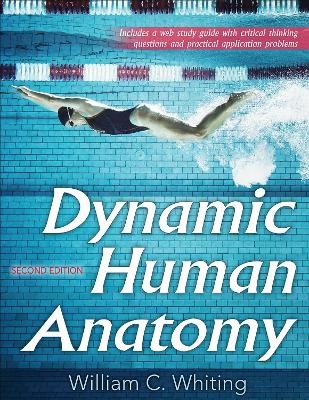
Dynamic Human Anatomy 2nd Edition with Web Study Guide
Human Kinetics (Verlag)
978-1-4925-4987-1 (ISBN)
Applied Sport Mechanics, 4th Edition helps students understand how the fundamental laws of human movement can affect an athlete’s performance. It explores the basic principles of kinetics, kinematics and sports technique through a variety of applied scenarios.
Split into two parts, the first section focuses on the fundamentals of sport mechanics. Major topics covered include the anatomy of sport mechanics, linear motion and kinetics in sport and moving through fluids.
The second part of the book helps students apply the information they learnt in Part I. Students are taught how to break a skill into phases and what to look for
in each phase. They also learn the mechanical principles to help them correct
any errors.
Formerly titled Sport Mechanics for Coaches this guide builds on the success of its previous editions. New material includes a web study guide, updated pedagogical aids, visual aids, reorganised content and expanded sidebars.
Brendan Burkett is professor at the University of the Sunshine Coast, Queensland. He has written more than 150 peer-reviewed articles for journals in sport science, biomechanics and coaching. As an elite athlete, Burkett represented Australia for 13 years as a swimmer and was crowned Paralympic Champion and World Champion. He has also worked as the sport scientist for the Australian Paralympic team for the last four Paralympic Games.
Part I. Anatomical Foundations
Chapter 1. Introduction to Human Anatomy and Movement
Introduction to Human Anatomy
Introduction to Human Movement
Movement Across the Life Span
Anatomical Concepts
Levels of Structural Organization
Anatomical References and Terminology
Study of Human Movement
Concluding Comments
Suggested Readings
Chapter 2. Osteology and the Skeletal System
Functions of the Skeletal System
Bone Histology and Composition
Bone Modeling, Growth, and Development
Skeletal System Organization
Bone Adaptation
Bone Health
Concluding Comments
Suggested Readings
Chapter 3. Joint Anatomy and Function
Joint Structure and Classification
Joint Motion and Movement Description
Types of Joint Movement
Joint Structure and Movement
Concluding Comments
Suggested Readings
Chapter 4. Skeletal Muscle
Functions of Skeletal Muscle
Structure and Function of Skeletal Muscle
Muscle Names
Functional Actions of Muscles
Muscles of Major Joints
Muscle Injury, Pain, and Soreness
Concluding Comments
Suggested Readings
Part II. Biomechanics and Movement Control
Chapter 5. Biomechanics
Biomechanical Concepts
Movement Mechanics
Fluid Mechanics
Joint Mechanics
Material Mechanics
Concluding Comments
Suggested Readings
Chapter 6. Muscular Control of Movement and Movement Assessment
Muscle Function
Muscle Action
Coordination of Movement
Movement Efficiency
Muscle Redundancy and Abundancy
Movement Assessment
Concluding Comments
Suggested Readings
Part III. Fundamentals of Movements
Chapter 7. Posture and Balance
Fundamentals of Posture and Balance
Concluding Comments
Suggested Readings
Chapter 8. Gait
Walking
Running
Concluding Comments
Suggested Readings
Chapter 9. Basic Movement Patterns
Jumping
Kicking
Lifting
Throwing
Striking
Concluding Comments
Suggested Readings
Part IV. Movement Applications
Chapter 10. Strength and Conditioning Applications
General Principles
Types of Strength and Conditioning Programs
Resistance Training
Concluding Comments
Suggested Readings
Chapter 11. Sport and Dance Applications
American Football
Baseball and Softball
Basketball
Cycling
Golf
Soccer
Swimming
Tennis
Volleyball
Dance Applications
Concluding Comments
Suggested Readings
Chapter 12. Clinical Applications
Concepts of Musculoskeletal Injury
Injury Prevention
Rehabilitation
Common Injuries
Prosthetics and Orthotics
Concluding Comments
Suggested Readings
Chapter 13. Ergonomics Applications
Ergonomic Concepts
Lifting
Overuse Conditions
Concluding Comments
Suggested Readings
| Erscheinungsdatum | 02.08.2018 |
|---|---|
| Zusatzinfo | 146 Halftones, color; 169 Illustrations, color |
| Verlagsort | Champaign, IL |
| Sprache | englisch |
| Maße | 216 x 279 mm |
| Gewicht | 953 g |
| Themenwelt | Studium ► 1. Studienabschnitt (Vorklinik) ► Anatomie / Neuroanatomie |
| Studium ► 1. Studienabschnitt (Vorklinik) ► Physiologie | |
| Naturwissenschaften ► Biologie ► Humanbiologie | |
| ISBN-10 | 1-4925-4987-8 / 1492549878 |
| ISBN-13 | 978-1-4925-4987-1 / 9781492549871 |
| Zustand | Neuware |
| Informationen gemäß Produktsicherheitsverordnung (GPSR) | |
| Haben Sie eine Frage zum Produkt? |
aus dem Bereich