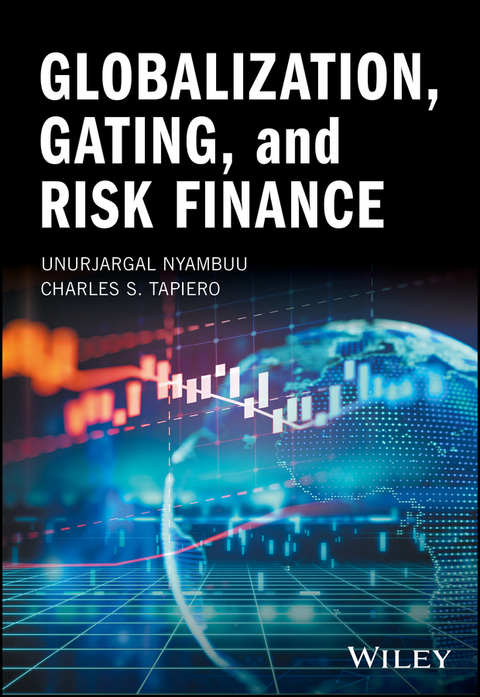
Globalization, Gating, and Risk Finance (eBook)
John Wiley & Sons (Verlag)
978-1-119-25270-2 (ISBN)
An in-depth guide to global and risk finance based on financial models and data-based issues that confront global financial managers.
Globalization, Gating, and Risk Finance offers perspectives on global risk finance in a world with economies in transition. Developed from lectures and research projects investigating the consequences of globalization and strategic approaches to fundamental economics and finance, it provides an approach based on financial models and data; it includes many case-study problems. The book departs from the traditional macroeconomic and financial approaches to global and strategic risk finance, where economic power and geopolitical issues are intermingled to create complex and forward-looking financial systems.
Chapter coverage includes: Globalization: Economies in Collision; Data, Measurements, and Global Finance; Global Finance: Utility, Financial Consumption, and Asset Pricing; Macroeconomics, Foreign Exchange, and Global Finance; Foreign Exchange Models and Prices; Asia: Financial Environment and Risks; Financial Currency Pricing, Swaps, Derivatives, and Complete Markets; Credit Risk and International Debt; Globalization and Trade: A Changing World; and Compliance and Financial Regulation.
- Provides a framework for global financial and inclusive models, some of which are not commonly covered in other books.
- Considers risk management, utility, and utility-based multi-agent financial theories.
- Presents a theoretical framework to assist with a variety of problems ranging from derivatives and FX pricing to bond default to trade and strategic regulation.
- Provides detailed explanations and mathematical proofs to aid the readers' understanding.
Globalization, Gating, and Risk Finance is appropriate as a text for graduate students of global finance, general finance, financial engineering, and international economics, and for practitioners.
UNURJARGAL NYAMBUU is a Professor of Economics in the Department of Social Science, New York City College of Technology (NYCCT), The City University of New York (CUNY), Brooklyn, NY.
CHARLES S. TAPIERO is the Topfer Chair Distinguished Professor of Financial Engineering and Technology Management, Department of Finance and Risk Engineering, Tandon School of Engineering, New York University (NYU), Brooklyn, NY.
UNURJARGAL NYAMBUU is a Professor of Economics in the Department of Social Science, New York City College of Technology (NYCCT), The City University of New York (CUNY), Brooklyn, NY. CHARLES S. TAPIERO is the Topfer Chair Distinguished Professor of Financial Engineering and Technology Management, Department of Finance and Risk Engineering, Tandon School of Engineering, New York University (NYU), Brooklyn, NY.
As we enter the third millennium, information technology--by crushing the cost of communications--is accelerating the globalization of manufacturing, commerce, and especially finance thereby morphing national financial markets into one huge, efficient global marketplace for capital. Indeed, the relentless rise of the digital cyber-economy is weakening the grip of the nation-state as government policies are subjected to a continuing referendum by financial markets. And yet diehard sovereigns are holding firmly to their prerogatives of having a national currency, a national regulatory framework, and a national tax code of their own and much more. Nyambuu and Tapiero's Globalization, Gating, and Risk Finance is a powerful recast of core international pricing models in a world of gated/segmented capital markets. It redefined risks and opportunities in a world of incomplete financial globalization, and is a must read for savvy financiers and their apprentices in their everlasting quest of exploitable capital market abnormalities and imperfections.
Laurent Jacque, Walter B. Wriston Professor of International Finance & Banking, The Fletcher School (Tufts University)
This book represents a major contribution to our understanding of the key issues currently facing the world economy and global financial markets. It can be highly recommended as a stand-alone textbook in international finance. It can also serve as an essential reference for both academics and practitioners interested in going beyond the standard approaches that assume market integration. This book is unique in providing both a lucid and rigorous exposure of the complexities of risk that pervade our world, where globalization is giving way to increased nationalism and protectionism.
Lorne N. Switzer, Professor of Finance and the Van Berkom Endowed Chair in Small Cap Equities, John Molson School of Business (JMSB) at Concordia University, Montreal, Canada
Chapters' Outline
The book is organized as follows.
Chapter 1, Globalization: Economies in Collision, provides a broad overview by introducing a selected number of problems motivating interest in global risk finance. This chapter provides a summary of foreign exchange (FX) markets, exchange rate regimes, and the evolution of reserve currencies from a macroeconomic perspective. We discuss the emergence of the Chinese yuan as a global exchange currency, its usage in global trade, and its inclusion in the International Monetary Fund’s basket of foreign currencies. Further discussion of the yuan is relegated to subsequent chapters. Chapter 1 further outlines the history of globalization and presents a list of special issues for further discussion.
Chapter 2, Data, Measurements, and Global Finance, provides a review of standard statistical measurement approaches commonly used in economics and finance. We discuss national accounts, big data and model‐less finance, technology and financial data, and data management. Particular attention is given to multivariate data and its treatment. For example, an introduction to data reduction and statistical measurement, principle component analysis, data modeling, copulas, implied volatility, autoregressive moving average, and related multivariate probability models are presented as an approach to the modeling and the study of global financial data. Autoregressive conditional heteroscedasticity (ARCH) and its extensions (generalized ARCH (GARCH), threshold GARCH, and GARCH‐in‐mean) are suggested for the measurement of FX volatility. This chapter assumes that the reader is already familiar with basic statistical techniques and seeks only to learn their relevance for practical problems. For the further study of data analytics and statistics, an extensive list of references is given.
Chapter 3, Global Finance: Utility, Financial Consumption, and Asset Pricing, outlines microeconomic and financial approaches to financial and asset pricing models and their extensions to a multi‐country and multi‐currency world. We develop the theoretical underpinnings underlying the Arrow–Debreu theory for complete market as well as the utility theory and its consumption capital asset pricing model (CCAPM). These theories are applied to valuation pricing in competing and a multi‐agent framework. To do so, we introduce an approach based on the financial commitments to consumption. We then apply this framework to both standard and multi‐country financial pricing and investment problems. This is shown to be far more representative of global finance based on competing agents. Examples for pricing foreign bonds, investments in securities, debt management, and currency wars are also outlined. CCAPM, in its multi‐agent form, is shown to be particularly useful in pricing debt, financial leverage, inequality, swaps, and other aspects of global finance. Our tentative analyses are essentially essays which express the complexity of the pricing of financial products across national boundaries. Throughout the chapter, we introduce pricing and valuation models that are consistent with fundamental approaches, yet seek their marginal expansion to problems recurrent in global finance. The chapter’s intent is to provide a relatively simple approach to some theoretical issues that occur in both conventional and multi‐agent applications of global finance models.
Chapter 4, Macroeconomics, Foreign Exchange, and Global Finance. Global finance and international macroeconomics are intimately related to one another, yet they differ by the time scale of their statistics and by their concern with economic and financial global policies. This chapter presents several fundamental macroeconomic FX rate models required to provide a broader appreciation of global finance as well as to better predict sovereign state policies based mostly on macroeconomic statistics and political and geopolitical factors. We refer to the closed economy model introduced by Keynes and study its extension to an open economy by the Mundell–Fleming model. In this context, the implications of monetary and fiscal policies under the IS–LM–balance of payments model are discussed, describing the relationship between the goods and money markets and the balance of payments. Also, an equilibrium exchange rate determined by the demand and supply of currency is described, with further discussion on major factors affecting the exchange rate. Interactions between expenditures by the private sector, government, and transactions with foreign economies are highlighted. Their evolution underlies the relationships between cross‐border trade, capital, and job flows. We discuss the importance of balance of payments in global finance and its implications. The sustainability of external debt, trends in foreign direct investment, and capital flows are highlighted. This chapter discusses recent trends in macroeconomic policies and exchange rate movements that shape global finance. At the same time, it highlights practical policy concerns and predictable scenarios concordant with macroeconomic finance. In addition, we analyze a correlation between globalization and income inequality and present the existing literature.
Chapter 5, Foreign Exchange Models and Prices, assesses FX rate pricing based on different models for FX. Purchasing power parity is explained using an application of the law of one price (concurrent to the no‐arbitrage principle in finance) and empirical findings for its validity. Furthermore, FX rates and interest rates are studied based on covered interest arbitrage and uncovered interest parity (UIP). Monetary and asset‐based approaches to FX rate determinations are presented along with the UIP model. We cover the Balassa–Samuelson model, the Dornbusch overshooting model, and the present‐value models, all of which are outlined as extensions together with empirical evidence. A list of works for econometric and statistical analysis is suggested.
Chapter 6, Asia: Financial Environment and Risks, provides an overview of Asia’s financial and economic development, emphasizing engines of growth and implications for the global economy and finance. Included is discussion of Asia’s increasing international trade and its regional interdependence, FX rate issues, and foreign investment. We analyze the financial environment in Asia with an emphasis on the banking sector, bond market, and stock market development, and use different approaches to assess the financial and investment risks that Asia’s financial industry is facing. Based on currency data, we discuss FX risks. We also consider regional systematic risk based on local stock exchange data. In addition to the study of Eastern and South‐Eastern Asia, a detailed discussion on China and Japan is presented. In the case of China, while stressing the importance and achievements of the banking sector, we analyze the problem of shadow banking and look at challenges in equity markets, and corporate debt in particular. Econometric and statistical analyses for selected problems are provided.
Chapter 7, Financial Currency Pricing, Swaps, Derivatives, and Complete Markets, provides analysis of pricing the consumer price index and the FX‐based securities in complete financial markets using modeling as well as empirical approaches. We present both relative and martingale‐based FX models with an emphasis on risks and approaches found in US currency indices, global index reversion, the Ricatti FX model, and basket‐based price reversion. We introduce a partial generalization by considering multivariate stochastic models and outline mean‐reverting volatility‐based models. Given the extensive use of options in finance, we assess their use only through some simple examples pertaining to FX options, cross‐national boundary investments, and so on. The currency option pricing models and their applications are presented with further examples using spreads and other options (with references directing the reader to the extremely rich family of optional models). Furthermore, we look at option‐based trading strategies, emphasizing protective puts, foreign trading, the covered call, and others. Finally, this chapter presents the, so‐called, Greek analysis, which measures the sensitivity of option prices to parameters defining the price (e.g., interest rates, volatility). Although, in a global and heterogeneous economic world, “assumed complete markets” may in fact be incomplete, we note that the complete market framework may also be used to price specific and tailor‐made financial products adapted to the needs of international financial transactions. To this purpose, we have also introduced swaps and some of their applications. More detailed developments and applications of swaps, accounting for a substantial part of foreign transactions, are introduced in Chapter 8, where loan‐debt contracts are also defined as swaps.
Chapter 8, Credit Risk and International Debt, presents the growth of debt and debt dependency, highlighting both credit and global risks. This chapter analyzes country‐specific risks, FX risks, credit trading, sovereign bond risks, as well as credit derivatives. In this context, different swaps (e.g., currency swaps, swaptions, credit default swaps, and securitized volatility) are defined and explained. This is important because, under assumptions of complete markets, option‐based products (e.g., swaptions) are used extensively in global...
| Erscheint lt. Verlag | 8.11.2017 |
|---|---|
| Sprache | englisch |
| Themenwelt | Mathematik / Informatik ► Mathematik |
| Naturwissenschaften | |
| Recht / Steuern ► Wirtschaftsrecht | |
| Wirtschaft ► Betriebswirtschaft / Management ► Allgemeines / Lexika | |
| Wirtschaft ► Betriebswirtschaft / Management ► Finanzierung | |
| Schlagworte | and Risk Finance • Business & Finance • Economics • Finance & Investments • Financial Engineering • Financial Management • Finanztechnik • Finanz- u. Anlagewesen • Finanz- u. Wirtschaftsstatistik • Gating • global and risk finance • Global Economics • Global Finance • global financial management • Globalisierung • Globalization • globalization and economics in collision • guide to global finance • guide to risk finance • International Economics • International finance • International Macroeconomics • Mathematics • Mathematik • Mathematik in Wirtschaft u. Finanzwesen • portfolio optimization • Risk finance • Risk Management • risk modelling • Statistics • Statistics for Finance, Business & Economics • Statistik |
| ISBN-10 | 1-119-25270-9 / 1119252709 |
| ISBN-13 | 978-1-119-25270-2 / 9781119252702 |
| Informationen gemäß Produktsicherheitsverordnung (GPSR) | |
| Haben Sie eine Frage zum Produkt? |
 EPUB (Adobe DRM)
Kopierschutz: Adobe-DRM
Adobe-DRM ist ein Kopierschutz, der das eBook vor Mißbrauch schützen soll. Dabei wird das eBook bereits beim Download auf Ihre persönliche Adobe-ID autorisiert. Lesen können Sie das eBook dann nur auf den Geräten, welche ebenfalls auf Ihre Adobe-ID registriert sind.
Details zum Adobe-DRM
Dateiformat: EPUB (Electronic Publication)
EPUB ist ein offener Standard für eBooks und eignet sich besonders zur Darstellung von Belletristik und Sachbüchern. Der Fließtext wird dynamisch an die Display- und Schriftgröße angepasst. Auch für mobile Lesegeräte ist EPUB daher gut geeignet.
Systemvoraussetzungen:
PC/Mac: Mit einem PC oder Mac können Sie dieses eBook lesen. Sie benötigen eine
eReader: Dieses eBook kann mit (fast) allen eBook-Readern gelesen werden. Mit dem amazon-Kindle ist es aber nicht kompatibel.
Smartphone/Tablet: Egal ob Apple oder Android, dieses eBook können Sie lesen. Sie benötigen eine
Geräteliste und zusätzliche Hinweise
Buying eBooks from abroad
For tax law reasons we can sell eBooks just within Germany and Switzerland. Regrettably we cannot fulfill eBook-orders from other countries.
aus dem Bereich