


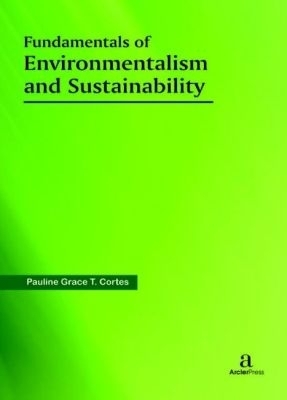
Fundamentals of Environmentalism and Sustainability
Seiten
2016
Arcler Education Inc (Verlag)
978-1-68094-623-9 (ISBN)
Arcler Education Inc (Verlag)
978-1-68094-623-9 (ISBN)
- Titel z.Zt. nicht lieferbar
- Versandkostenfrei
- Auch auf Rechnung
- Artikel merken
Offers an introduction to environmental sustainability. Sustainability and sustainable development focuses on balancing that fine line between competing needs - our need to move forward technologically and economically, and the needs to protect the environments in which we and others live.
We live in a modern, consumerist, and largely urban existence throughout the developed world where we consume a lot of natural resources every day. In our urban centers, we consume more power than those who live in rural settings. Urban centers need to keep streets and civic buildings lit, power our appliances and heating, and other public and household requirements. However, this does not mean that sustainable living should only focus in urban centers, as improvement can be made everywhere. It is estimated that we use about 40% more resources every year than we can put back, which needs to change.
Sustainability and sustainable development focuses on balancing that fine line between competing needs - our need to move forward technologically and economically, and the needs to protect the environments in which we and others live. Sustainability is not just about the environment, It is also about examining the long-term effects of the actions that humanity does and asking questions on how it may be improved. Sustainability issues arise where there is a risk of difficult or irreversible loss of the things or qualities of the environment that people value. Whenever there are such risks there is a degree of urgency to take action. Environmental sustainability programs include actions to reduce the use of physical resources, the adoption of a ‘recycle everything/buy recycled’ approach, the use of renewable rather than depletable resources, the redesign of production processes and products to eliminate the production of toxic materials, and the protection and restoration of natural habitats and environments valued for their livability or beauty. These sustainability programs need to operate on an adequate scale and need to continue operating reliably for as long as the threats continue.
We live in a modern, consumerist, and largely urban existence throughout the developed world where we consume a lot of natural resources every day. In our urban centers, we consume more power than those who live in rural settings. Urban centers need to keep streets and civic buildings lit, power our appliances and heating, and other public and household requirements. However, this does not mean that sustainable living should only focus in urban centers, as improvement can be made everywhere. It is estimated that we use about 40% more resources every year than we can put back, which needs to change.
Sustainability and sustainable development focuses on balancing that fine line between competing needs - our need to move forward technologically and economically, and the needs to protect the environments in which we and others live. Sustainability is not just about the environment, It is also about examining the long-term effects of the actions that humanity does and asking questions on how it may be improved. Sustainability issues arise where there is a risk of difficult or irreversible loss of the things or qualities of the environment that people value. Whenever there are such risks there is a degree of urgency to take action. Environmental sustainability programs include actions to reduce the use of physical resources, the adoption of a ‘recycle everything/buy recycled’ approach, the use of renewable rather than depletable resources, the redesign of production processes and products to eliminate the production of toxic materials, and the protection and restoration of natural habitats and environments valued for their livability or beauty. These sustainability programs need to operate on an adequate scale and need to continue operating reliably for as long as the threats continue.
Pauline Cortes graduated in 2011 with a degree in Environmental Planning and Management. Her areas of interest are environmental sustainability, biodiversity conservation, and renewable energy. She is currently working for a global conglomerate to promote a sustainable supply chain based on the principles of United Nations Global Compact.
| Erscheinungsdatum | 20.03.2018 |
|---|---|
| Sprache | englisch |
| Maße | 152 x 229 mm |
| Gewicht | 835 g |
| Themenwelt | Naturwissenschaften ► Biologie ► Ökologie / Naturschutz |
| Technik ► Umwelttechnik / Biotechnologie | |
| ISBN-10 | 1-68094-623-4 / 1680946234 |
| ISBN-13 | 978-1-68094-623-9 / 9781680946239 |
| Zustand | Neuware |
| Informationen gemäß Produktsicherheitsverordnung (GPSR) | |
| Haben Sie eine Frage zum Produkt? |
Mehr entdecken
aus dem Bereich

aus dem Bereich
Gewinnung - Aufbereitung - Speicherung - Verteilung
Buch | Softcover (2022)
Springer Vieweg (Verlag)
CHF 55,95
Methoden – Lösungen – Anwendungen
Buch | Hardcover (2025)
Hanser (Verlag)
CHF 69,95


